Understanding How Cells Process Energy Using Network Models

Jenn Hoskins
9th April, 2025

Understanding How Cells Process Energy Using Network Models

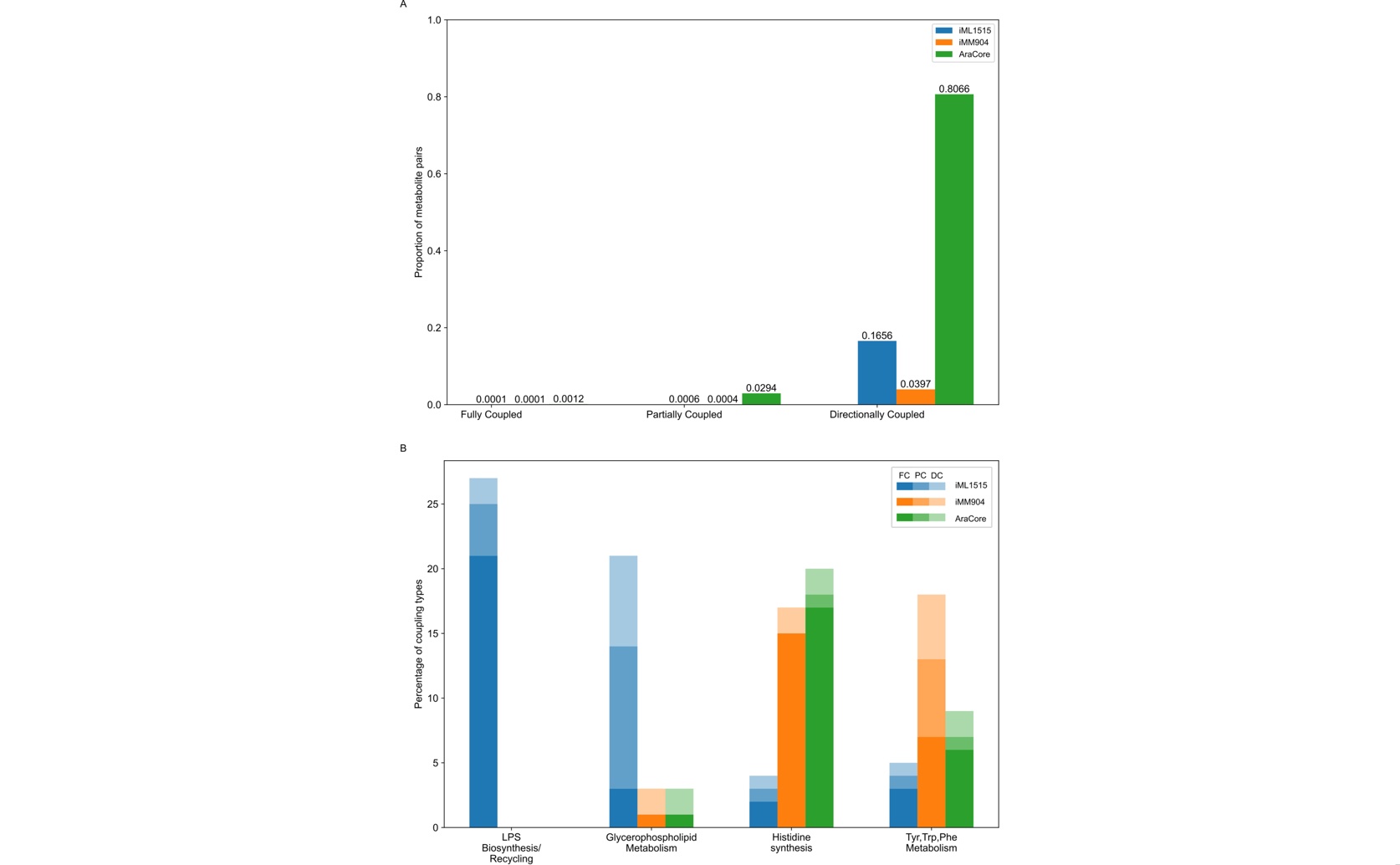
Flux-Sum Coupling Analysis of metabolic models for the bacterium Escherichia coli, yeast Saccharomyces cerevisiae, and plant Arabidopsis thaliana reveals that directional coupling is the most common type of metabolite relationship (a) and that these coupled pairs are concentrated in distinct, organism-specific metabolic pathways (b).

Image adapted from: Seyis et al. / CC BY (Source)

Key Findings

  • Researchers at the University of Potsdam developed FSCA, a new method to measure metabolite levels in cells more easily
  • They applied FSCA to bacteria, yeast, and plants, revealing common patterns in how metabolites interact across different species
  • This method allows scientists to understand cellular processes without extensive experiments, advancing biology and medicine
Metabolites, the small molecules involved in biochemical reactions, are essential for maintaining cellular functions. Understanding how these metabolites interact and regulate various biochemical pathways is crucial for advancements in biology and medicine. However, accurately determining the concentrations of these metabolites within cells has been a significant challenge. Traditional methods require extensive measurements, which are not always feasible, especially for large-scale studies. A recent study conducted by researchers at the University of Potsdam, Germany, introduced a novel approach called flux-sum coupling analysis (FSCA) to address this challenge[1]. FSCA is a constraint-based method designed to explore the relationships between metabolite concentrations without the need for exhaustive measurements. This method leverages the concept of flux-sum, which refers to the total flow of metabolites through a metabolic network, to establish coupling relationships between different metabolites. The study applied FSCA to the metabolic models of three different organisms: Escherichia coli, Saccharomyces cerevisiae, and Arabidopsis thaliana. These organisms were chosen due to their well-characterized metabolic networks and their relevance in various biological research areas. The application of FSCA revealed three distinct coupling relationships present across all three models. These relationships highlighted similarities in how certain pairs of metabolites interact, suggesting that there are underlying principles governing metabolic networks across different species. One of the significant findings of the study was that FSCA could reliably predict qualitative associations between metabolite concentrations. By comparing the FSCA results with available concentration measurements of E. coli metabolites, the researchers demonstrated that flux-sum serves as an effective proxy for actual metabolite concentrations. This means that FSCA can provide meaningful insights into metabolite interactions even when direct concentration data is unavailable. The implications of this study are multifaceted. First, FSCA offers a new tool for scientists to investigate metabolic regulation more efficiently. By reducing the reliance on extensive experimental measurements, researchers can focus on modeling and predicting metabolic behaviors, which is particularly valuable in studying complex organisms like plants and microbes. This aligns with previous work that emphasizes the importance of understanding metabolic networks to manipulate their functions effectively[2]. Moreover, the introduction of FSCA builds on the foundation of synthetic biology advancements. Earlier research has shown that designing artificial metabolic pathways can significantly enhance crop yields and nutritional value[3]. However, implementing these synthetic pathways in plants is challenging due to the complexity of plant metabolism, which involves compartmentalization and multicellularity. FSCA provides a computational method to test the feasibility of these synthetic pathways within the intricate plant metabolic context, addressing some of the hurdles identified in previous studies[3]. Additionally, understanding the interdependencies between metabolites is crucial for identifying metabolic trade-offs, which are situations where enhancing one metabolic trait may compromise another[4]. FSCA contributes to this understanding by mapping out how changes in the flux-sum of one metabolite might affect others, thereby shedding light on potential trade-offs within the metabolic network. This knowledge is vital for optimizing metabolic engineering strategies aimed at improving organismal traits without unintended consequences. The study also highlighted that metabolic networks are inherently simpler than their structural complexity suggests[2]. By identifying concordant complexes—groups of metabolites that interact in a coordinated manner—FSCA helps reduce the apparent complexity of these networks. This simplification facilitates a better understanding of how metabolic pathways are regulated and how they respond to various stimuli or genetic modifications. In practical terms, FSCA can be integrated into existing systems biology approaches to enhance their predictive power. Systems biology aims to understand the complex interactions within biological systems, and having a reliable method to estimate metabolite concentrations based on flux-sum can significantly improve model accuracy. This integration is particularly beneficial for large-scale metabolic models, where direct measurement of every metabolite concentration is impractical. The research underscores the importance of computational tools in modern biological research. As biological systems become increasingly complex, the ability to model and predict their behavior using advanced algorithms and computational methods becomes indispensable. FSCA represents a step forward in this direction, offering a method that bridges the gap between theoretical models and experimental data. Future research can expand on this work by applying FSCA to a broader range of organisms and metabolic conditions. Additionally, integrating FSCA with other modeling approaches could provide a more comprehensive understanding of metabolic regulation. Collaborations between computational biologists and experimentalists will be essential to validate and refine the predictions made by FSCA, ensuring that the models accurately reflect biological reality. In conclusion, the introduction of flux-sum coupling analysis by the University of Potsdam researchers marks a significant advancement in the study of metabolic networks. By providing a reliable proxy for metabolite concentrations, FSCA enables more efficient and accurate exploration of metabolic interdependencies. This tool not only enhances our understanding of cellular metabolism but also supports the development of synthetic biology applications aimed at improving crop yields and addressing metabolic trade-offs.

BiotechBiochem

References

Main Study

1) Flux-sum coupling analysis of metabolic network models

Published 7th April, 2025

https://doi.org/10.1371/journal.pcbi.1012972


Related Studies

2) The hidden simplicity of metabolic networks is revealed by multireaction dependencies.

https://doi.org/10.1126/sciadv.abl6962


3) Computational Approaches to Design and Test Plant Synthetic Metabolic Pathways.

https://doi.org/10.1104/pp.18.01273


4) Models and molecular mechanisms for trade-offs in the context of metabolism.

https://doi.org/10.1111/mec.16879


Related Articles

An unhandled error has occurred. Reload 🗙