
Fat storage as a survival tactic in stressed cyanobacteria
Jenn Hoskins
22nd February, 2026


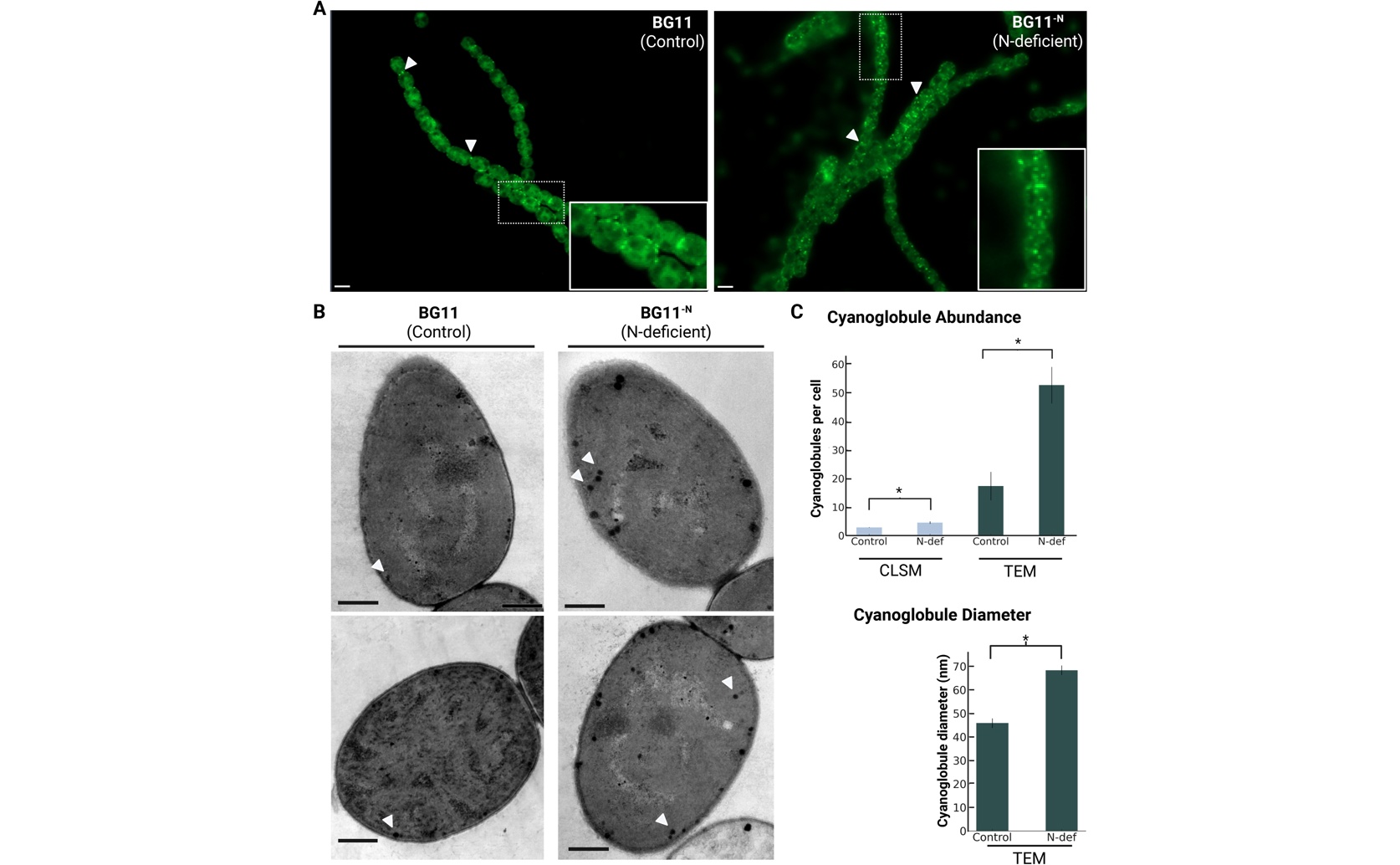
Microscopic imaging (a, b) and subsequent quantification (c) reveal that nitrogen deficiency significantly increases the number and size of cyanoglobules in the non-nitrogen-fixing AnabaenaΔN strain, highlighting the formation of these lipid droplets as a core cellular response to nutrient stress.
Key Findings
- In a strain of cyanobacteria lacking nitrogen fixation ability, structures called cyanoglobules increased in size and number when exposed to nitrogen deficiency
- The protein composition of these cyanoglobules closely resembled that of plastoglobules found in plant cells, suggesting a shared function
- Under nitrogen stress, cyanoglobules accumulated redox molecules like plastoquinones and decreased levels of certain lipids, indicating a role in stress response and cellular remodeling
References
Main Study
1) Cyanoglobule lipid droplet accumulation as a stress response to nitrogen starvation in a non-N2-fixing mutant strain of Anabaena sp. PCC 7120
Published 20th February, 2026
https://doi.org/10.1371/journal.pone.0343220
Related Studies
2) Plastoglobuli: Plastid Microcompartments with Integrated Functions in Metabolism, Plastid Developmental Transitions, and Environmental Adaptation.
3) Dynamic changes to the plastoglobule lipidome and proteome in maize during heat stress and recovery.
4) Dynamic changes to the plastoglobule lipidome and proteome in maize over a dehydration-rehydration cycle.
5) Molecular changes of Arabidopsis thaliana plastoglobules facilitate thylakoid membrane remodeling under high light stress.
Related Articles
 15th August, 2025 | Jenn Hoskins