Ear bones and fins reveal distinct Atlantic sturgeon populations

Jenn Hoskins
3rd March, 2026

Ear bones and fins reveal distinct Atlantic sturgeon populations

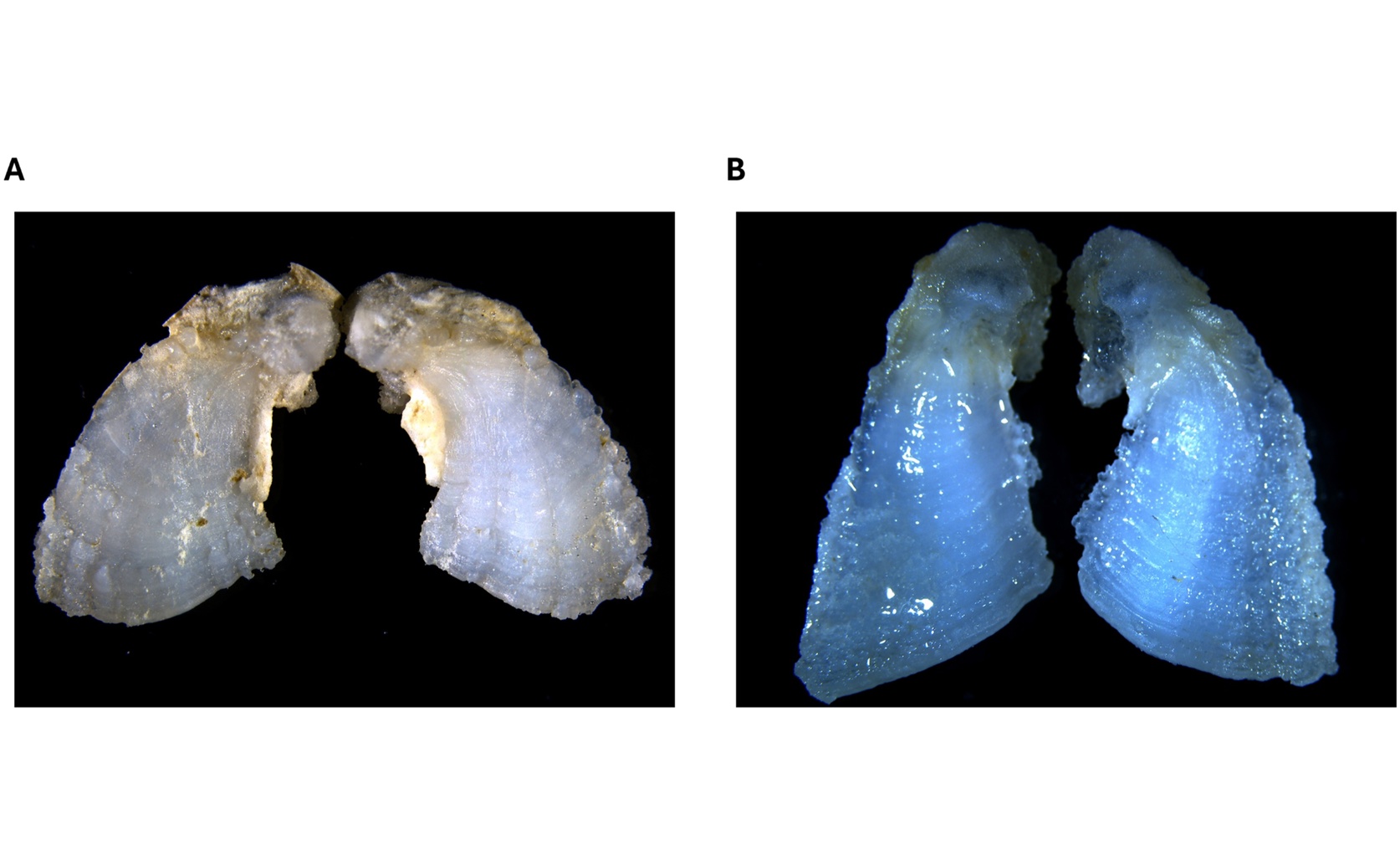
The elemental composition of sagittal otoliths from Acipenser oxyrinchus in the St. Lawrence River (A) and St. John River (B) was analyzed to assess if their chemical fingerprints could reliably distinguish between the two populations.

Image adapted from: Bernatchez et al. / CC BY (Source)

Key Findings

  • This Canadian study on Atlantic sturgeon in the St. Lawrence and St. John Rivers aimed to find a cost-effective way to determine fish origins and habitat use
  • Fin ray chemistry was more accurate than otolith chemistry in identifying where sturgeon originated, correctly classifying 90% of fish
  • Analysis of fin rays revealed distinct habitat use patterns, with sturgeon from the St. Lawrence River preferring freshwater and those from the St. John River favoring saltwater environments
Atlantic sturgeon are long-lived fish that migrate extensively between freshwater and saltwater, making their conservation challenging. Understanding where these fish spend their lives – their habitat use – is crucial for effective management, but tracking them, especially during their early life stages, is difficult. Researchers at the Ministère de l’Environnement, Université du Québec à Chicoutimi, have been investigating ways to determine the origin and life history of Atlantic sturgeon populations in the St. Lawrence River (SLR) and Saint John River (SJR) regions of Eastern Canada[1]. The core problem lies in accurately identifying where a sturgeon originated and the habitats it has used throughout its life. Traditional methods often involve lethal sampling, which isn’t ideal for a species already facing conservation concerns. To overcome this, scientists are turning to the natural chemical markers incorporated into the fish’s bodies as they grow. Specifically, they’re examining otoliths (ear bones) and fin rays – bony structures that accumulate elements from the surrounding water. The study focused on analyzing the chemical composition of otoliths and fin rays from sturgeon caught in the SLR and SJR. These structures essentially create a timeline of the fish’s life, with the core representing their earliest life stages and the outer edges reflecting more recent experiences. The researchers used a technique called LA-ICP-MS (Laser Ablation Inductively Coupled Plasma Mass Spectrometry) to measure the concentrations of various elements within these structures. This technique allows for precise mapping of elemental signatures along the core-to-edge growth axis. A key aspect of this research builds upon earlier work showing that trace metals in calcified structures like otoliths and scales can act as indicators of water chemistry[2]. Previous studies have demonstrated that the ratios of certain metals to calcium (Me:Ca) vary predictably within watersheds, allowing scientists to potentially “fingerprint” different river systems based on the chemical composition of fish tissues. However,[2] also highlighted the importance of understanding the stability of these elemental ratios over time and space, as variations can affect the accuracy of the analysis. The researchers in[2] found that while there was some variability, the four elements they examined (Strontium, Barium, Magnesium, and Manganese) remained relatively stable, and a four-element model could classify rivers with 92.5% accuracy. The current study takes this concept further by applying it to distinguish between two specific sturgeon populations. Importantly, the results revealed that fin ray microchemistry was more effective at differentiating between SLR and SJR sturgeon than otolith microchemistry. Fin rays showed clearer and more distinct elemental signatures, leading to higher reclassification success. This suggests that the elements are incorporated differently into these two structures, and fin rays provide a more reliable record of habitat use. Interestingly, the study also found that the elemental composition at the core of fin rays and otoliths was only strongly correlated for three elements: Strontium, Manganese, and Lithium. This is a critical finding because it indicates that using only these three elements might lead to misclassification errors. It emphasizes the need for a broader range of elemental markers and careful consideration of how elements are integrated into different calcified tissues. This aligns with the findings of[2], which showed that increasing the number of elements used in the classification model improved accuracy, although the benefit diminished beyond a certain point. The success of the machine learning classification approach in demonstrates the potential of this technique for monitoring sturgeon populations without resorting to lethal sampling. By analyzing fin ray samples, researchers can gain valuable insights into population structure and habitat use, informing conservation efforts and ensuring the long-term survival of this iconic species. This method offers a cost-effective and non-destructive way to track the movements and life histories of Atlantic sturgeon, providing essential data for their careful management in Eastern Canada.

WildlifeGeneticsEcology

References

Main Study

1) Comparative evaluation of otolith and fin ray as tools for assessing population differentiation in Atlantic sturgeon (Acipenser oxyrinchus)

Published 2nd March, 2026

https://doi.org/10.1371/journal.pone.0343989


Related Studies

2) Flowing down the river: Influence of hydrology on scale and accuracy of elemental composition classification in a large fluvial ecosystem.

https://doi.org/10.1016/j.scitotenv.2020.143320


Related Articles

An unhandled error has occurred. Reload 🗙