DNA testing reveals two breeding seasons for Korean clawed salamanders

Jim Crocker
7th February, 2026

DNA testing reveals two breeding seasons for Korean clawed salamanders

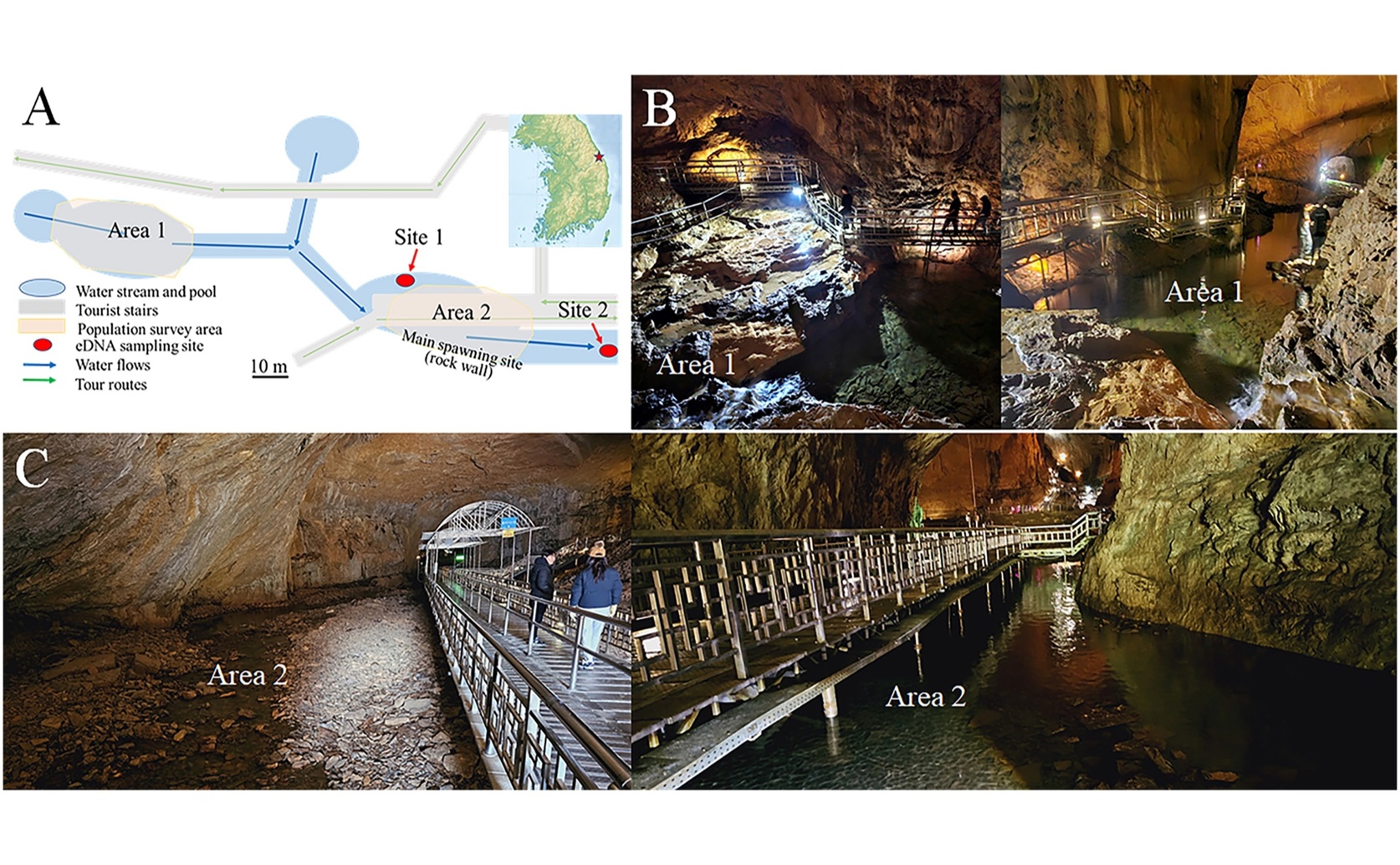
The biannual breeding season of the Korean clawed salamander (Onychodactylus koreanus) was established by conducting population surveys (B, C) and environmental DNA sampling, as shown in the schematic (A), within this specific Hwanseongul Cave study site.

Image adapted from: Park et al. / CC BY (Source)

Key Findings

  • This study, conducted in Korea’s Hwanseongul Cave, investigated the breeding habits of Onychodactylus koreanus, a small amphibian breeding underground
  • O. koreanus appears to breed twice annually, with peak breeding activity occurring in April-June and November-December
  • eDNA detection strongly correlated with adult presence, suggesting it’s a useful tool for monitoring breeding seasons, but doesn’t accurately reflect larval numbers
Understanding the breeding cycle of a species is fundamental to effective conservation efforts. This is particularly challenging for species that breed underground, where direct observation is difficult. Traditional methods of population surveys can be unreliable, especially for species existing at low densities[2]. Recent advances in environmental DNA (eDNA) analysis offer a promising new tool for monitoring such species, however, the relationship between eDNA presence and actual breeding activity needs further investigation. Researchers from Kangwon National University and Charles University[1] investigated the breeding habits of Onychodactylus koreanus, a small, external-fertilizing amphibian that breeds in underground caves in Korea. The study, conducted from April 2024 to June 2025, aimed to determine the frequency and timing of breeding seasons using a combination of larval and adult population surveys alongside eDNA detection. The team collected samples every two weeks, focusing on the influx of young larvae, the emergence of adults, and the presence of eDNA within the cave systems. They found a significant influx of one-year-old larvae in both June and November, indicating breeding events around these times. Adult emergence mirrored this pattern, occurring in May-June and November-December, with a complete absence of adults during the July-September and February months. Importantly, three egg clutches were observed in December 2024, and a further 110 eggs were counted at the same site in July 2025. The results showed a strong correlation between peak eDNA detection and the periods of adult emergence. However, the eDNA signal didn’t accurately reflect the larval influx, suggesting that adult presence is a better indicator of eDNA concentration than larval abundance. Major eDNA detection occurred during two distinct periods: April-June and November-December 2024. This study demonstrates that O. koreanus exhibits two separate breeding seasons annually – one in the spring (April-June) and another in the late autumn/early winter (November-December). This finding contrasts with some amphibian species which exhibit either continuous or discontinuous breeding patterns[3]. The research highlights the potential of combining eDNA analysis with traditional population surveys to accurately identify breeding seasons in subterranean amphibians. The observed discrepancies between eDNA detection and larval influx suggest that the release of DNA into the environment is primarily driven by adult activity, likely through shedding of skin cells and gametes during breeding. This aligns with findings from studies on great crested newts[4], which also showed that eDNA concentrations peaked in relation to adult breeding activity and body condition. While eDNA can be a powerful tool, it's crucial to understand the factors influencing its concentration, as environmental conditions and life stages can impact the signal detected.[3] notes that temperature, for example, can affect eDNA concentrations. The fact that eDNA detection correlated with adult emergence, and the observation of egg clutches during the periods of high eDNA, reinforces the idea that eDNA sampling can be strategically timed to identify critical breeding habitat. This is particularly important for species like Petromyzon marinus[2], where spawning events are associated with higher DNA concentrations, enabling focused conservation efforts. The study by also suggests that even in fast-moving aquatic systems, snapshot sampling techniques can be effective for monitoring low-density species.

EnvironmentWildlifeEcology

References

Main Study

1) Integrated environmental DNA analysis and population assessment revealed a biannual breeding season of the Korean clawed salamander (Onychodactylus koreanus)

Published 5th February, 2026

https://doi.org/10.1371/journal.pone.0342469


Related Studies

2) Identifying spawning sites and other critical habitat in lotic systems using eDNA "snapshots": A case study using the sea lamprey Petromyzon marinus L.

https://doi.org/10.1002/ece3.4777


3) Ovarian control and monitoring in amphibians.

https://doi.org/10.1016/j.theriogenology.2017.12.005


4) Seasonal variation in environmental DNA in relation to population size and environmental factors.

https://doi.org/10.1038/srep46294


Related Articles

An unhandled error has occurred. Reload 🗙