Tracking rare Amazonian manatees with DNA traces in the water

Jenn Hoskins
5th February, 2026

Tracking rare Amazonian manatees with DNA traces in the water

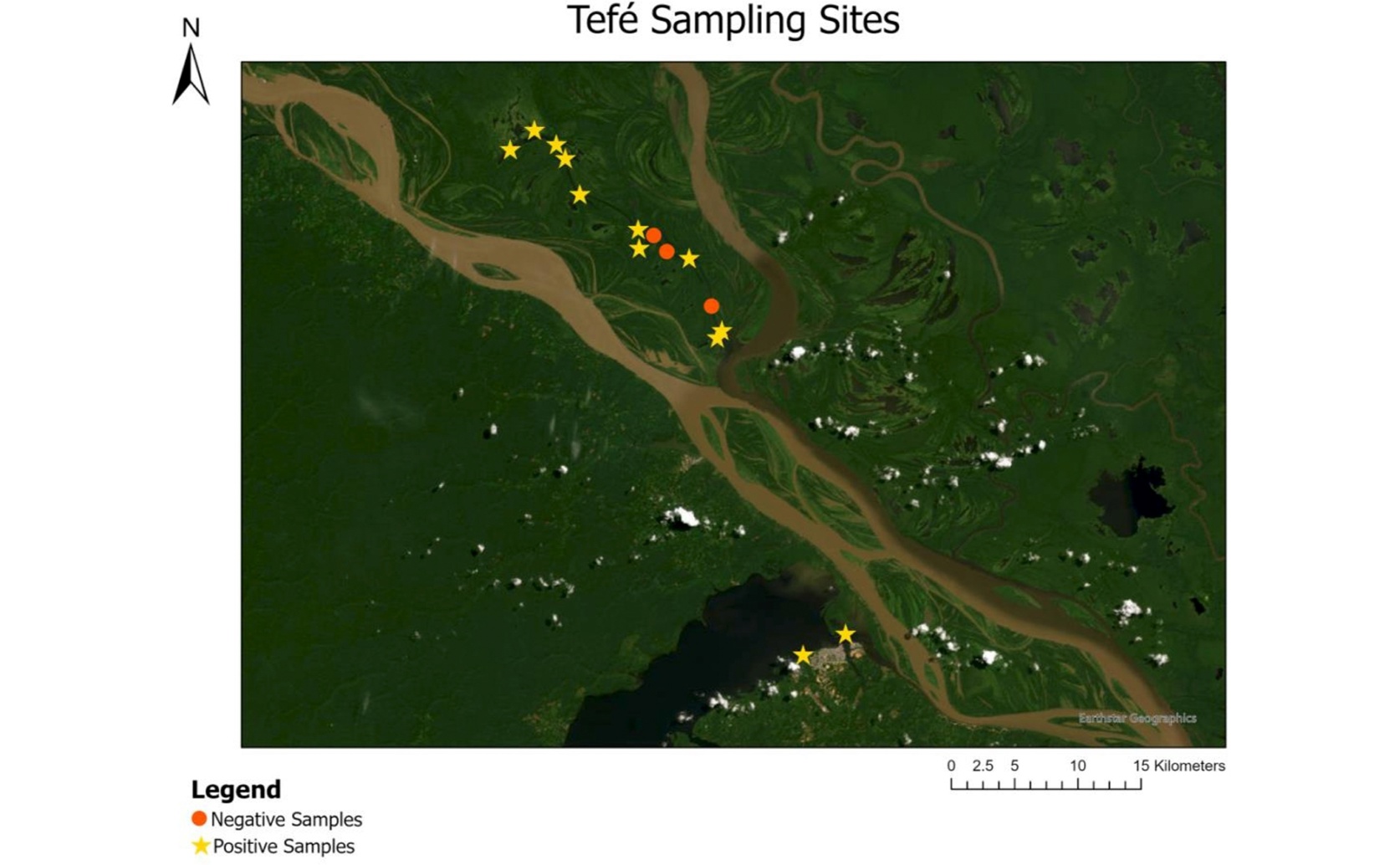
Consistent with the study's main findings, environmental DNA sampling revealed a high frequency of positive detections for the Amazonian manatee (Trichechus inunguis) within the protected Mamirauá Reserve and near the town of Tefé, a region of low human impact.

Image adapted from: Romoser et al. / CC BY (Source)

Key Findings

  • This study successfully used environmental DNA (eDNA) to detect Amazonian manatees in the Amazon River Basin, a first for this species
  • Manatee DNA was found more often in rural areas with minimal human activity compared to areas near cities, suggesting a correlation between human disturbance and manatee presence
  • The new DNA preservation method, drying samples with desiccant beads, worked as well as traditional cooling techniques, simplifying fieldwork in remote tropical locations
Assessing the health of aquatic ecosystems often relies on monitoring the animals that live within them. However, directly observing many species, particularly those that are rare, elusive, or live in vast environments, is incredibly challenging and resource-intensive. Traditional methods like visual surveys, capture-recapture studies, and physical sample collection can be expensive, time-consuming, and may even harm the animals being studied. Environmental DNA (eDNA) analysis offers a promising alternative. This technique involves collecting water samples and analyzing the DNA shed by organisms into the environment – essentially, detecting a species’ presence by finding traces of its genetic material. Researchers from Texas A&M University and the Federal University of Pará[1] recently employed eDNA analysis to assess the distribution of the Amazonian manatee ( Trichechus inunguis ), a vulnerable species facing increasing threats. Manatees are difficult to track due to their shy nature and the vastness of the Amazon River system. The study focused on three locations along the Amazon River – Tefé, Manaus, and Belém – representing a gradient of human disturbance, from relatively pristine areas to more heavily populated regions. The core of the study involved collecting water samples at various sites within each location, spanning areas with differing levels of human impact, from urban environments to protected reserves. A key innovation was the development of a field methodology allowing for DNA preservation for over 13 days without the need for freezing or cooling. This is a significant advancement, as maintaining a consistent cold chain during sample transport can be difficult, especially in remote tropical locations. The researchers demonstrated that this new preservation method was as effective as traditional cold-storage techniques. Once collected, DNA was extracted from the water samples and analyzed using Polymerase Chain Reaction (PCR) amplification and Illumina sequencing. PCR is a technique used to make many copies of specific DNA fragments, allowing for easier detection. Illumina sequencing then identifies the species present based on the unique genetic signatures found in the amplified DNA. The results revealed a clear pattern: manatee DNA detection rates were over three times higher in the western Amazon (Tefé and Mamirauá Reserve) where human activity is minimal, compared to the central (Manaus) and eastern (Belém) regions. Manatee DNA was found at six sites in Manaus and only two in Belém, indicating a decline in presence with increasing human impact. This research builds upon earlier work demonstrating the potential of eDNA to characterize marine communities at large scales[2]. That study, conducted in the Arabian Gulf, showed that seawater samples could effectively capture vertebrate diversity and identify habitat-specific molecular signatures. Similarly, a study of ichthyofauna (fish diversity) in the Amazon basin[3] highlighted the effectiveness of eDNA metabarcoding for identifying species, even in poorly documented regions. However, that study also acknowledged the limitations of taxonomic identification due to incomplete reference databases. The current study overcomes some of these limitations by focusing on a single, well-defined target species – the Amazonian manatee. Furthermore, the success of the field preservation method developed by addresses a common logistical challenge in eDNA research, highlighted in a study focusing on freshwater metazoan biodiversity[4], which emphasized the importance of appropriate filter preservation for maximizing DNA recovery. That study recommended dry preservation or lysis buffer storage, methods validated in the current Amazonian manatee research. The findings from have clear implications for conservation efforts. By providing a rapid and non-invasive method for assessing manatee distribution, eDNA analysis can help prioritize conservation areas and monitor the effectiveness of management strategies. The technique is also expected to be valuable for surveying other aquatic species in tropical rivers, offering a powerful tool for understanding and protecting biodiversity in these complex ecosystems.

EnvironmentWildlifeEcology

References

Main Study

1) Survey of vulnerable Amazonian manatees using environmental DNA (eDNA): A method for survey in remote field settings

Published 4th February, 2026

https://doi.org/10.1371/journal.pone.0339410


Related Studies

2) Using vertebrate environmental DNA from seawater in biomonitoring of marine habitats.

https://doi.org/10.1111/cobi.13437


3) Unveiling biogeographical patterns of the ichthyofauna in the Tuichi basin, a biodiversity hotspot in the Bolivian Amazon, using environmental DNA.

https://doi.org/10.1371/journal.pone.0262357


4) Environmental DNA filtration techniques affect recovered biodiversity.

https://doi.org/10.1038/s41598-018-23052-8


Related Articles

An unhandled error has occurred. Reload 🗙