Do nest boxes help endangered species bounce back after wildfires?

Jim Crocker
4th December, 2025

Do nest boxes help endangered species bounce back after wildfires?

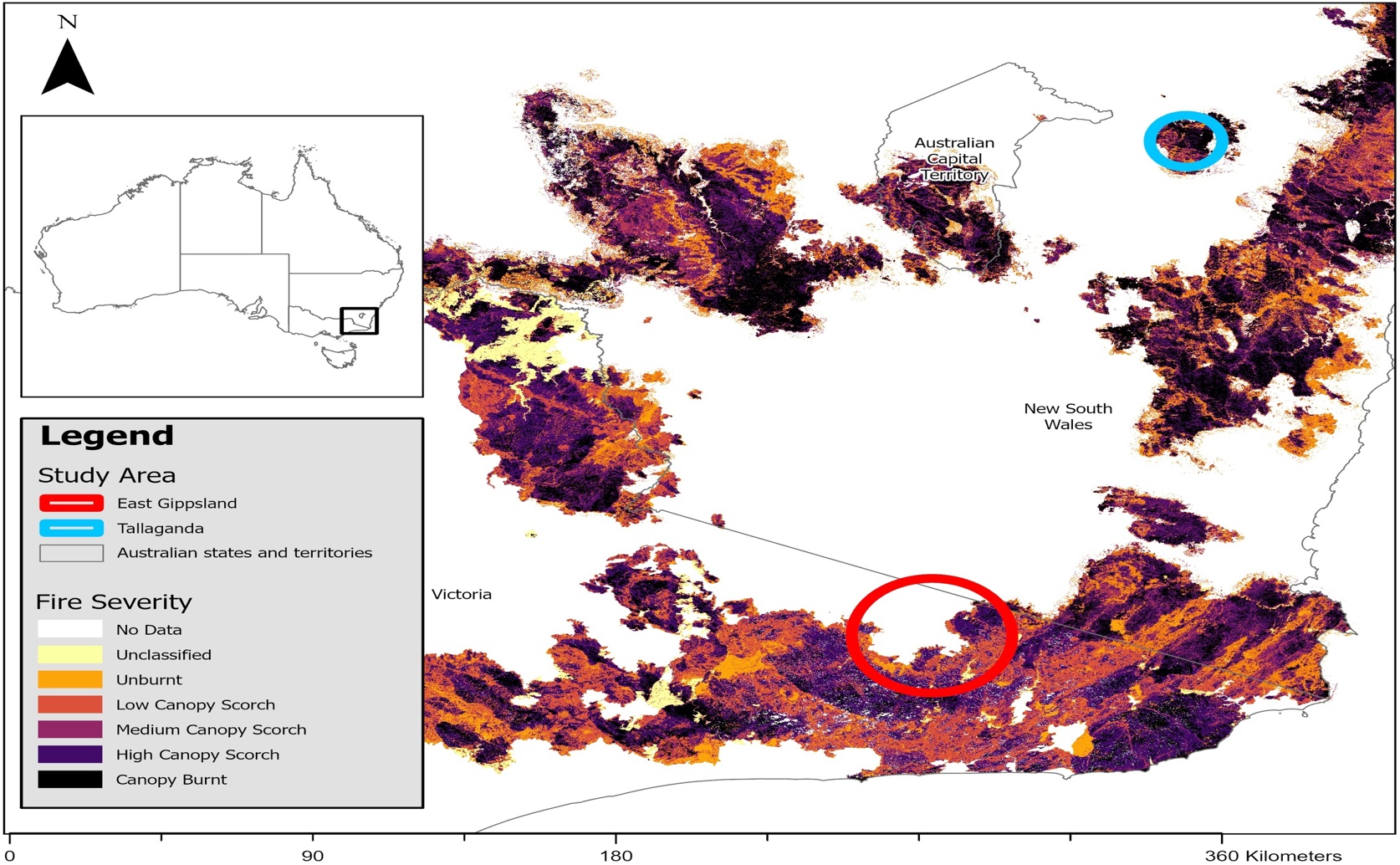
Study sites were established in two regions of southeastern Australia, East Gippsland and Tallaganda, within the area burned by the 2019/2020 megafires to test if providing nestboxes can support the recovery of the endangered southern greater glider, Petauroides volans.

Image adapted from: Ridley et al. / CC BY (Source)

Key Findings

  • This Australian study investigated if artificial nestboxes could help endangered greater gliders recover after severe 2019/2020 bushfires in Victoria and New South Wales
  • While gliders used the nestboxes, particularly in Tallaganda, there was no overall increase in glider numbers between areas with and without nestboxes
  • Glider abundance was higher in areas of Tallaganda that experienced less severe fire damage, highlighting the importance of reducing fire intensity for species recovery
The southern greater glider, an endangered marsupial, relies heavily on tree hollows for shelter and breeding. These hollows are naturally formed over many years, typically in older trees. However, disturbances like wildfires can drastically reduce the availability of these essential habitats, leading to population declines. This is particularly concerning given predictions of increased fire frequency due to climate change. Researchers at the Australian National University[1] investigated whether artificial nestboxes could help these gliders recover after severe bushfires. The 2019/2020 Australian megafires caused widespread habitat loss and significant mortality for many species, including the southern greater glider. Following these fires, a study was designed to assess the effectiveness of nestboxes as a conservation tool. The research involved installing 234 nestboxes across two regions – East Gippsland in Victoria and Tallaganda in New South Wales – and comparing glider populations in areas with nestboxes to those without (control sites). Spotlight surveys and camera traps were used to monitor glider presence and abundance. The initial findings revealed that gliders did use the nestboxes, particularly in the Tallaganda region. However, surprisingly, there was no significant difference in the overall number of gliders observed between the nestbox sites and the control sites. This suggests that simply providing artificial hollows doesn’t automatically translate to population recovery. Interestingly, in Tallaganda, glider numbers were higher in areas that experienced less severe fire damage. This outcome aligns with concerns raised in earlier research[2] regarding the long-term challenges of habitat recovery after intense wildfires. That study highlighted that even if animals initially survive a fire, the loss of critical resources like hollow-bearing trees can have lasting consequences, especially if fires occur too frequently for these resources to regenerate. The current study builds on this by directly testing a mitigation strategy – nestboxes – and finding that their immediate impact on population size isn’t substantial. The lack of a strong positive effect from nestboxes could be due to several factors. It’s possible that nestboxes don’t fully replicate the qualities of natural hollows, such as thermal properties or protection from predators[3]. Furthermore, the study acknowledges that the long-term success of nestboxes remains to be seen. It takes time for gliders to establish breeding colonies and for populations to respond to increased shelter availability. The finding that gliders were more abundant in less severely burnt areas underscores the importance of fire management strategies that aim to reduce fire intensity and protect unburnt or partially burnt habitat. This also highlights the concept of ‘hidden collapse’ described in previous work[3], where ecosystems may appear intact superficially but are undergoing a prolonged decline due to the loss of key structural components. In this case, the loss of hollow-bearing trees represents a critical stressor. While the initial results aren’t conclusive, the ongoing nature of the study is crucial. Continued monitoring will reveal whether nestboxes contribute to glider recovery over time, particularly in relation to breeding success and population growth. The research also emphasizes the need for a nuanced approach to conservation, recognizing that artificial refuges[4] are just one tool in a broader strategy that must address the underlying drivers of habitat loss and degradation.

EnvironmentWildlifeEcology

References

Main Study

1) Establishing foundations: Designing a long-term experiment to evaluate whether nestboxes assist population recovery of an endangered species after fire

Published 3rd December, 2025

https://doi.org/10.1371/journal.pone.0334130


Related Studies

2) The effects of wildfire on mortality and resources for an arboreal marsupial: resilience to fire events but susceptibility to fire regime change.

https://doi.org/10.1371/journal.pone.0022952


3) Hidden collapse is driven by fire and logging in a socioecological forest ecosystem.

https://doi.org/10.1073/pnas.1721738115


4) Artificial refuges for wildlife conservation: what is the state of the science?

https://doi.org/10.1111/brv.12776


Related Articles

An unhandled error has occurred. Reload 🗙