Gene controls plant growth by managing hormone delivery

Greg Howard
4th March, 2026

Gene controls plant growth by managing hormone delivery

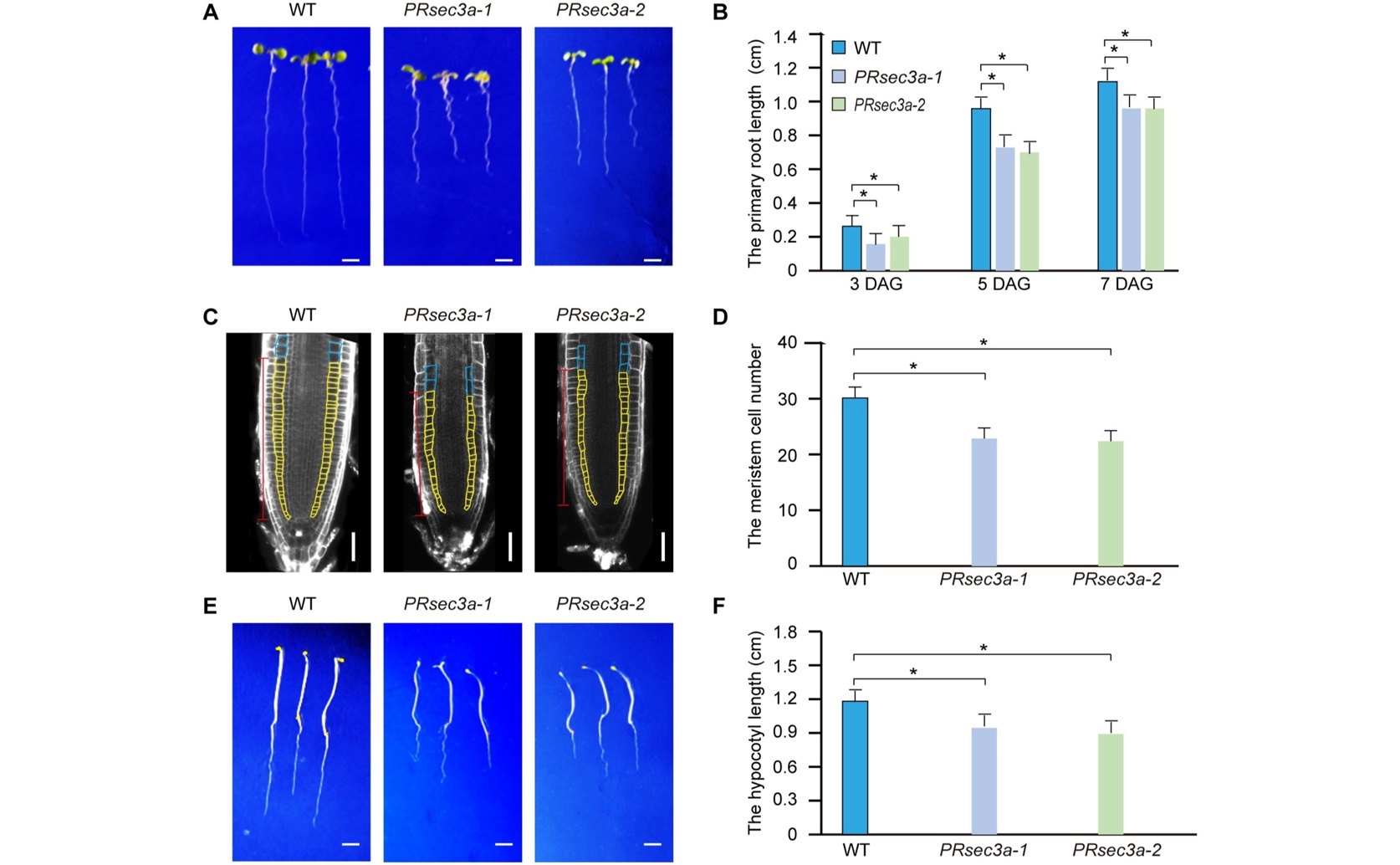
Deficiency in the exocyst subunit SEC3A impairs both cell division and elongation in Arabidopsis thaliana, leading to retarded primary root growth (a–d) and shorter etiolated hypocotyls (e, f).

Image adapted from: Qiao et al. / CC BY (Source)

Key Findings

  • In Arabidopsis plants, a protein called SEC3A is vital for normal root growth and the ability to sense gravity
  • Reduced SEC3A levels disrupt the recycling of key proteins, PIN1 and PIN2, which are essential for auxin transport within root cells
  • SEC3A directly interacts with another protein, RabE1b, suggesting RabE1b regulates SEC3A activity and controls PIN protein movement
Plant growth and development are heavily reliant on the movement of auxin, a plant hormone, from where it’s produced to where it’s needed. This movement isn’t random; it’s a carefully directed process called polar auxin transport. This transport is primarily facilitated by proteins called PIN proteins, which are strategically positioned within the cell’s outer membrane (the plasma membrane) to control the flow of auxin. Understanding how these PIN proteins are regulated is crucial for understanding plant growth, and for potentially improving crop yields[2]. Researchers at Nanjing Agricultural University and King George’s Medical University recently investigated a key component of this regulatory system: the exocyst complex[1]. The exocyst is a group of eight proteins that work together to deliver cellular components, including PIN proteins, to the right locations within the cell. Previous studies have shown that specific subunits of the exocyst, like SEC6, SEC8, and EXO70A1, are involved in recycling PIN proteins, ensuring they can continue to transport auxin. However, the precise mechanisms of how the exocyst integrates into the PIN recycling process and the overall control hierarchy remained unclear. To address this, the research team focused on a specific exocyst subunit, SEC3A. They created mutant plants with a reduced amount of SEC3A, specifically rescuing pollen development to allow for study of sporophytic (non-reproductive) growth. These mutant plants, designated PRsec3a, displayed significant growth defects, including stunted root growth and impaired gravitropism – the ability of the plant to sense and grow in response to gravity. Crucially, these plants also showed reduced auxin accumulation in the roots, indicating a problem with auxin transport. Further investigation revealed that the recycling of PIN1 and PIN2 – key PIN proteins involved in auxin transport – was disrupted in the PRsec3a mutants. This was tested by using Brefeldin A, a chemical that disrupts cellular trafficking. Normally, cells can recover from Brefeldin A induced disruption by recycling proteins like PIN1 and PIN2. However, in the PRsec3a mutants, this recycling process was compromised, suggesting that SEC3A plays a vital role in returning these proteins to the plasma membrane after they’ve been internalized. The study also found that another protein, BRI1, involved in plant immunity, also exhibited impaired recycling in the mutants. Interestingly, the researchers discovered that SEC3A is regulated by a small GTPase called RabE1b. GTPases are like molecular switches that control various cellular processes, and RabE1b appears to directly influence SEC3A activity, establishing a new regulatory pathway. This finding is significant because it identifies a previously unknown link between RabE1b and the exocyst complex in regulating PIN protein dynamics. These findings build upon earlier research highlighting the ancient origins of auxin transport mechanisms[3]. The study suggests that the basic machinery for auxin transport, including proteins like PINs and potentially the exocyst, may have evolved very early in plant evolution, even before the emergence of complex multicellular life. The conservation of PIN and PIN-like proteins across diverse organisms suggests a fundamental role for auxin signaling throughout the plant kingdom.[3] also notes that auxin transporters form a larger bacterial family, further pointing to an ancient origin of these proteins. The current study doesn't directly investigate the evolutionary history of SEC3A, but it adds to the growing body of evidence supporting the idea that the exocyst complex, and its role in membrane trafficking, is a crucial component of this ancient signaling system. The research provides a more detailed understanding of how the exocyst complex functions in plant development and identifies new targets for manipulating auxin transport to improve plant growth.

GeneticsBiochemPlant Science

References

Main Study

1) SEC3A acts as an effector of RabE1b to regulate auxin transport in arabidopsis

Published 3rd March, 2026

https://doi.org/10.1371/journal.pone.0342670


Related Studies

2) Structure and Function of Auxin Transporters.

https://doi.org/10.1146/annurev-arplant-070523-034109


3) Auxin's origin: do PILS hold the key?

https://doi.org/10.1016/j.tplants.2021.09.008


Related Articles

An unhandled error has occurred. Reload 🗙