Boosting onion growth and soil health with beneficial microbes

Jim Crocker
26th February, 2026

Boosting onion growth and soil health with beneficial microbes

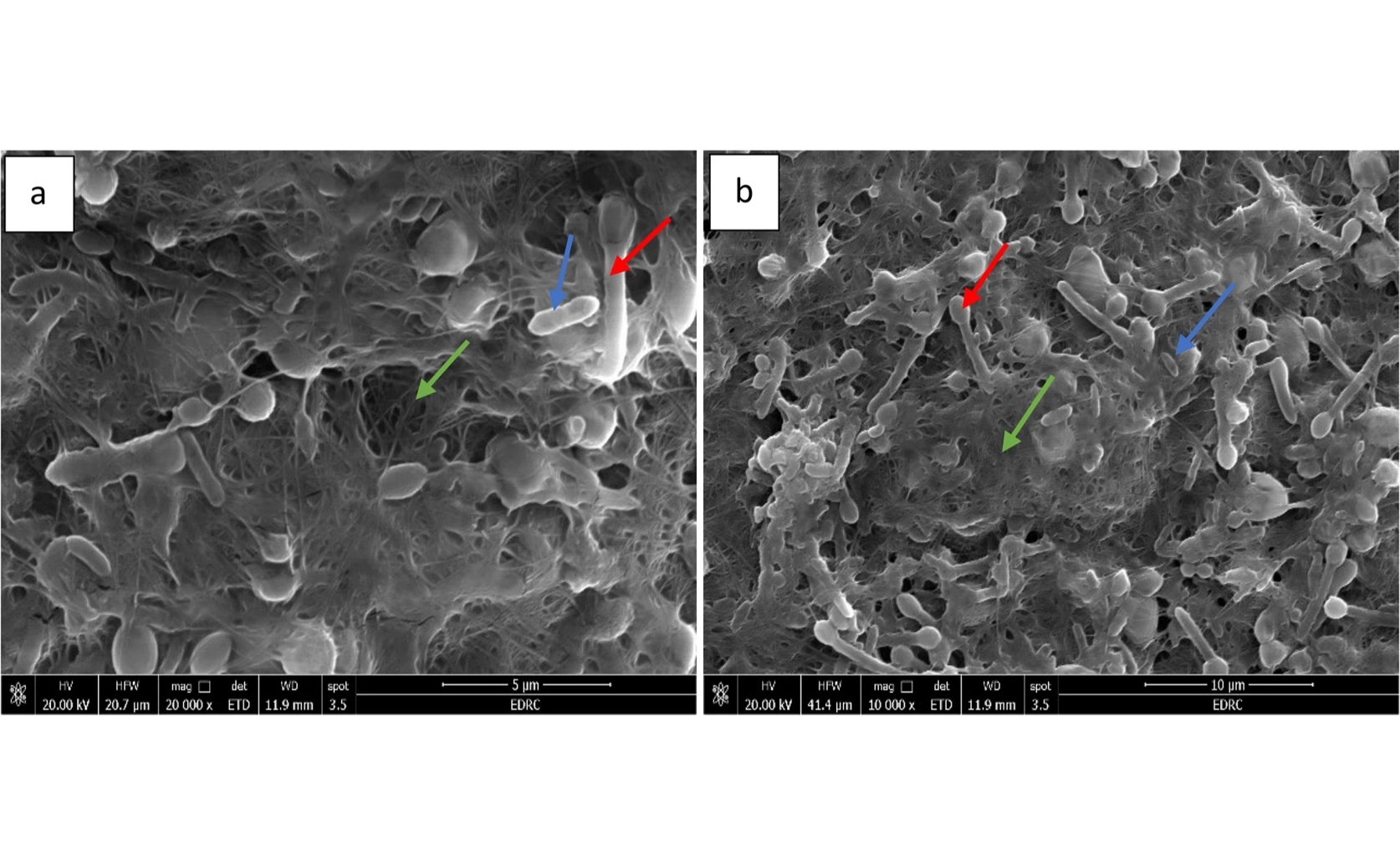
Scanning electron microscopy reveals the successful immobilization of the plant-beneficial bacteria Pseudomonas stutzeri and Beijerinckia mobilis within the protective, porous nanofiber network of the bacterial cellulose carrier (a, b).

Image adapted from: Rabaa Yaseen / CC BY (Source)

Key Findings

  • In Egypt’s El-Kharga Oasis, onion crops showed significant growth improvements when treated with beneficial bacteria
  • Encapsulating bacteria in bacterial cellulose (BC) increased onion bulb yield by 44.9% compared to untreated crops and outperformed free-cell treatments
  • Treating onion crops with bacteria, especially when protected by BC, altered the soil microbiome by favoring helpful bacteria and improving nutrient availability
Improving crop yields while minimizing environmental impact is a critical challenge in modern agriculture. Traditional mineral fertilizers, while effective in the short term, can degrade soil health and reduce its long-term productivity[2]. A promising alternative lies in harnessing the power of plant growth-promoting rhizobacteria (PGPR) – beneficial bacteria that reside in the root zone of plants and enhance their growth and nutrient uptake. However, a significant hurdle in widespread PGPR application is their survival and effectiveness in the harsh conditions of the soil environment. Researchers at the Desert Research Center, Cairo, recently addressed this challenge in a field study[1] investigating the immobilization of a microbial consortium, Pseudomonas stutzeri and Beijerinckia mobilis, within bacterial cellulose (BC). BC is a naturally produced polymer created by bacteria like Komagataeibacter xylinus and possesses a unique, highly porous structure. The aim was to determine if encapsulating these PGPR within BC would protect them and improve their performance in a real-world agricultural setting. The study focused on onion crops grown in the El-Kharga Oasis, New Valley Governorate, Egypt, during the 2025 winter cropping season. Three experimental groups were established: an uninoculated control, a group receiving the PGPR as free cells, and a group receiving the PGPR immobilized within the BC matrix. The results demonstrated a significant improvement in plant growth, nutrient uptake, and soil fertility across both inoculation groups compared to the control. Notably, the bulbs from plants treated with the immobilized PGPR exhibited a remarkable 44.9% increase in yield compared to the control group, and even outperformed the plants treated with free cells. This positive outcome is likely due to the protective effect of the BC. The BC matrix shields the bacteria from environmental stresses, such as desiccation and predation, allowing for a higher survival rate and sustained release of beneficial compounds. This aligns with previous research highlighting the potential of microbial biostimulants to enhance plant resilience under abiotic stress[3]. The study also found that both inoculation methods increased nitrogen (N), phosphorus (P), and potassium (K) levels in both the onion bulbs and the surrounding soil, indicating enhanced nutrient mobilization. The immobilized cells were particularly effective in this regard. Beyond simply increasing nutrient levels, the study investigated the impact of the inoculations on the composition of the microbial community within the onion rhizosphere – the narrow zone of soil directly influenced by plant roots. Analysis of ecological diversity indices revealed an interesting phenomenon: the bacterial treatments, particularly with immobilized cells, led to a short-term reduction in the overall diversity of the rhizosphere microbiome. This might seem counterintuitive, but the researchers interpret this as a positive outcome. The reduction in diversity was attributed to the selective enrichment of plant-beneficial bacteria, suppressing the growth of less helpful or even harmful competitors. This functional shift, enhancing the efficiency of the rhizosphere, did not appear to have long-term negative consequences on soil health, as post-harvest observations indicated stable microbial populations. The success of Pantoea agglomerans strain PVM in producing indole-3-acetic acid (IAA), a key plant hormone, through a simple and cost-effective method[4] further emphasizes the potential of optimizing bacterial processes for agricultural benefit. While this study didn’t directly focus on IAA production, it demonstrates how providing a favorable environment – in this case, BC – can enhance the activity of beneficial bacteria, potentially leading to increased hormone production and improved root development. The novelty of this work lies in its field-scale validation of BC as a biodegradable carrier for PGPR in arid conditions. Previous studies have shown the potential of combining PGPM with mineral fertilizers to improve crop yields[2], but this research demonstrates a more sustainable approach, reducing reliance on synthetic inputs while simultaneously modulating the rhizosphere microbiome for enhanced performance. The researchers concluded that immobilizing PGPR within BC offers a robust and eco-friendly strategy for improving crop yields and nutrient dynamics, representing a scalable solution for sustainable agriculture.

AgricultureBiochemPlant Science

References

Main Study

1) Immobilization of a biostimulator microbial consortium on bacterial cellulose and its effect on onion growth, soil nutrient status and the microbial community

Published 23rd February, 2026

https://doi.org/10.1007/s11274-025-04739-3


Related Studies

2) Optimizing plant growth, nutrient uptake, and yield of onion through the application of phosphorus solubilizing bacteria and endophytic fungi.

https://doi.org/10.3389/fmicb.2024.1442912


3) Molecular Communication of Microbial Plant Biostimulants in the Rhizosphere Under Abiotic Stress Conditions.

https://doi.org/10.3390/ijms252212424


4) Optimization of medium for indole-3-acetic acid production using Pantoea agglomerans strain PVM.

https://doi.org/10.1111/j.1365-2672.2011.04976.x


Related Articles

An unhandled error has occurred. Reload 🗙