How nitrogen levels in soil affect carbon dioxide use in soybean leaves

Jenn Hoskins
2nd February, 2026

How nitrogen levels in soil affect carbon dioxide use in soybean leaves

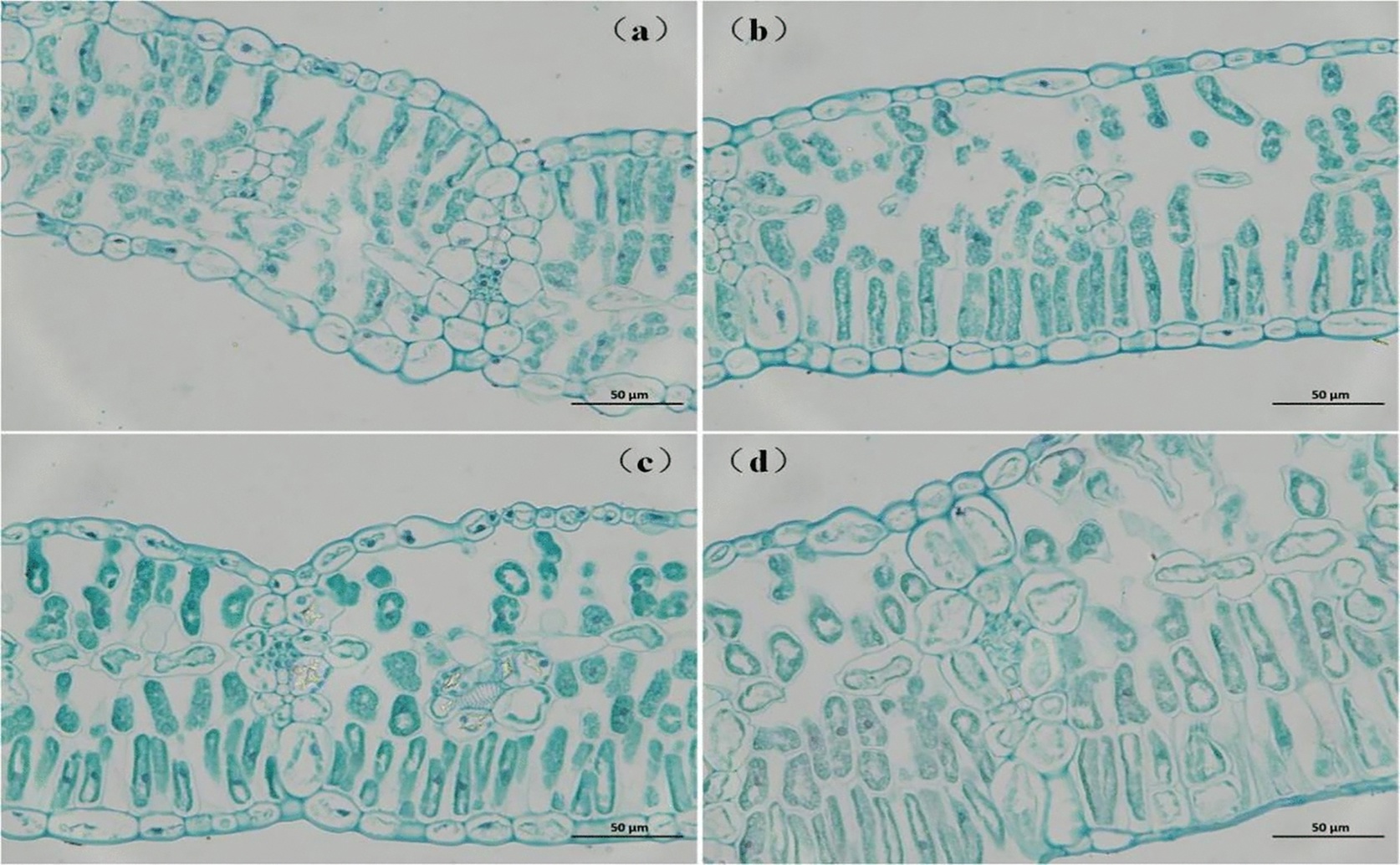
Transverse leaf sections of soybean (Glycine max) show that increasing soil nitrogen addition progressively improves mesophyll cell turgidity, arrangement, and intercellular space enlargement (a–d: control, low, medium, and high nitrogen), reflecting structural modifications that accompany the biochemically driven enhancement of intra-leaf CO₂ diffusion.

Image adapted from: Zuo et al. / CC BY (Source)

Key Findings

  • Soybean plants in Shanxi, China showed increased photosynthesis with moderate nitrogen (N) levels (7.5-15.0 g urea/m2)
  • The improved photosynthesis was mainly due to faster carbon dioxide movement inside the leaf (mesophyll conductance) not wider leaf pores
  • Increasing nitrogen boosted the efficiency of biochemical processes within the leaf, rather than simply changing its physical structure, leading to better carbon dioxide uptake and water use
Plants need carbon dioxide from the air to grow, a process called photosynthesis. However, getting that carbon dioxide into the leaf efficiently can be a limitation, especially when environmental conditions change rapidly. This limitation is governed by a property called mesophyll conductance (gm), which describes how easily carbon dioxide moves through the internal air spaces and tissues of a leaf. Understanding what controls gm is therefore crucial for improving plant growth and yield, particularly in a changing climate. Recent research from Shanxi Agricultural University and Guizhou University[1] has investigated how nitrogen (N) availability affects gm in soybean plants, and whether changes in the leaf’s internal structure or biochemical processes are more important in driving rapid responses to environmental shifts. The study focused on how varying levels of nitrogen in the soil impacted the movement of carbon dioxide within the soybean leaf and its overall ability to photosynthesize. Researchers found that increasing nitrogen supply from 7.5 to 15.0 grams of urea per square meter significantly boosted both the internal carbon dioxide diffusion and the rate of carbon assimilation – the process of converting carbon dioxide into plant sugars. Interestingly, the pores on the leaf surface (stomatal conductance, or gsc) didn't show a similar response to nitrogen levels. This suggests that the increased carbon dioxide uptake wasn’t simply due to wider stomatal openings, but something happening inside the leaf itself. Further analysis revealed that the increase in carbon dioxide diffusion was primarily due to improvements in gm. This finding is important because it narrows down the focus to the internal processes within the leaf as the key driver of this effect. The researchers then investigated whether this improvement in gm was linked to changes in leaf anatomy – the physical structure of the leaf – or biochemical metabolism – the chemical processes happening within the leaf. The results showed that enhancing biochemical metabolism was the dominant mechanism. While some changes in leaf structure were observed, they were not the primary reason for the increased gm. This means that the nitrogen wasn't simply making the leaf’s internal pathways wider, but rather, it was improving the efficiency of the chemical processes that facilitate carbon dioxide movement. This study builds upon earlier work showing that nitrogen supply influences the allocation of resources within the leaf, impacting components of photosynthesis[2]. Specifically, the amount of nitrogen available affects the balance between the enzyme Rubisco (responsible for capturing carbon dioxide) and the electron transport chain (involved in energy production). Plants with low nitrogen levels tend to be limited by Rubisco, while those with high nitrogen levels are limited by the regeneration of the molecule Rubisco uses.[2] demonstrated that leaf nitrogen content directly affects these processes, and the current study expands on this by showing that increased nitrogen also boosts the biochemical capacity for carbon dioxide diffusion. Furthermore, the research team observed improvements in water use efficiency (WUE) alongside the increased gm. They found a correlation between WUE and aquaporins – channel proteins in plant cells that regulate water transport[3]. This suggests that aquaporins play a role in optimizing water relations, which in turn contributes to improved WUE when nitrogen levels are sufficient.[4] highlights the dramatic increase in reactive nitrogen in Asia due to food and energy demands, and the need for efficient nitrogen use. This study adds to that understanding by demonstrating how optimizing nitrogen supply can improve both carbon assimilation and water use efficiency in crops. In essence, the research from demonstrates that increasing nitrogen availability in soybean plants primarily enhances the biochemical processes within the leaf that facilitate carbon dioxide diffusion, leading to improved photosynthesis and water use efficiency. This suggests that focusing on optimizing nitrogen metabolism, rather than solely on anatomical changes, is a key strategy for improving plant performance under varying environmental conditions.

AgricultureBiochemPlant Science

References

Main Study

1) Biochemical metabolic enhancement acting as a dominant driver in intra-leaf CO2 diffusional response to soil nitrogen supplying in Soybean

Published 30th January, 2026

https://doi.org/10.1371/journal.pone.0340250


Related Studies

2) The rate-limiting step for CO(2) assimilation at different temperatures is influenced by the leaf nitrogen content in several C(3) crop species.

https://doi.org/10.1111/j.1365-3040.2011.02280.x


3) Plant aquaporins: membrane channels with multiple integrated functions.

https://doi.org/10.1146/annurev.arplant.59.032607.092734


4) The Asian nitrogen cycle case study.

Journal: Ambio, Issue: Vol 31, Issue 2, Mar 2002


Related Articles

An unhandled error has occurred. Reload 🗙