Bacterial compound boosts soybean health and yield during drought

Jim Crocker
22nd October, 2025

Bacterial compound boosts soybean health and yield during drought

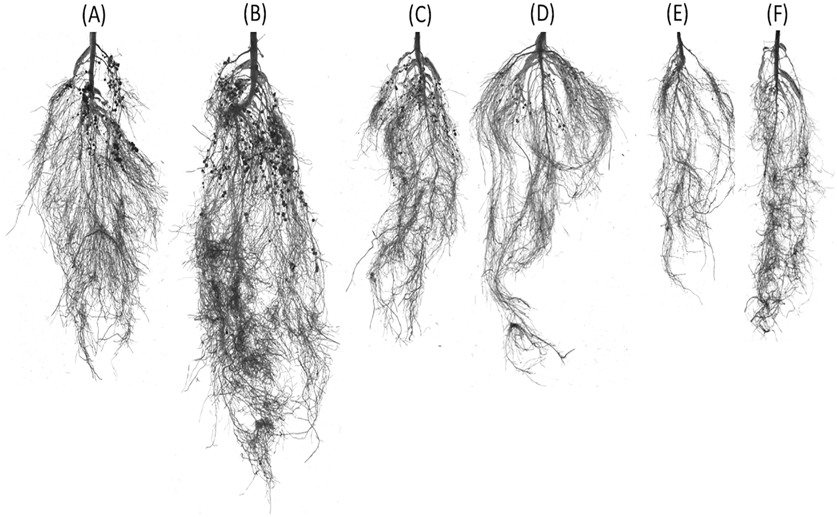
Soybean roots treated with the bacterial compound Bacillin 20 (B, D, F) demonstrate greater resilience and growth under drought stress compared to their untreated counterparts (A, C, E).

Image adapted from: Eisvand, Smith / CC BY (Source)

Key Findings

  • Soybean plants experienced reduced growth and photosynthesis under drought stress, a common issue for this major crop
  • Applying Bacillin 20 partially counteracted drought’s negative effects by increasing leaf area and shoot biomass under moderate stress
  • Bacillin 20 influenced root development, specifically increasing the number of root tips, potentially improving water access
Water scarcity is a growing global problem, significantly impacting agriculture and food production. Drought conditions reduce crop yields and make plants more susceptible to various environmental stresses. Researchers at Lorestan University, McGill University, and the Nuclear Science and Technology Research Institute[1] recently investigated how a specific bacterium, Bacillus thuringiensis derivative Bacillin 20, affects soybean plants under drought stress, focusing on growth, photosynthesis, and nutrient uptake. The study focused on soybeans because they are a major global crop and are sensitive to drought. The experiment involved growing soybeans under different levels of drought stress – normal conditions (control), moderate stress (-0.75 MPa), and severe stress (-1.5 MPa) – and applying different concentrations of Bacillin 20 (0, 10-11 M, and 10-9 M). The researchers then measured various plant characteristics to see how drought and Bacillin 20 influenced them. The results showed that drought significantly hindered soybean growth. Plant height, leaf area, shoot dry weight (the amount of plant material after removing water), and root development were all reduced as drought severity increased. Photosynthesis, the process plants use to convert light into energy, also declined under drought conditions, along with related measures like stomatal conductance (how open the pores on leaves are for gas exchange) and transpiration (water loss from leaves). Importantly, nodulation – the formation of nodules on roots by symbiotic bacteria that fix nitrogen – was also negatively impacted by drought. Interestingly, Bacillin 20 didn't uniformly improve all aspects of plant growth. It had no significant effect on plant height, but it did increase leaf area and, crucially, shoot dry weight under moderate drought stress. This suggests Bacillin 20 can help mitigate some of the negative effects of drought on plant biomass. Furthermore, it improved the photosynthetic rate in drought-stressed plants. The most significant effects occurred when the bacterium and drought stress interacted, highlighting a complex relationship. The study also revealed that Bacillin 20 influenced root development, increasing the number of root tips by 12.6% at a concentration of 10-11 M. This is important as a more extensive root system can access more water in the soil. However, Bacillin 20’s effect on nodulation was complex; it increased nodule number under normal conditions but decreased it under drought stress. This suggests a possible shift in the plant’s reliance on nitrogen fixation versus other nitrogen sources when dealing with water scarcity. The researchers noted that this decreased nodulation, coupled with increased plant nitrogen levels under drought, could indicate enhanced efficiency of the existing nodules, meaning each nodule is fixing more nitrogen. Nutrient content in the leaves was also affected by both drought and Bacillin 20. Drought increased the levels of nitrogen, magnesium, zinc, iron, manganese, and boron. Bacillin 20 increased leaf nitrogen levels under moderate drought stress but decreased zinc and manganese levels under severe drought. The levels of phosphorus, potassium, calcium, and sulfur were only influenced by drought, not by the bacterium. These findings build upon previous research showing that drought stress reduces the concentration of essential nutrients in plants[2]. This reduction in nutrient status is often linked to a decrease in the levels of nutrient-uptake proteins in the roots, which are responsible for absorbing nutrients from the soil. While the study by[2] highlighted the correlation between reduced nutrient levels and protein concentrations, the current research delves into potential mitigation strategies using a bacterial derivative. Furthermore, the importance of the rhizosphere – the soil area around plant roots – in plant drought response is well-established[3]. Soil microbes play a crucial role in modulating plant responses to stress, and the use of drought-tolerant bacteria to enhance plant resilience is a promising area of research. The results of align with this understanding, demonstrating the positive effects of a specific bacterium on plant growth and physiology under drought conditions. The observed changes in root development and nodulation are consistent with the known effects of soil microbes on root system architecture and nitrogen fixation. The use of bacterial signals, like those explored in a separate study on soybean seed germination under salt stress[4], also provides context for the findings of. The study[4] showed that bacterial signals altered the proteome (the complete set of proteins produced by a cell) of germinating seeds, enhancing metabolic pathways related to carbon, nitrogen, and energy. While didn’t directly examine the proteome, the observed changes in nutrient content and photosynthetic activity suggest a similar reprogramming of plant metabolism in response to Bacillin 20. Interestingly, the bacterium Bacillus thuringiensis is also known to produce bacteriocins[5], proteins with antimicrobial activity. While did not investigate the antimicrobial properties of Bacillin 20, it’s possible that its ability to enhance plant growth is partly due to its suppression of competing microbes in the rhizosphere, creating a more favorable environment for the soybean plant. This could explain the observed effects on nodulation and nutrient uptake.

AgricultureBiochemPlant Science

References

Main Study

1) Bacillin 20, a bacterial derived compound, improves soybean growth, photosynthesis and nutrients content under drought stress conditions

Published 21st October, 2025

https://doi.org/10.1371/journal.pone.0332803


Related Studies

2) Effects of Drought on Nutrient Uptake and the Levels of Nutrient-Uptake Proteins in Roots of Drought-Sensitive and -Tolerant Grasses.

https://doi.org/10.3390/plants7020028


3) Plant survival under drought stress: Implications, adaptive responses, and integrated rhizosphere management strategy for stress mitigation.

https://doi.org/10.1016/j.micres.2020.126626


4) A Proteomic Approach to Lipo-Chitooligosaccharide and Thuricin 17 Effects on Soybean GerminationUnstressed and Salt Stress.

https://doi.org/10.1371/journal.pone.0160660


5) A PGPR-Produced Bacteriocin for Sustainable Agriculture: A Review of Thuricin 17 Characteristics and Applications.

https://doi.org/10.3389/fpls.2020.00916


Related Articles

An unhandled error has occurred. Reload 🗙