Uncovering Soil Bacteria That Boost Chickpea Growth

Jenn Hoskins
17th August, 2025

Uncovering Soil Bacteria That Boost Chickpea Growth

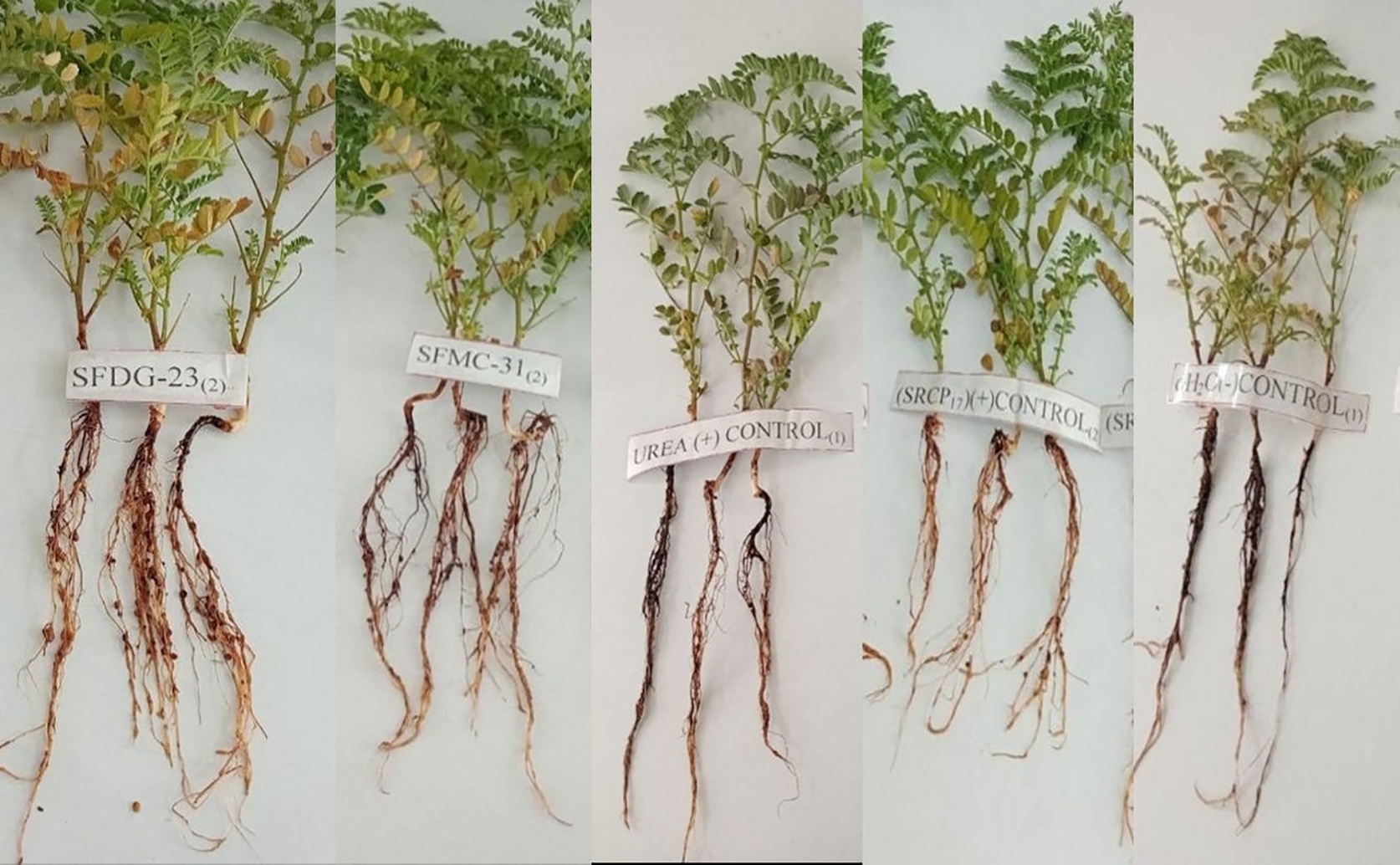
Effect of rhizobia on the growth of chickpea by pot assay.

Image adapted from: Gebre et al. / CC BY (Source)

Key Findings

  • Researchers in Woldia, Ethiopia, successfully identified native Rhizobium bacteria from chickpea plants that can significantly boost crop growth
  • These beneficial bacteria, especially strain WUSFDG-23, greatly improved chickpea seed germination, root development, and overall plant mass, even outperforming chemical fertilizers
  • Using these local Rhizobium strains offers a natural, eco-friendly way to increase chickpea yields and reduce the need for synthetic fertilizers in agriculture
Feeding a growing global population sustainably is one of humanity's most pressing challenges. A key part of this challenge involves ensuring plants receive enough nitrogen, an essential nutrient for their growth. While synthetic nitrogen fertilizers have boosted food production, their overuse can harm soil health and the environment. A natural alternative is Biological Nitrogen Fixation (BNF), a process where certain microorganisms convert atmospheric nitrogen into a form plants can use. In fact, more than 60% of the Earth's fixed nitrogen comes from BNF[2]. Optimizing this natural process in agriculture is increasingly urgent to meet food demands without compromising the planet. Legume crops like chickpeas are vital in this regard because they form a special partnership with nitrogen-fixing bacteria called Rhizobium. These bacteria live in swellings on plant roots, known as root nodules, where they perform BNF, essentially providing the plant with natural fertilizer. Chickpea is a crucial crop worldwide, valued for its nutritional content and its contribution to soil fertility through this process. However, despite its importance, chickpea yields often fall short in many regions, including Ethiopia, largely due to poor soil fertility and the insufficient use of effective Rhizobium inoculants. Bio-inoculants are preparations of beneficial microorganisms applied to seeds or soil to enhance plant growth. To address this, a recent study conducted by researchers from Woldia University and Universiti Putra Malaysia (UPM)[1] focused on finding and evaluating native Rhizobium strains from chickpea root nodules in the Woldia region of Ethiopia. The goal was to identify strains that could effectively promote chickpea growth and reduce the need for chemical fertilizers. The researchers collected root nodules from healthy, robust chickpea plants in the field. From these nodules, they isolated a total of 41 different bacterial strains. After initial tests, 12 of these were identified as likely Rhizobium based on their growth characteristics. These isolates were then further examined for their physical appearance (morphology) and chemical properties (biochemical characteristics). From this group, five particularly promising isolates were chosen for a more rigorous test in a controlled greenhouse environment. In this 45-day experiment, chickpea seeds were inoculated, meaning they were treated with these selected Rhizobium isolates, and their growth was compared to untreated control plants. The results were significant: inoculation with these native Rhizobium strains markedly improved seed germination and the early growth of seedlings. The effectiveness of these symbiotic relationships, where both the plant and the bacteria benefit, varied among the isolates, ranging from 74.3% to 121.9%. Notably, three isolates—WUSFDG-23, WUSFMC-31, and WUSFMC-23—showed high effectiveness. Isolate WUSFDG-23 was particularly impressive, leading to a significant increase in the number and size of root nodules and overall plant mass, known as biomass accumulation. This demonstrates the potential of these native Rhizobium isolates, especially WUSFDG-23, to serve as effective bio-inoculants for sustainable chickpea production. This research directly contributes to the urgent need for optimizing BNF in agriculture by identifying efficient nitrogen-fixing microorganisms as biofertilizers, as highlighted in earlier discussions on BNF[2]. The study's approach of isolating native strains aligns with the understanding that a good knowledge of the diversity of nitrogen-fixing microorganisms is crucial for selecting and formulating effective biofertilizers[2]. These native strains are likely well-adapted to local soil and environmental conditions, which is a key consideration for the successful application of plant growth-promoting rhizobacteria (PGPR) in the field. Rhizobium are a type of PGPR, and their ability to colonize the plant root zone (rhizosphere) and thrive under specific environmental conditions are critical factors for their success[3]. The effectiveness of the isolates found in this study suggests they possess these competitive traits, making them suitable candidates for bio-inoculants. However, the path to sustainable agriculture is not without challenges. While studies like this one focus on harnessing beneficial microbes, other common agricultural practices can undermine their effectiveness. For instance, the widely used herbicide glyphosate, employed for weed control, has been shown to negatively impact soil fertility by harming nitrogen-fixing Rhizobium populations[4]. A study on Rhizobium isolated from grass pea plants found that glyphosate significantly inhibited their growth, with the effect varying depending on the concentration and the specific Rhizobium isolate[4]. This means that even if highly effective native Rhizobium bio-inoculants are developed, their benefits could be reduced if farmers continue to use herbicides like glyphosate without considering their impact on these vital soil microbes. This underscores the need for integrated agricultural strategies that not only promote the use of beneficial microorganisms but also consider the broader implications of chemical inputs on soil health and microbial communities. The variability in Rhizobium sensitivity to glyphosate[4] also suggests that future research might need to identify native strains that are not only effective nitrogen fixers but also more resilient to common agricultural chemicals, further enhancing the goal of sustainable chickpea production. Ultimately, the findings from Woldia University and Universiti Putra Malaysia (UPM) offer a promising natural solution to boost chickpea yields and reduce reliance on synthetic fertilizers. By identifying and utilizing effective native Rhizobium strains, this research takes a concrete step towards more sustainable and environmentally friendly agricultural practices, while also highlighting the complex interplay between beneficial microbes and other farming inputs.

AgricultureBiochemPlant Science

References

Main Study

1) Isolation, biochemical characterization, and greenhouse authentication of chickpea (Cicer arietinum L.) rhizobia collected from some major chickpea growing areas of Woldia, North Wollo, Ethiopia

Published 14th August, 2025

Journal: PLOS One

Issue: Vol. 20, Iss. 8


Related Studies

2) Exploiting Biological Nitrogen Fixation: A Route Towards a Sustainable Agriculture.

https://doi.org/10.3390/plants9081011


3) Rhizosphere Colonization Determinants by Plant Growth-Promoting Rhizobacteria (PGPR).

https://doi.org/10.3390/biology10060475


4) Effect of glyphosate on the growth and survival of rhizobia isolated from root nodules of grass pea (Lathyrus sativus L.).

https://doi.org/10.1038/s41598-023-48424-7


Related Articles

An unhandled error has occurred. Reload 🗙