Disease Guide for Houseplants: A Complete Resource for Identifying Plant Issues

Greg Howard
16th January, 2025

Disease Guide for Houseplants: A Complete Resource for Identifying Plant Issues

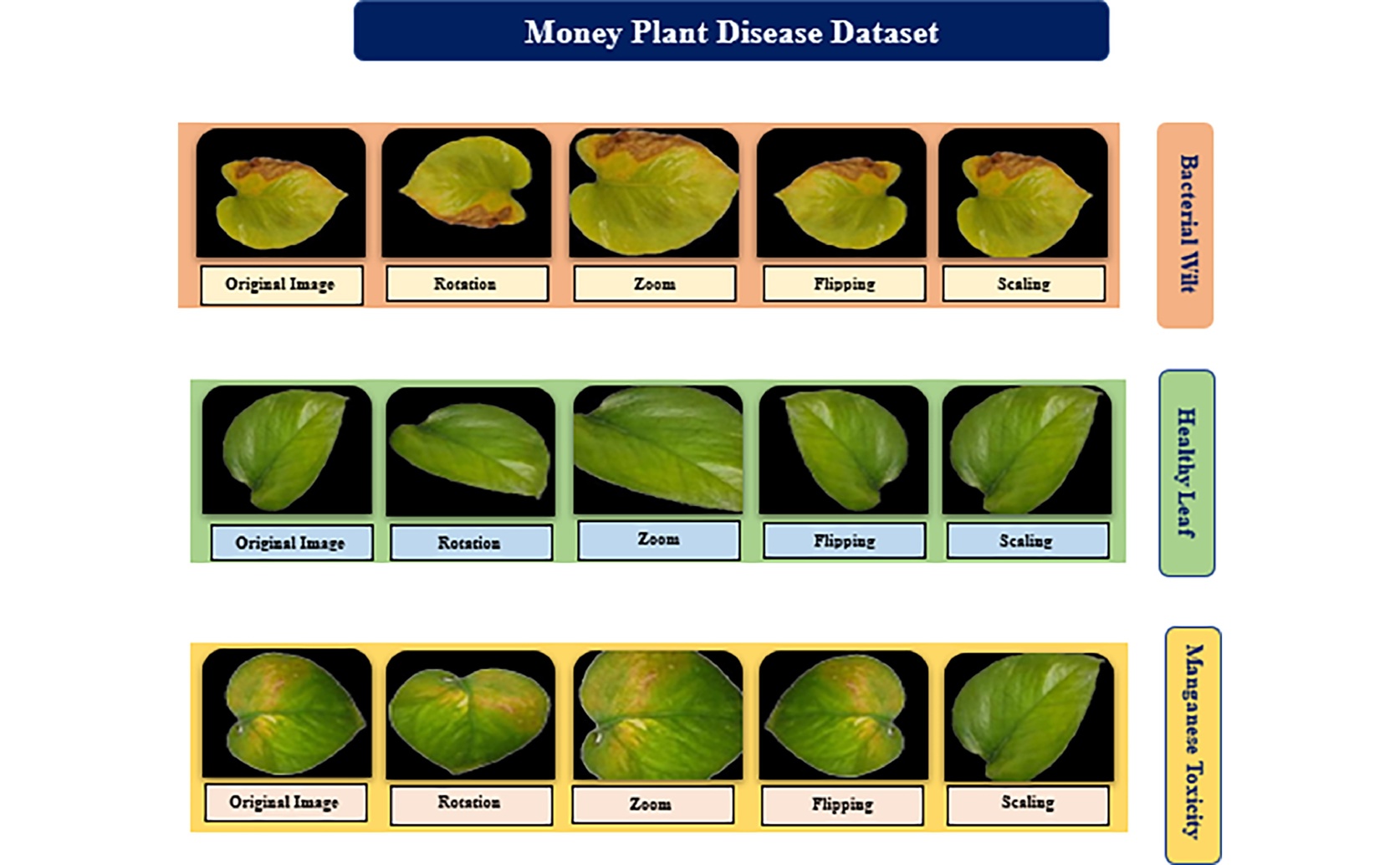
Transforming raw images of the Money Plant (Epipremnum aureum) through a crucial pre-processing pipeline of labeling, resizing, noise removal, and segmentation created the standardized, high-quality dataset essential for successful model-based disease classification.

Image adapted from: Biswas et al. / CC BY (Source)

Key Findings

  • Researchers at Daffodil International University developed a new method using image processing to diagnose diseases in Money Plants
  • The study focused on identifying bacterial wilt and manganese poisoning in Money Plants using high-resolution images
  • This non-invasive technique, which employs deep learning, offers a more accurate and efficient way to monitor plant health compared to traditional methods
The Epipremnum aureum, commonly known as the Money Plant, is a popular houseplant appreciated for its heart-shaped leaves, durability, and air cleaning abilities. Despite their hardiness, these plants are susceptible to various diseases that can affect their appearance and health. Recent research conducted by Daffodil International University aims to address this by utilizing image processing to diagnose diseases in Money Plants more accurately[1]. The study focuses on bacterial wilt and manganese poisoning, alongside healthy leaves, to provide a comprehensive overview of prevalent issues affecting Money Plants. By employing a dataset of 224 × 224 pixel images, the researchers aim to enhance support in ornamental horticulture practices. The dataset is intended to serve as a foundation for deep learning approaches in ornamental agriculture, offering valuable insights for researchers studying the cultivation of Money Plants. One of the critical challenges in agriculture is the early detection and accurate diagnosis of plant stress and diseases. Traditional methods for monitoring plant health, such as metabolomics and qualitative techniques like fluorescence and thermography, come with their limitations. Metabolomics, while sensitive, is disruptive and prevents follow-up studies, whereas qualitative methods, though non-disruptive, lack accuracy[2]. The new study builds on these findings by leveraging image processing, a non-disruptive method that can provide accurate disease diagnosis. The research utilizes deep learning, a subset of artificial intelligence that mimics the human brain's neural networks to process data and make decisions. By training algorithms on the dataset of Money Plant images, the system can learn to identify signs of bacterial wilt and manganese poisoning. This method offers a non-invasive way to monitor plant health, aligning with the need for real-time and precise monitoring as highlighted in previous studies[3]. Wearable electrodes for real-time monitoring of leaf capacitance have shown promise in providing precise physiological information without damaging the plants[3]. Similarly, the use of image processing in the current study offers a non-intrusive means to diagnose plant diseases, ensuring the plants remain undisturbed while still receiving accurate health assessments. The study's findings underscore the potential of image processing in advancing ornamental horticulture. By providing a reliable dataset and deep learning framework, the research paves the way for more accurate and efficient plant disease diagnosis. This approach not only benefits researchers but also has practical applications for hobbyists and professionals in ornamental horticulture, enabling them to maintain healthier and more attractive plants. In conclusion, the research conducted by Daffodil International University demonstrates the significant potential of image processing in diagnosing diseases in Money Plants. By leveraging a dataset of high-resolution images and deep learning techniques, the study offers a non-invasive, accurate method for plant health monitoring. This innovative approach builds on previous findings and provides a valuable tool for the future of ornamental horticulture.

AgricultureBiochemPlant Science

References

Main Study

1) Money plant disease atlas: A comprehensive dataset for disease classification in ornamental horticulture.

Published 15th January, 2025

https://doi.org/10.1016/j.dib.2024.111216


Related Studies

2) Past and Future of Plant Stress Detection: An Overview From Remote Sensing to Positron Emission Tomography.

https://doi.org/10.3389/fpls.2020.609155


3) A wearable and capacitive sensor for leaf moisture status monitoring.

https://doi.org/10.1016/j.bios.2023.115804


Related Articles

An unhandled error has occurred. Reload 🗙