How Onion Plants Respond to Different Salt Levels

Jenn Hoskins
30th October, 2024

How Onion Plants Respond to Different Salt Levels

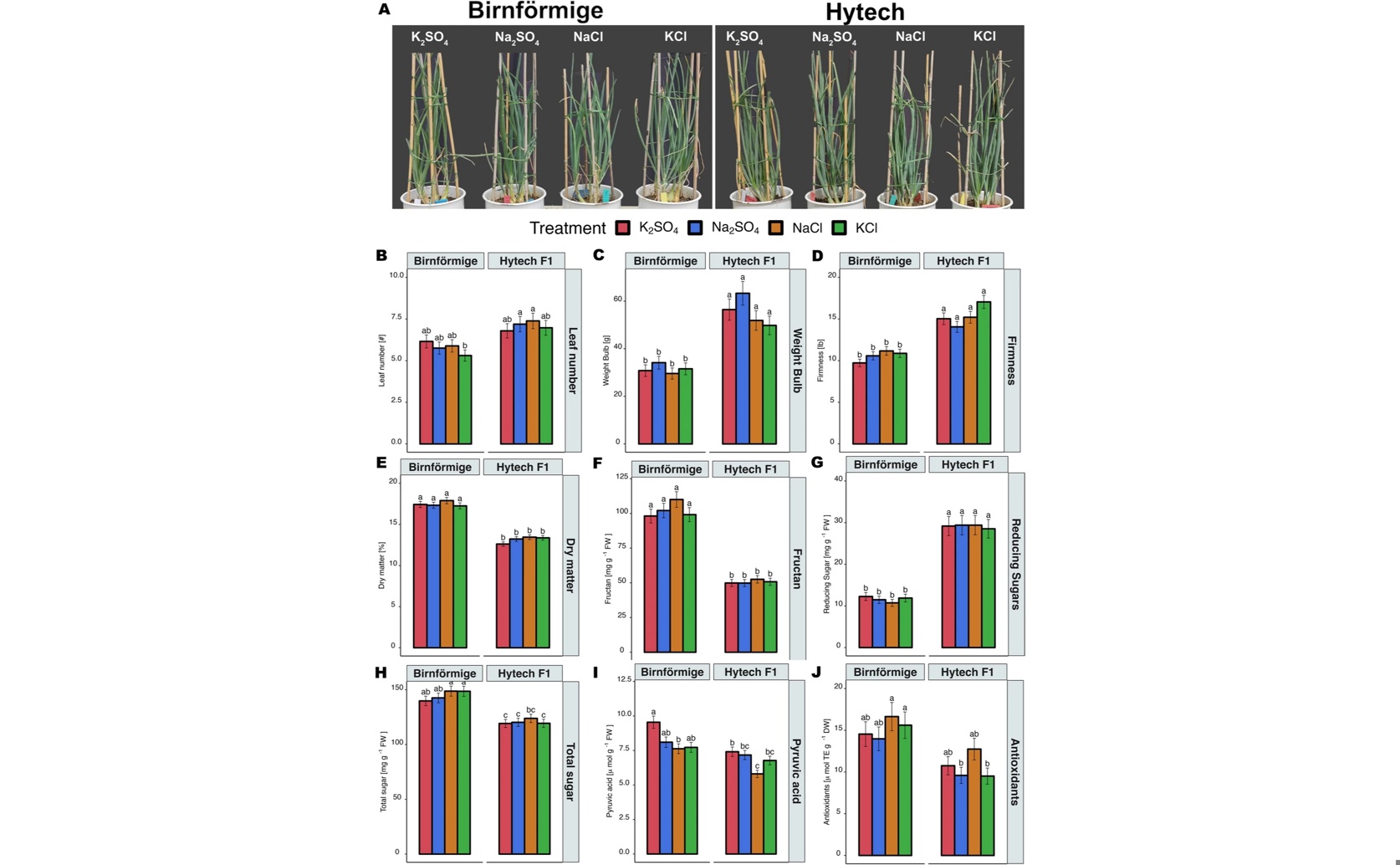
The various salt treatments successfully induced an early, non-toxic stress response in onion (Allium cepa L.) plants, which showed no significant changes in physical health or major quality parameters (a–h) but did exhibit a slight decrease in pungency (i) and an increase in antioxidant activity (j).

Image adapted from: Romo-Pérez et al. / CC BY (Source)

Key Findings

  • The study from the University of Hohenheim examined how sodium (Na+) and chloride (Cl-) salts affect onion metabolism
  • Chloride (Cl-) had a more significant impact on onion metabolic profiles than sodium (Na+)
  • The onion variety Birnförmige managed Na+/K+ balance better and had a milder response to Cl- compared to the hybrid Hytech
Salinity poses a significant threat to crop production, particularly for salt-sensitive species like onions (Allium cepa L.). Addressing this challenge is crucial for securing agricultural yields in the face of global warming and population growth. While much of the research has focused on sodium (Na+) toxicity, a recent study from the University of Hohenheim[1] has shed light on the equally important role of chloride (Cl-) accumulation in salinity stress. The study investigated the early metabolic responses of two onion varieties, Birnförmige and Hytech, to different sodium and chloride salts. The objective was to understand how these ions affect onion metabolism without causing toxicity. This research is particularly relevant given the findings of earlier studies that emphasized the need to consider both Na+ and Cl- in salinity research[2][3]. The results revealed that Cl- had a more pronounced impact on the metabolic profiles of onions compared to Na+. This is consistent with previous findings that highlighted the underestimated role of Cl- toxicity in plant growth and yield reductions under salinity stress[3]. Onions initially adapt to salinity by altering their organic acid concentrations, which are vital for energy production and stress responses. Specifically, significant changes were observed in organic acids involved in the TCA cycle, such as fumaric acid and succinic acid, in both onion varieties. Interestingly, the landrace Birnförmige exhibited a more effective regulation of its Na+/K+ balance and a milder response to Cl- compared to the hybrid Hytech. This aligns with earlier research that identified the importance of ion regulation in salinity tolerance[4]. Additionally, the study found a variety-specific increase in ethanolamine in Birnförmige and lysine in Hytech in response to Cl- accumulation. These metabolic alterations were analyzed using advanced techniques, providing a detailed understanding of the specific responses in leaves and bulbs to Cl- accumulation. The findings from the University of Hohenheim underscore the importance of considering both Na+ and Cl- when assessing plant responses to salinity. This comprehensive study offers new insights into onion ion regulation and stress adaptation during the initial stages of salinity exposure. By highlighting the substantial impact of Cl- accumulation, the research challenges the traditional focus on Na+ toxicity and calls for a more holistic approach to salinity stress research. In conclusion, this study not only expands our understanding of onion adaptation to salinity but also emphasizes the need to consider both Na+ and Cl- in future research. By integrating these findings with earlier studies, we can develop more effective strategies to enhance crop resilience to salinity, ultimately securing agricultural yields in a changing climate.

AgricultureBiochemPlant Science

References

Main Study

1) The tale of two Ions Na+ and Cl-: unraveling onion plant responses to varying salt treatments.

Published 29th October, 2024

https://doi.org/10.1186/s12870-024-05719-9


Related Studies

2) Salinity and crop yield.

https://doi.org/10.1111/plb.12884


3) High concentrations of Na+ and Cl- ions in soil solution have simultaneous detrimental effects on growth of faba bean under salinity stress.

https://doi.org/10.1093/jxb/erq251


4) Sodium transport in plants: a critical review.

https://doi.org/10.1111/j.1469-8137.2010.03540.x


Related Articles

An unhandled error has occurred. Reload 🗙