Calcium-Rich Algae Extract Eases Salt Stress in Young Papaya Plants

Jenn Hoskins
26th September, 2024

Calcium-Rich Algae Extract Eases Salt Stress in Young Papaya Plants

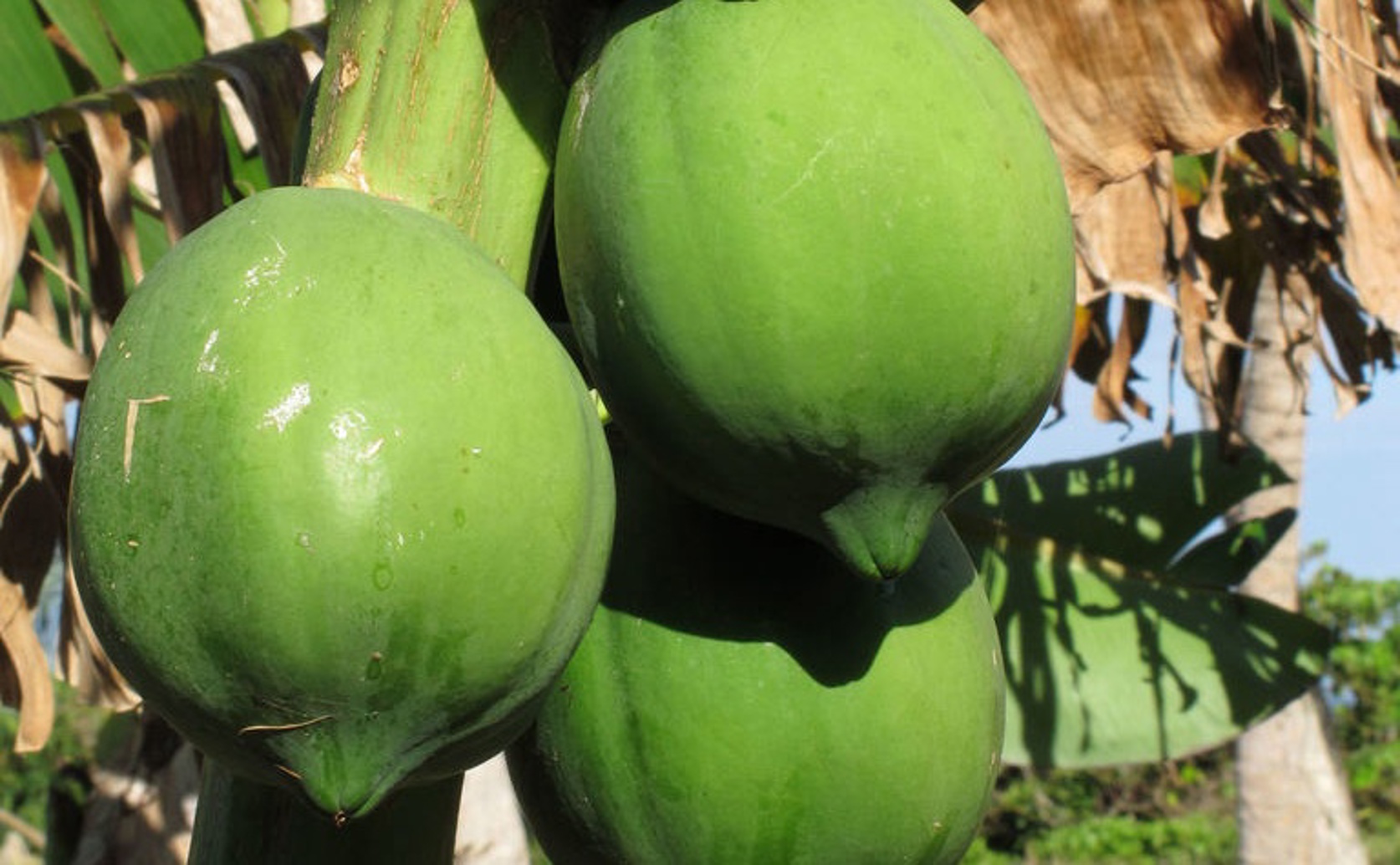
Papaya (Carica papaya)

Photo adapted from: John Barkla / CC BY (Source)

Key Findings

  • Researchers from the Universidade Federal da Paraíba found that calcium-enriched microalgae extract (EMa-Ca) significantly improves the growth of papaya seedlings under saline stress
  • EMa-Ca increased plant height by 6.05% and trunk diameter by 6.33%, even under high salinity conditions
  • EMa-Ca also enhanced net photosynthesis, CO2 concentration, transpiration, and stomatal conductance by up to 42.85%, improving overall plant health
Salinity in irrigation water poses a significant challenge to agriculture, particularly in tropical and subtropical regions where papaya (Carica papaya L.) is a major fruit crop. High salinity can impair plant growth and physiological functions, leading to reduced crop yields. Researchers from the Universidade Federal da Paraíba (UFPB) conducted a study to evaluate the effectiveness of calcium-enriched microalgae extract (EMa-Ca) in mitigating the effects of saline stress on Formosa papaya seedlings, hybrid Tainung[1]. The study was designed to investigate how different levels of salinity in irrigation water, combined with the presence or absence of EMa-Ca in the substrate, affect the growth and physiological parameters of papaya seedlings. The experiment included five levels of electrical conductivity of irrigation water (0.50, 1.10, 2.50, 3.90, and 4.50 dSm-1) and assessed plant height, number of leaves, stem diameter, leaf area, and dry mass of roots and aboveground parts. Additionally, gas exchanges and chlorophyll indices (a, b, and total) were evaluated. The findings revealed that the application of EMa-Ca significantly improved various growth parameters. Specifically, EMa-Ca increased plant height by 6.05% and trunk diameter by 6.33%. The number of leaves decreased with increasing salinity, and leaf area was reduced by 33% at higher salinity levels. In the absence of EMa-Ca, all seedling dry masses showed more significant declines. Moreover, EMa-Ca enhanced net photosynthesis, CO2 concentration, transpiration, and stomatal conductance by 39.13%, 30.43%, 38.88%, and 42.85%, respectively. Chlorophyll indices also showed a decrease without EMa-Ca, with reductions of 1.21%, 0.41%, and 1.62% for Chla, Chlb, and Chlt, respectively. These results align with earlier studies that have demonstrated the potential of microalgae species as bio-fertilizers to improve plant growth under stress conditions. For instance, the application of Chlorella vulgaris, Nannochloropsis salina, and Enterobacter cloacae has been shown to enhance the growth and yield of Moringa oleifera in saline environments[2]. This suggests that microalgae extracts can be effective in mitigating the adverse effects of salinity on various plant species. Salinity affects plant physiology by impairing germination, growth, photosynthesis, and nutrient uptake, leading to osmotic and ionic stress[3]. Plants respond to salinity by modulating various physiological and biochemical traits, including the production of phytohormones and metabolites that help mitigate these stresses. The use of EMa-Ca in the current study appears to enhance these natural plant responses, thereby improving growth and physiological functions under saline conditions. The study's methodology involved a controlled experiment in a protected environment, allowing for precise manipulation of salinity levels and the application of EMa-Ca. By evaluating a range of growth and physiological parameters, the researchers were able to comprehensively assess the impact of EMa-Ca on papaya seedlings. The significant improvements observed in plant height, trunk diameter, gas exchanges, and chlorophyll indices indicate that EMa-Ca can be an effective tool for enhancing papaya growth under saline stress. In conclusion, the application of calcium-enriched microalgae extract (EMa-Ca) significantly enhances the vegetative development, gas exchanges, and chlorophyll indices of papaya seedlings under saline stress conditions. This study, conducted by researchers from the Universidade Federal da Paraíba (UFPB), provides valuable insights into the potential of microalgae extracts as a sustainable solution to mitigate the adverse effects of salinity on crop production. These findings build on previous research demonstrating the benefits of microalgae species in enhancing plant growth under stress conditions[2][3].

AgricultureBiochemPlant Science

References

Main Study

1) Effect of calcium-enriched microalgae extract on mitigating saline stress in papaya seedlings.

Published 25th September, 2024

https://doi.org/10.1590/1519-6984.283432


Related Studies

2) Evaluation of the effects of Chlorella vulgaris, Nannochloropsis salina, and Enterobacter cloacae on growth, yield and active compound compositions of Moringa oleifera under salinity stress.

https://doi.org/10.1016/j.sjbs.2020.12.007


3) Salinity induced physiological and biochemical changes in plants: An omic approach towards salt stress tolerance.

https://doi.org/10.1016/j.plaphy.2020.08.042


Related Articles

An unhandled error has occurred. Reload 🗙