How Clay and Guar Gum Mixtures Change With Repeated Wetting and Drying

Jim Crocker
21st September, 2025

How Clay and Guar Gum Mixtures Change With Repeated Wetting and Drying

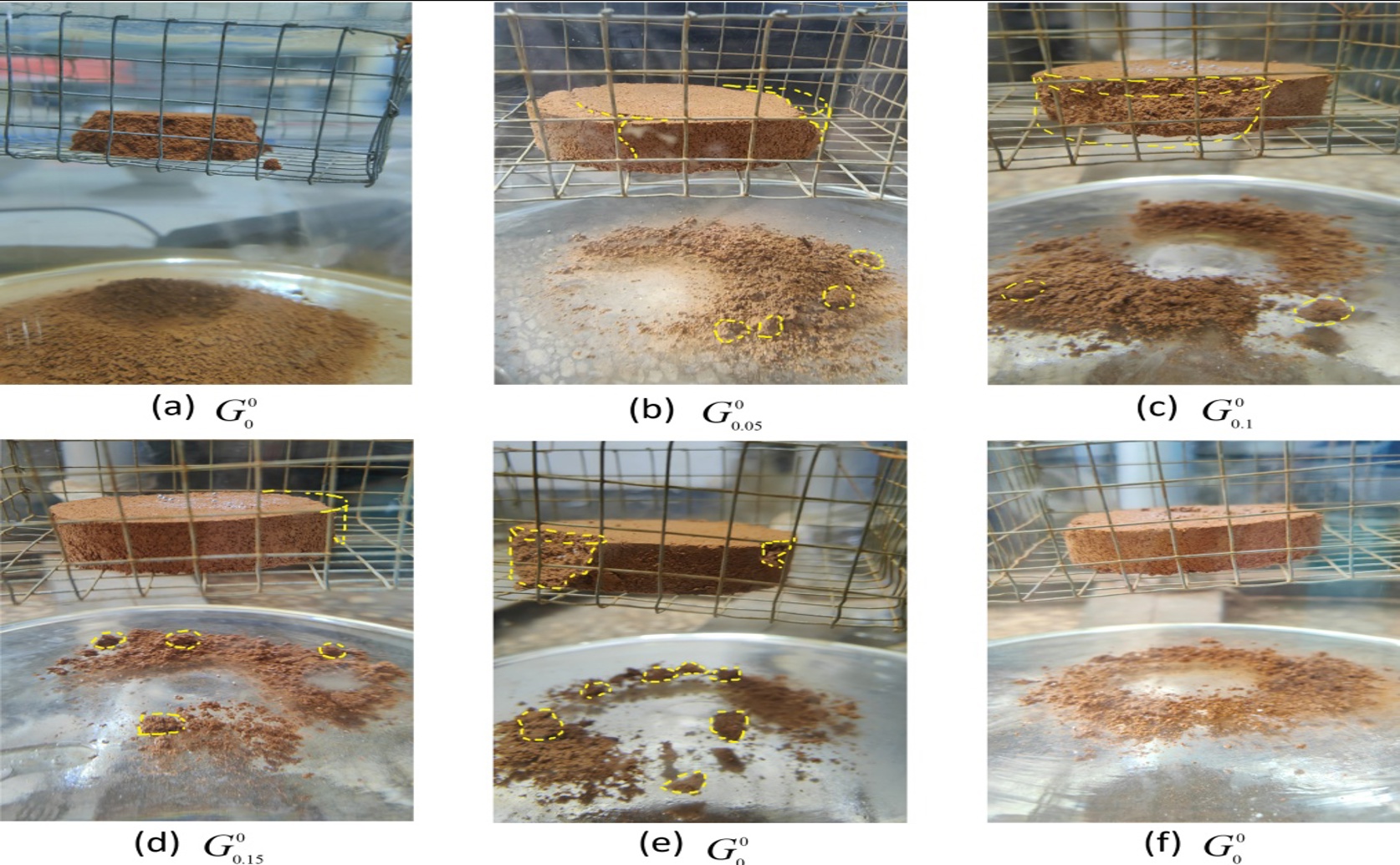
The disintegration tests demonstrate that increasing Guar Gum dosage (a–f) effectively mitigates the severe structural collapse and turbidity seen in untreated red clay, resulting in maintained structural integrity and clearer water at higher concentrations.

Image adapted from: Zhang et al. / CC BY (Source)

Key Findings

  • Red clay from southern China is prone to weakening with repeated drying and wetting, posing challenges for construction
  • Adding guar gum (GG) to red clay reduces its disintegration, with 0.225% being the most effective dosage for improved stability
  • GG works by filling gaps between soil particles and forming “cementing bonds” with clay minerals, strengthening the soil’s structure and resisting water damage
Guar gum (GG) is increasingly used to strengthen soils for construction and engineering projects. A significant challenge in many regions is the instability of red clay – a type of soil prone to breaking down when exposed to repeated cycles of drying and wetting. This disintegration weakens the ground, making it unsuitable for building foundations, roads, and other infrastructure. Researchers at Guangxi University of Technology, South China University of Technology, Fucheng Oil Sand Resources Development, Shenzhen University, Guilin University of Aerospace Technology, and Jazan University College of Engineering[1] investigated whether GG could improve the stability of red clay and how it achieves this, with the aim of making it more viable for engineering applications. The study focused on testing red clay mixed with varying amounts of GG – 0.05%, 0.1%, 0.15%, 0.2%, and 0.25% – and observing how these mixtures behaved under dry and wet conditions. The core idea was to understand if GG could prevent the clay from falling apart when repeatedly exposed to moisture changes. The researchers found that adding GG initially reduced the clay’s disintegration, but this effect plateaued after a certain amount of GG was added. The most effective dosage was determined to be 0.225%. Crucially, red clay treated with GG disintegrated at a slower rate over multiple drying and wetting cycles compared to untreated clay. This suggests GG provides a lasting improvement to the soil’s stability, even with prolonged exposure to the elements. To understand how GG works, the team examined the clay at both a macroscopic (visible) and microscopic level. Macroscopically, they observed that GG enhanced the soil particles, improved their grading (distribution of sizes), and filled gaps between them. Microscopically, they found that GG formed “cementing bonds” with the kaolinite – a common mineral in clay – strengthening the overall structure. This observation aligns with earlier research showing that GG can act as a binding agent in soil mixtures[2][3]. The formation of these bonds is thought to be due to GG’s unique chemical properties. It’s a polysaccharide, a complex sugar molecule, that can interact with soil particles and create a network that holds them together. This is similar to how nano-cement improves soil properties by forming calcium silicate hydrate (C-S-H) gel, filling pores and bonding particles[2]. The study’s findings demonstrate GG’s ability to enhance both the strength and stability of red clay, making it a promising alternative to traditional soil stabilization methods. Interestingly, the study also builds upon work demonstrating the potential of biopolymers like guar gum for environmentally friendly soil stabilization[3]. While guar gum treatment can increase the cost of pavement construction[3], the long-term stability benefits observed in suggest it could be a worthwhile investment, reducing the need for frequent repairs and replacements. Furthermore, research into guar gum blends has shown its effectiveness in removing pollutants like lead from soil[4], potentially adding another layer of benefit to its use in construction projects. The work by the research team at Guangxi University of Technology and collaborating institutions provides valuable insight into the anti-disintegration behavior of red clay and establishes a solid theoretical basis for using GG to improve soil engineering performance in regions where red clay is prevalent.

AgricultureBiochemPlant Science

References

Main Study

1) Disintegration behavior and improvement mechanism of guar gum modified red clay in dry and wet cycle

Published 18th September, 2025

https://doi.org/10.1371/journal.pone.0332742


Related Studies

2) Nano soil improvement technique using cement.

https://doi.org/10.1038/s41598-023-37918-z


3) Effect of Guar Gum Content on the Mechanical Properties of Laterite Soil for Subgrade Soil Application.

https://doi.org/10.3390/polym16152202


4) Understanding the microstructure, mineralogical and adsorption characteristics of guar gum blended soil as a liner material.

https://doi.org/10.1007/s10661-021-09644-4


Related Articles

An unhandled error has occurred. Reload 🗙