
Underwater photos help map artificial reefs for growing seaweed beds
Greg Howard
4th March, 2026


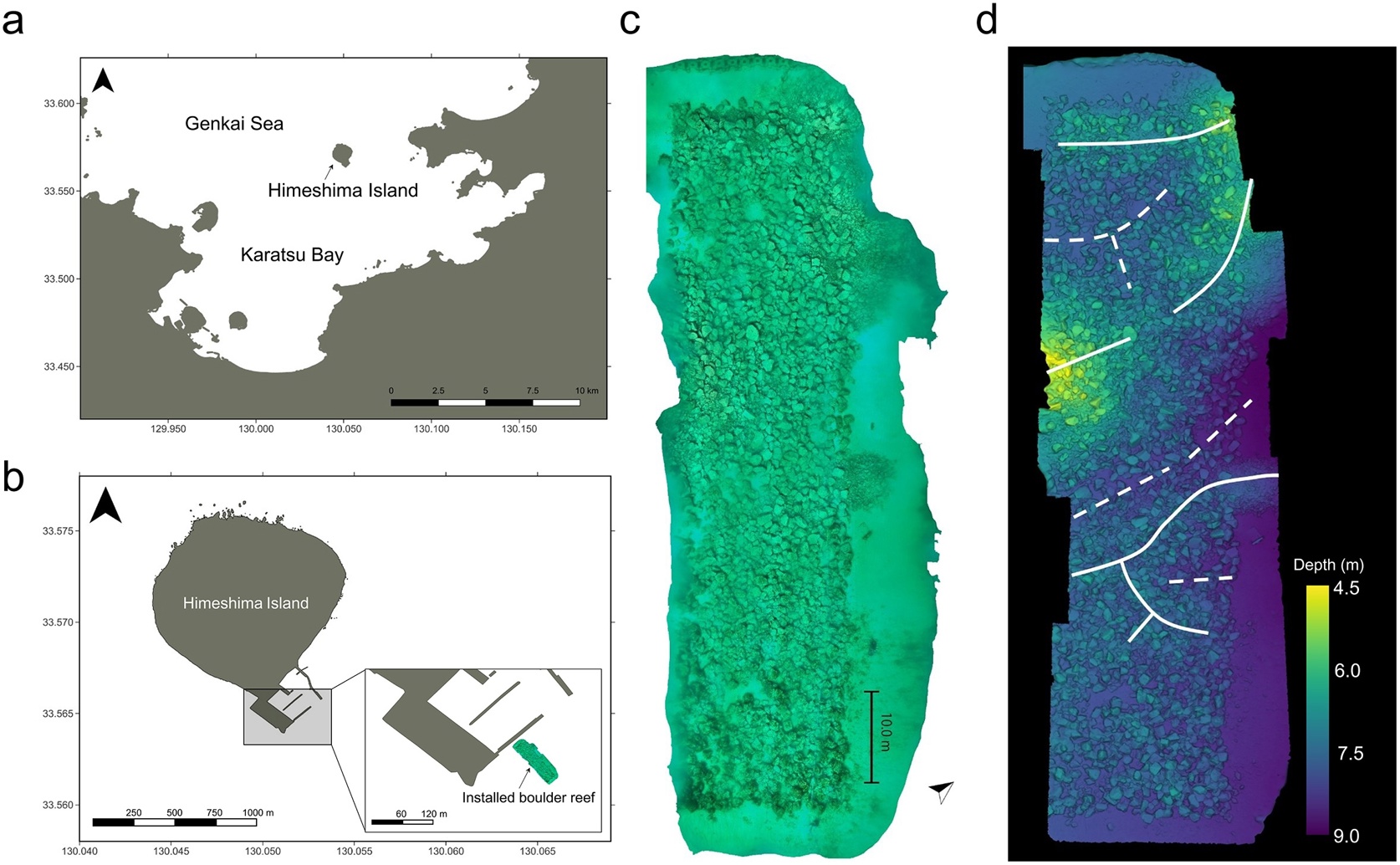
The study site at Himeshima Island, Japan (a, b) is an artificial reef where boulders were placed across a varied seascape of sandy bottoms and natural cobble/boulder ridges (c, d), allowing for a direct comparison of which bottom type is more suitable for restoring macroalgal beds.
Key Findings
- This study, off Himeshima Island, Japan, mapped seafloor vegetation to find ideal locations for restoring macroalgal beds
- Macroalgal growth thrived on artificial boulders placed on sandy bottoms, supporting diverse species like Sargassum and Undaria
- Boulders on natural rocky reefs showed limited vegetation, often only short-lived seaweed, suggesting sandy bottoms are more favorable for restoration
EnvironmentEcologyMarine Biology
References
Main Study
1) Seafloor vegetation map of man-made boulders reef by underwater photogrammetry: Suggestions for site selections in macroalgal bed creations
Published 2nd March, 2026
https://doi.org/10.1371/journal.pone.0341865
Related Studies
2) Coastal urbanization leads to remarkable seaweed species loss and community shifts along the SW Atlantic.
3) Climate change and species facilitation affect the recruitment of macroalgal marine forests.
4) Reduction of herbivorous fish pressure can facilitate focal algal species forestation on artificial structures.
Related Articles
 9th November, 2025 | Greg Howard