Useful compounds from ocean bacteria show promise as anti-fouling agents

Jim Crocker
4th February, 2026

Useful compounds from ocean bacteria show promise as anti-fouling agents

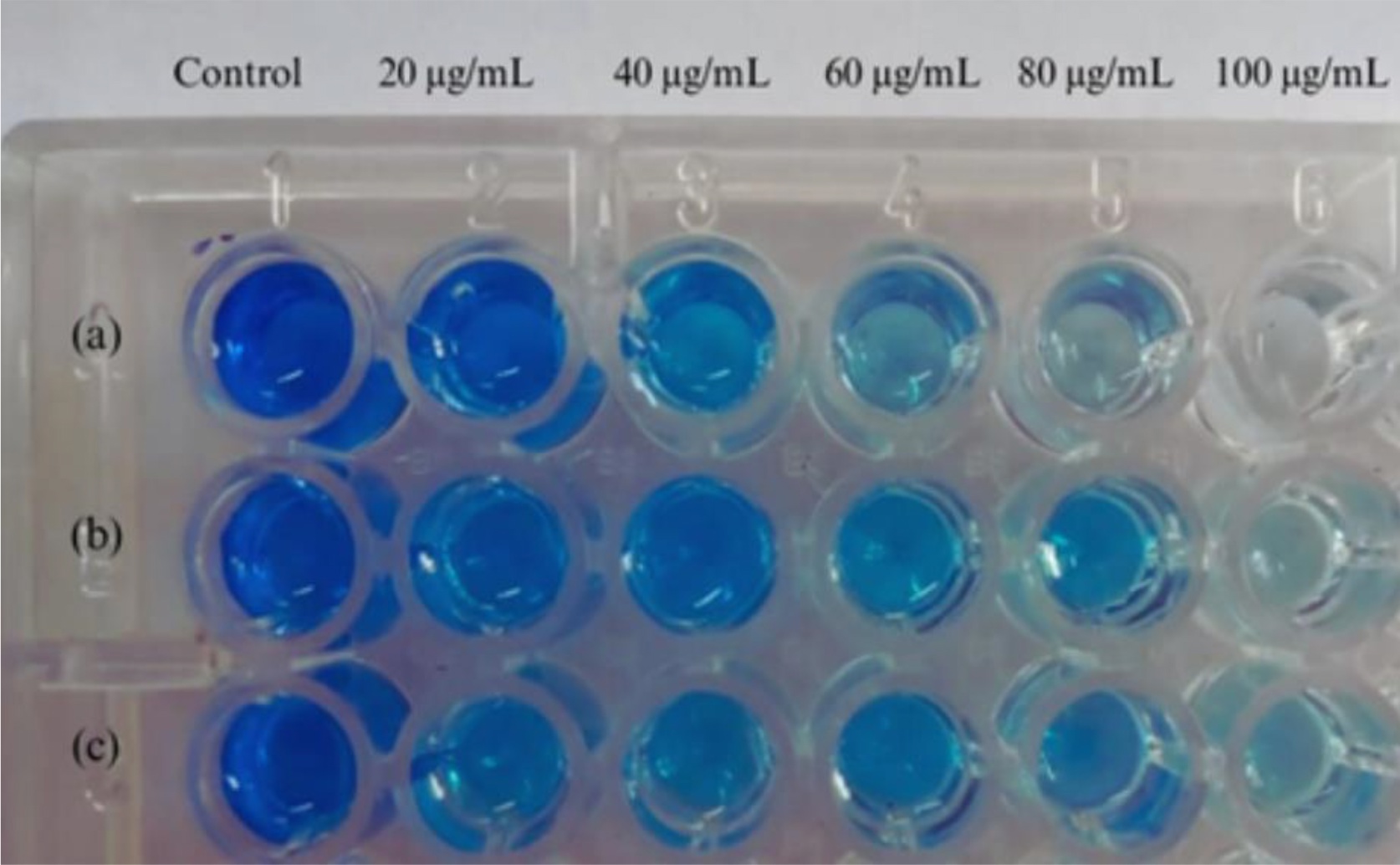
Inhibition of violacein pigment production in Chromobacterium violaceum by (a) Desferrioxamine (b) Cell Free Supernatant (c) Purified siderophore demonstrating their quorum quenching activity.

Image adapted from: Sirajudeen et al. / CC BY (Source)

Key Findings

  • Researchers isolated bacteria from the Gulf of Mannar, India, and identified Streptomyces coelicolor as a siderophore producer
  • The isolated siderophore, identified as ferrioxamine, effectively scavenges iron and inhibits the growth of both microbial pathogens and human breast cancer cells
  • Optimizing the growth medium composition using response surface methodology increased siderophore production, showing potential for scalable therapeutic use
Cancer cells require a significantly higher amount of iron to grow and multiply compared to normal cells. This increased iron demand makes iron metabolism a potential target for new cancer therapies. Disrupting iron availability could potentially slow cancer growth or even kill cancer cells, but it’s a complex area, as iron is also essential for healthy cell function[2]. Researchers at V. O. Chidambaram College, in collaboration with Friedrich Schiller University, have been investigating naturally produced molecules called siderophores, which bind to iron, as a potential strategy to combat cancer and bacterial infections. The recent study[1] focused on identifying and characterizing siderophores produced by bacteria isolated from the Gulf of Mannar, a region of the Indian Ocean. Two bacterial species were isolated, one of which was identified as Streptomyces coelicolor. This bacterium was found to produce a siderophore – a molecule designed to capture iron. Further analysis revealed this siderophore to be a trihydroxamate type, meaning it has a specific chemical structure with three hydroxamate groups that allow it to strongly bind iron with a hexadentate (six-point) connection. Techniques like FTIR (Fourier Transform Infrared Spectroscopy) and NMR (Nuclear Magnetic Resonance) spectroscopy confirmed its chemical identity as ferrioxamine. Siderophores are known for their ability to scavenge iron in environments where it’s scarce[3][4]. The Streptomyces coelicolor siderophore demonstrated this ability, inhibiting the growth of several microbial pathogens in laboratory tests. Importantly, the study also showed that the siderophore wasn’t just effective against bacteria; it also suppressed the proliferation of a human breast cancer cell line (MCF-7). This effect is thought to be due to the siderophore disrupting the iron homeostasis within the cancer cells, essentially depriving them of a vital nutrient. The researchers also observed that the siderophore was sensitive to sunlight, exhibiting a shift in its light absorption properties when exposed to it. This photoreactive nature could have implications for its use as a therapeutic agent, potentially influencing how it’s administered or stored. Beyond iron, the siderophore displayed an affinity for other heavy metals like zinc, cobalt, cadmium, lead, and magnesium, suggesting potential applications in environmental remediation as well as medicine. A key aspect of the study involved optimizing the production of the siderophore. Using a statistical approach called response surface methodology (RSM), the researchers determined the ideal composition of the growth medium (ISP2 medium) to maximize siderophore yield in a cost-effective manner. This is crucial for making the production of the siderophore scalable for potential therapeutic use. Interestingly, the study also found that the siderophore possessed quorum quenching activity. Quorum quenching refers to the ability to interfere with bacterial communication systems, which rely on signaling molecules to coordinate behavior like biofilm formation. Biofilms are communities of bacteria encased in a protective matrix, making them significantly more resistant to antibiotics. The siderophore’s ability to inhibit biofilm formation and induce the production of reactive oxygen species (ROS) – damaging molecules to cells – further enhances its potential as an antibacterial agent. These findings build upon previous research highlighting the complex role of iron in cancer biology[2]. While simply removing iron can be toxic to all cells, strategies that specifically target the iron metabolism of cancer cells, like using siderophores to disrupt iron uptake, offer a more nuanced approach. The ability of these siderophores to bind multiple metals, including those toxic to cells, expands the potential applications beyond just cancer and bacterial infections. The study’s demonstration of quorum quenching activity further adds to the versatility of this naturally produced molecule, potentially offering a multi-pronged approach to combatting bacterial pathogens.

BiotechBiochemMarine Biology

References

Main Study

1) Optimization, characterization and biological activity of siderophore produced by marine Streptomyces coelicolor

Published 2nd February, 2026

https://doi.org/10.1371/journal.pone.0341555


Related Studies

2) Altered Iron Metabolism and Impact in Cancer Biology, Metastasis, and Immunology.

https://doi.org/10.3389/fonc.2020.00476


3) Understanding the Potential and Risk of Bacterial Siderophores in Cancer.

https://doi.org/10.3389/fonc.2022.867271


4) Siderophores: Importance in bacterial pathogenesis and applications in medicine and industry.

https://doi.org/10.1016/j.micres.2021.126790


Related Articles

An unhandled error has occurred. Reload 🗙