Copper nanoparticles from thyme boost antibiotic power and fight cancer

Jenn Hoskins
14th February, 2026

Copper nanoparticles from thyme boost antibiotic power and fight cancer

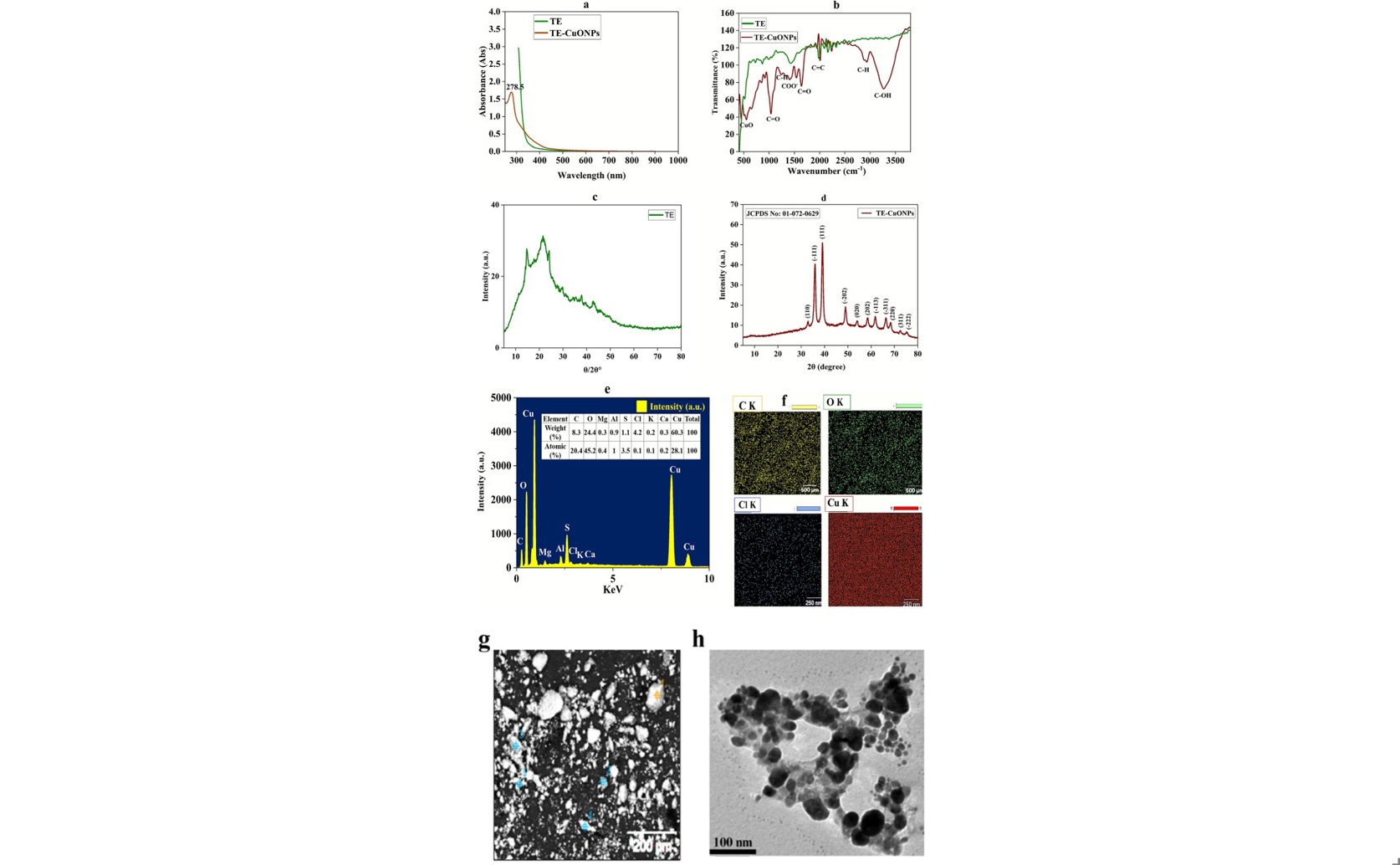
Physicochemical analysis confirms that Thymus vulgaris extract successfully mediates the green synthesis of crystalline, spherical copper oxide nanoparticles (d, h), whose phytochemical surface functionalization (b) confers high colloidal stability (l), a key property for their potent antimicrobial and anticancer activities.

Image adapted from: Abu-Hussien et al. / CC BY (Source)

Key Findings

  • Researchers developed a method using thyme extract to create copper oxide nanoparticles (CuONPs) with optimized conditions for efficient production
  • These CuONPs effectively killed several antibiotic-resistant bacteria in lab tests, showing a similar effect to the antibiotic gentamicin and potentially reducing the amount needed
  • The CuONPs also slowed the growth of breast cancer cells and triggered programmed cell death, demonstrating potential as a dual-action therapy against both infections and cancer
Antimicrobial resistance and cancer are two major global health challenges, often requiring increasingly complex and potentially toxic treatments. Researchers at Ain Shams University and the University of KwaZulu-Natal have been exploring new ways to combat both issues simultaneously, focusing on the potential of nanoparticles[1]. Their work centers on copper oxide nanoparticles (CuONPs) created using a “green” method – utilizing compounds extracted from the herb Thymus vulgaris (thyme). The core problem is the rise of bacteria that are resistant to multiple antibiotics. This resistance develops when bacteria evolve to survive exposure to drugs, making infections harder to treat. Simultaneously, cancer cells also develop resistance to chemotherapy, reducing treatment effectiveness. Finding therapies that can overcome both these hurdles is critical. The study began by identifying the key compounds within Thymus vulgaris responsible for creating the nanoparticles. Using a technique called HPLC (High-Performance Liquid Chromatography), they found that quercetin, chlorogenic acid, and gallic acid were the most abundant phytochemicals – these act as both reducing and capping agents during nanoparticle formation. These compounds help to control the size and stability of the CuONPs. Creating nanoparticles reliably is a challenge, so the researchers employed a statistical method called Box-Behnken optimization. This involved systematically varying the amount of copper acetate used and the duration of the nanoparticle synthesis process to identify the ideal conditions. The results showed that the concentration of copper acetate and the incubation time were the most important factors, ultimately producing spherical nanoparticles with a diameter of 19-25nm, and a negative surface charge which promotes stability. Techniques like TEM (Transmission Electron Microscopy), XRD (X-ray Diffraction) and FTIR (Fourier-transform Infrared Spectroscopy) were used to confirm the nanoparticles’ size, crystalline structure, and the presence of the plant-derived compounds on their surface. Once created, the CuONPs were tested for their ability to kill bacteria. They demonstrated bactericidal activity (killing bacteria) against common pathogens including Staphylococcus aureus, Pseudomonas aeruginosa, Escherichia coli, and Enterococcus faecalis, with a minimum inhibitory concentration (MIC) ranging from 250-950 μg/mL. Importantly, they also inhibited biofilm formation – a process where bacteria create a protective layer, making them more resistant to antibiotics. This is particularly relevant given that bacteria in biofilms are notoriously difficult to eradicate. Interestingly, the CuONPs showed a synergistic effect when combined with the antibiotic gentamicin. Synergy means the combined effect was greater than the sum of their individual effects, allowing for a significant reduction in the amount of antibiotic needed to achieve the same level of bacterial killing. Checkerboard assays revealed a low Fractional Inhibitory Concentration index (FICI) of 0.13-0.28, indicating strong synergy and the potential to reduce antibiotic dosage by up to eightfold. Time-kill kinetics showed the combination achieved faster bacterial eradication – a reduction of 3 logs (a thousandfold decrease) in bacterial numbers 8-12 hours quicker than either treatment alone. This is a significant advantage for treating acute infections. The study didn’t stop at antibacterial activity. The CuONPs also exhibited moderate antiproliferative activity against MCF-7 breast cancer cells (IC₅₀ = 117.26 μg/mL), meaning they slowed the growth of these cells. While not highly selective (a selectivity index of 1.85 compared to normal fibroblasts), it was a sixfold improvement over the crude plant extract alone. Further analysis using flow cytometry revealed that the CuONPs induced apoptosis – programmed cell death – in the cancer cells, with 77.25% undergoing cell death. The researchers also investigated the antioxidant properties of the CuONPs. They found they scavenged free radicals more effectively than the plant extract alone, demonstrating an IC₅₀ of 55 μg/mL. This is important as oxidative stress is implicated in both cancer development and bacterial infections. These findings build upon previous research highlighting the potential of sediments as reservoirs for antibiotic-resistant bacteria[2]. The development of new antimicrobial agents, like these CuONPs, is crucial to combatting the spread of resistance, especially considering the potential for horizontal gene transfer observed in bacterial communities. Furthermore, the green synthesis approach used in this study aligns with efforts to create sustainable and eco-friendly solutions, as demonstrated by the biosynthesis of silver nanoparticles from olive cake waste[3]. While the essential oils of Moringa oleifera, Cinnamomum verum, and Nigella sativa show promising antimicrobial synergy[4], the CuONPs offer a different, nanoparticle-based approach with potentially broader applications.

HerbsMedicineBiotech

References

Main Study

1) Box-Behnken optimized copper oxide nanoparticles from Thymus vulgaris potentiate efficacy against multidrug-resistant bacterial pathogens and exhibit anticancer activity

Published 11th February, 2026

https://doi.org/10.1186/s40643-026-01008-5


Related Studies

2) High prevalence of multiple-antibiotic-resistant (MAR) Escherichia coli in river bed sediments of the Apies River, South Africa.

https://doi.org/10.1007/s10661-015-4879-6


3) Biogenic silver nanoparticles synthesized from Pseudomonas fluorescens-mediated olive cake waste: antimicrobial, larvicidal activity against Culex pipiens and cytotoxicity assessment.

https://doi.org/10.1186/s12896-025-01011-2


4) Synergistic antimicrobial activity of essential oils mixture of Moringa oleifera, Cinnamomum verum and Nigella sativa against Staphylococcus aureus using L-optimal mixture design.

https://doi.org/10.1186/s13568-024-01797-y


Related Articles

An unhandled error has occurred. Reload 🗙