Bacteria show promise breaking down common plastic waste

Greg Howard
7th February, 2026

Bacteria show promise breaking down common plastic waste

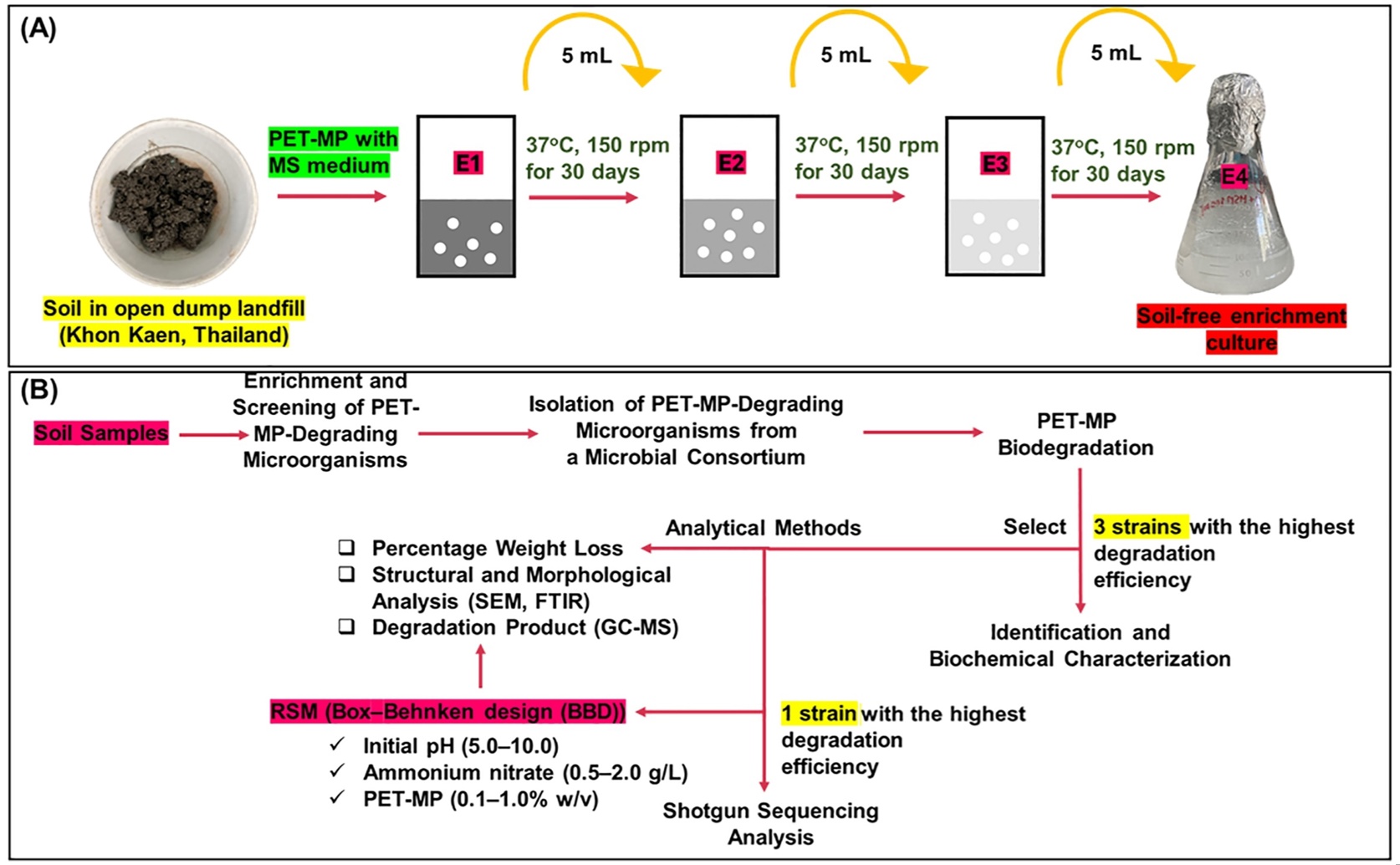
A sequential enrichment process (A) and a comprehensive experimental workflow (B) were used to isolate and characterize novel bacteria from landfill soil capable of degrading polyethylene terephthalate microplastics (PET-MP).

Image adapted from: Choonut et al. / CC BY (Source)

Key Findings

  • Researchers in Thailand isolated a bacterium, Paenibacillus naphthalenovorans PETKKU2, from landfill soil capable of breaking down PET microplastics
  • This bacterium degraded up to 9.48% of PET microplastics in 35 days under optimized conditions (pH 7.5, specific nutrient levels), using a novel enzymatic pathway
  • P. naphthalenovorans PETKKU2 breaks down PET using enzymes different from previously known PET-degrading bacteria, bypassing the typical intermediate compounds and utilizing monoacylglycerol lipases
The escalating production of plastics over the last century has led to a significant environmental problem: plastic waste accumulation[2]. While recycling efforts exist, the vast majority of plastic ends up in landfills or polluting natural ecosystems[2], with only a small fraction ever being effectively repurposed. Polyethylene terephthalate (PET), commonly used in bottles and packaging, is particularly problematic due to its slow degradation rate and potential to release harmful substances[3]. Addressing this requires innovative solutions for breaking down existing plastic waste, and specifically, microplastics—tiny fragments resulting from the breakdown of larger plastics—which pose a growing threat to both the environment and potentially human health[4]. Researchers at Khon Kaen University and Chulalongkorn University have recently identified a bacterium, Paenibacillus naphthalenovorans PETKKU2, isolated from landfill soil in Thailand, that demonstrates a remarkable ability to degrade PET microplastics (PET-MP)[1]. This discovery is significant because it represents the first known member of this bacterial species capable of this specific function. The team began by screening ten different bacterial isolates, ultimately finding PETKKU2 to be the most effective at breaking down the plastic. In initial experiments, the bacterium achieved a 6.07% weight loss of PET-MP over 35 days at a moderate temperature of 37°C. To optimize the degradation process, the researchers employed a technique called response surface methodology. This involved systematically adjusting factors like pH (acidity/alkalinity), nitrogen concentration (essential for bacterial growth), and the amount of PET-MP present. Through this process, they were able to significantly enhance degradation, reaching 9.48% weight loss – a 96% improvement compared to the initial, unoptimized conditions. This level of degradation was closely predicted by their modelling, indicating a well-understood and controllable process. A crucial aspect of this study was identifying how the bacterium breaks down the PET. Previous research has focused on enzymes like PETase and MHETase, which work in a specific, well-defined pathway to dismantle PET[3]. However, the researchers found no evidence of these enzymes in P. naphthalenovorans PETKKU2. Instead, they used a combination of analytical techniques – Fourier Transform Infrared Spectrophotometry (FTIR), Scanning Electron Microscopy (SEM), and Gas Chromatography-Mass Spectrometry (GC-MS) – to reveal a different mechanism. FTIR showed a substantial reduction in ester carbonyl groups, indicative of polymer oxidation, while SEM imaging demonstrated visible erosion of the PET-MP surface. The absence of intermediate breakdown products like mono(2-hydroxyethyl) terephthalate (MHET) further confirmed this alternative pathway. Whole genome sequencing revealed the presence of genes coding for thermostable lipases, carboxylesterases, and dioxygenases, suggesting these enzymes are responsible for the degradation. The discovery of this alternative degradation mechanism is important because it expands our understanding of how microbes can tackle plastic waste. Furthermore, P. naphthalenovorans PETKKU2 operates effectively at mesophilic temperatures (37°C), meaning it doesn’t require the high energy input associated with thermophilic (heat-loving) bacteria previously used in plastic degradation studies. The performance of this bacterium is comparable to those thermophilic degraders, offering a more sustainable solution. The accumulation of plastics, as highlighted in earlier studies[2], necessitates solutions beyond current recycling methods, and the ability to degrade plastic at lower temperatures is a significant advantage. The findings from provide a promising platform for developing bioremediation strategies, potentially offering a way to eliminate PET-MP from contaminated sites without the environmental costs associated with energy-intensive processes.

EnvironmentBiotechGenetics

References

Main Study

1) Biodegradation of polyethylene terephthalate microplastics by Paenibacillus naphthalenovorans PETKKU2: Response surface optimization and genomic evidence for an alternative degradation mechanism

Published 4th February, 2026

https://doi.org/10.1371/journal.pone.0341623


Related Studies

2) Production, use, and fate of all plastics ever made.

https://doi.org/10.1126/sciadv.1700782


3) In vivo degradation of polyethylene terephthalate using microbial isolates from plastic polluted environment.

https://doi.org/10.1016/j.chemosphere.2022.136757


4) Potential Health Impact of Microplastics: A Review of Environmental Distribution, Human Exposure, and Toxic Effects.

https://doi.org/10.1021/envhealth.3c00052


Related Articles

An unhandled error has occurred. Reload 🗙