Shrimp genes reveal clues to better starch digestion

Jim Crocker
16th January, 2026

Shrimp genes reveal clues to better starch digestion

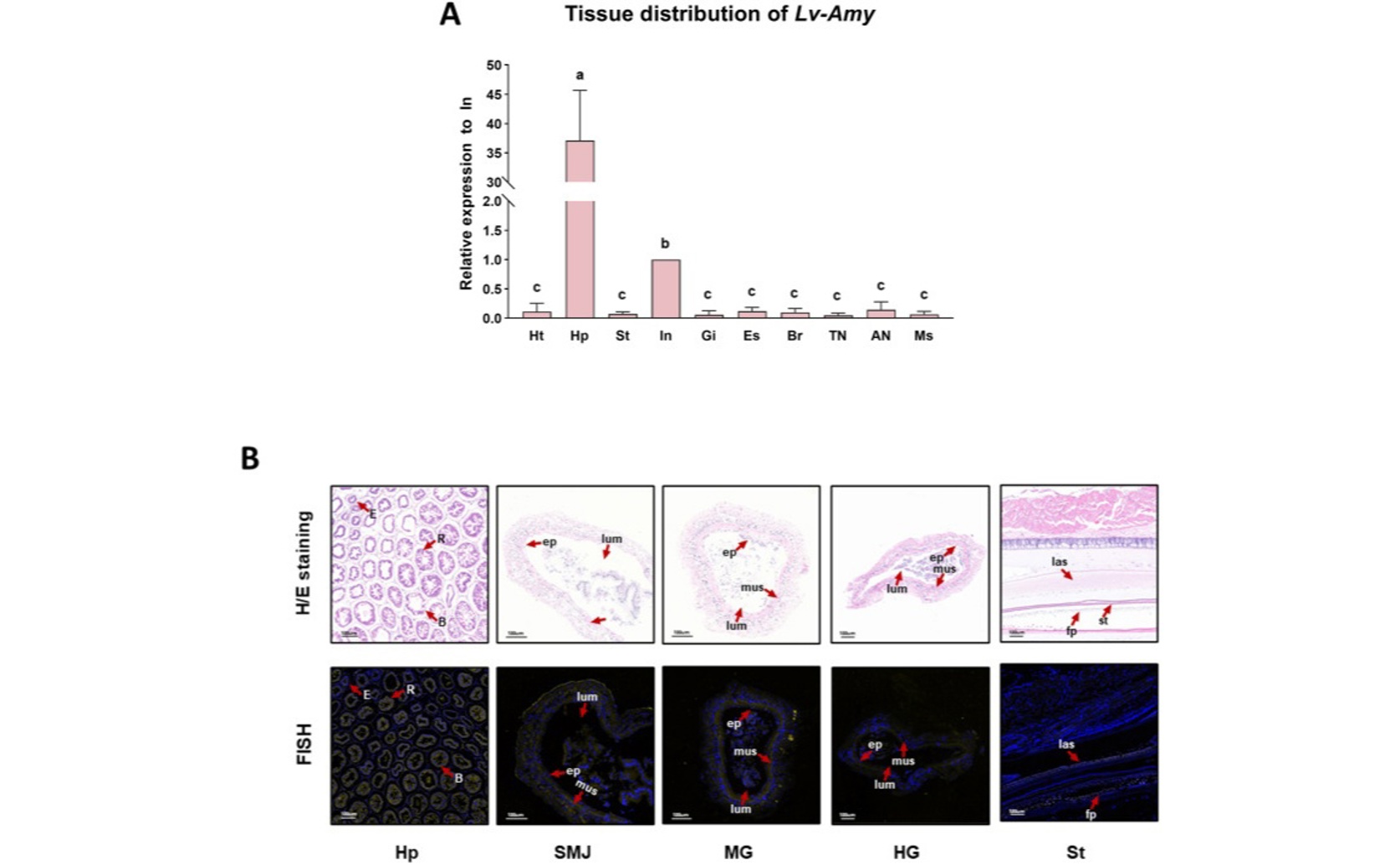
Quantitative (a) and spatial (b) analyses confirm that the key digestive enzyme gene Lv-Amy is overwhelmingly expressed in the hepatopancreas of the Pacific white shrimp (Litopenaeus vannamei), underscoring this organ's central role in carbohydrate digestion.

Image adapted from: Liang et al. / CC BY (Source)

Key Findings

  • In Pacific white shrimp (Litopenaeus vannamei), researchers identified six alpha-amylase genes, with one gene (Lv-Amy) showing particularly high activity
  • Lv-Amy is most active in the shrimp’s hepatopancreas, a key organ for digestion, and its activity increases during periods of high energy needs like growth and molting
  • Recombinant Lv-Amy functions best at a pH of 7.5 and 25°C, conditions typical of the shrimp’s tropical marine habitat, indicating it’s well-suited to its environment
Alpha-amylase is an enzyme crucial for breaking down carbohydrates, a fundamental process for energy acquisition in animals. Despite its importance, detailed understanding of its function and molecular properties has been lacking in many commercially significant species. This is particularly true for the Pacific white shrimp, Litopenaeus vannamei, a cornerstone of the aquaculture industry. Understanding the specifics of alpha-amylase in this shrimp species could lead to improved feeding strategies and more efficient shrimp farming practices.[1] Researchers at the Chinese Academy of Sciences recently undertook a study to address this knowledge gap. The study began with a broad examination of the alpha-amylase gene family across various arthropods, revealing that this family has expanded considerably, especially within crustaceans – the group that includes shrimp. This expansion suggests a strong evolutionary pressure related to carbohydrate metabolism in these animals. The research team identified six distinct alpha-amylase (Amy) genes within the L. vannamei genome. Importantly, despite the multiple genes, they found that the core regions responsible for the enzyme's catalytic activity – its ability to break down starch – remained remarkably consistent across these genes. To understand when and where these genes are active, the researchers investigated their expression patterns throughout the shrimp's life cycle and in different tissues. They discovered that the hepatopancreas, an organ analogous to both the liver and pancreas in mammals, exhibited the highest levels of Amy gene activity. This finding aligns with the known role of the hepatopancreas as the primary site of digestion and nutrient absorption in shrimp. Furthermore, they observed a significant increase in Amy gene expression during periods of high energy demand, specifically during the zoeal (larval) feeding stage and just before molting – a process where the shrimp sheds its shell to grow. Among the six identified genes, Lv-Amy (XP_027225605.1) stood out, displaying the most prominent expression pattern. Further analysis using quantitative real-time PCR (qPCR) – a method to precisely measure gene expression levels – and fluorescence in situ hybridization (FISH) – a technique to visualize gene activity within cells – confirmed Lv-Amy’s widespread presence in the hepatopancreas and provided insights into its cellular localization. The structure of Lv-Amy was also investigated. The enzyme possesses a characteristic (β/α)₈ TIM barrel conformation, a common structural motif found in many alpha-amylases[2]. The researchers also identified two conserved calcium-binding sites, which are known to be important for the enzyme’s stability and function. To fully characterize Lv-Amy, the researchers produced the protein in a laboratory setting using E. coli bacteria, a common technique for generating large quantities of proteins for study. They then measured the enzyme’s activity under different conditions. The results showed that Lv-Amy functions optimally at a pH of 7.5 and a temperature of 25°C. However, it remained relatively active across a broader range of pH (7.0–8.0) and temperature (20–45°C), suggesting it can effectively function under the variable environmental conditions typical of the tropical marine habitats where L. vannamei thrives. Interestingly, this research builds upon earlier work detailing the diversity of alpha-amylases across insects[3]. While insect amylases exhibit variations in optimal pH – with some preferring acidic conditions, others neutral, and still others alkaline – the L. vannamei Lv-Amy displays a neutral to slightly alkaline preference, consistent with the marine environment. The study also echoes the finding that amylase genes are often present in multiple copies within a species[3], allowing for tissue-specific regulation and adaptation to different dietary needs. The multiple copies observed in L. vannamei likely contribute to its ability to efficiently digest a variety of carbohydrate sources. The conserved catalytic domains identified in Lv-Amy and its other gene family members are consistent with the general understanding of alpha-amylases as members of the GH-H glycoside hydrolase family[2], further solidifying its role in carbohydrate metabolism.

BiotechGeneticsAnimal Science

References

Main Study

1) Genome-wide identification and functional characterization of alpha-amylase genes in Litopenaeus vannamei

Published 13th January, 2026

https://doi.org/10.1371/journal.pone.0338707


Related Studies

2) α-Amylase: an enzyme specificity found in various families of glycoside hydrolases.

https://doi.org/10.1007/s00018-013-1388-z


3) The Amylases of Insects.

https://doi.org/10.1177/1179543318804783


Related Articles

An unhandled error has occurred. Reload 🗙