New tools help researchers study wild rock hyrax behavior

Jim Crocker
25th February, 2026

New tools help researchers study wild rock hyrax behavior

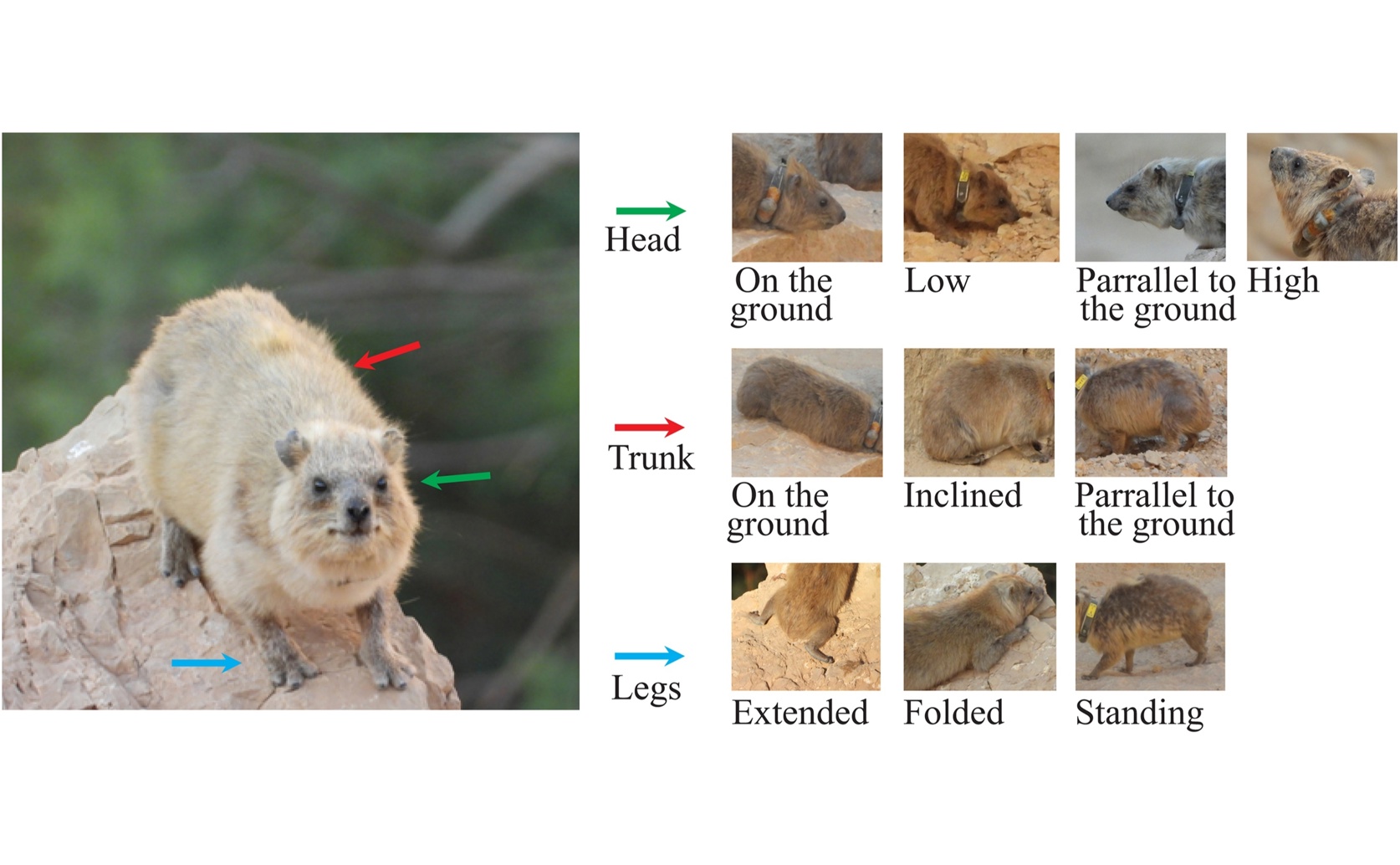
A standardized ethogram for the rock hyrax (Procavia capensis) was developed by defining all behaviours as combinations of specific, objective positions for the head, trunk, and legs.

Image adapted from: Brotier et al. / CC BY (Source)

Key Findings

  • Researchers created a detailed behavioral inventory, called an ethogram, for rock hyraxes in Israel, a species lacking standardized behavior definitions
  • The study identified 42 distinct hyrax behaviors, grouped into six categories—affiliative, foraging, agonistic, social, mating, and vocalizations—using statistical analysis to ensure objectivity
  • Seasonal patterns of hyrax behavior observed in 2024 matched previous research, confirming the ethogram accurately reflects real-world hyrax activities and validating its usefulness
Animal behaviour is a complex field, and drawing reliable conclusions requires consistent methods for observing and categorizing what animals do. Without standardized approaches, comparing results from different studies becomes difficult, hindering our understanding of animal life. Researchers at Bar Ilan University and Tel Aviv University recently addressed this issue with the rock hyrax (Procavia capensis), a small, social mammal found in Africa and the Middle East[1]. Despite being a frequently studied species, a universally accepted method for classifying hyrax behaviours didn’t exist. The study aimed to create a detailed and objective “ethogram” for the rock hyrax. An ethogram is essentially a comprehensive inventory of an animal’s behaviours, providing a framework for researchers to consistently record and analyze actions. This is crucial, as[2] highlights the importance of careful delineation of research questions, objectives, and hypotheses, alongside the identification of dependent and independent variables – all of which rely on a clear understanding of the behaviours being measured. To build this ethogram, the researchers observed four groups of rock hyrax. They used a method called “focal animal sampling”, which involves focusing on individual animals for set periods and recording everything they do. This method, as seen in other behavioral studies[3], helps minimize bias and ensures thorough documentation. The team then categorized these observed behaviours based on two key principles: the level of detail in the description and the overall function of the behaviour. Through this process, they identified 42 distinct behaviours. These were then grouped into six broader categories based on the context in which they occurred – essentially, what the hyrax was doing and why. To ensure these categories weren’t arbitrary, the researchers employed statistical techniques like correspondence analysis, multidimensional unfolding, and cluster analysis. These methods verified that the groupings accurately reflected the relationships between the observed behaviours. But simply creating a list of behaviours isn’t enough. The researchers also needed to confirm that their ethogram accurately represented real-world hyrax behaviour. They did this by comparing the seasonal patterns of behaviour they observed with findings from previous studies of the same species. This “biological validation” step is essential for ensuring the ethogram’s usefulness and reliability. The resulting ethogram, with its six validated categories, provides a standardized framework for future hyrax research. This means researchers can now more confidently compare findings across different locations and studies, leading to a more comprehensive understanding of hyrax social life, communication, and adaptation. This study builds upon the growing need for consistent terminology in behavioral research, as emphasized by the development of the Zebrafish Behavior Catalog[4], which aims to improve interpretation of findings and facilitate cross-species modeling. The approach used in this study isn’t limited to hyraxes. The researchers believe their methodology could be applied to other species, promoting greater consistency and comparability in animal behaviour research across a wider range of taxa. The PAE coding system[3] provides a similar framework for categorizing behaviours, and the principles used in this hyrax study could complement such systems, offering a robust method for developing standardized ethograms.

WildlifeEcologyAnimal Science

References

Main Study

1) Developing objective tools to study rock hyrax (Procavia capensis) behaviour in the field

Published 23rd February, 2026

https://doi.org/10.1371/journal.pone.0343302


Related Studies

2) Design and execution of animal behavior research: an overview.

Journal: Journal of animal science, Issue: Vol 65, Issue 5, Nov 1987


3) Ethogram of the Chinese Giant Salamander during the Breeding Period Based on the PAE Coding System.

https://doi.org/10.3390/ani13233632


4) Towards a comprehensive catalog of zebrafish behavior 1.0 and beyond.

https://doi.org/10.1089/zeb.2012.0861


Related Articles

An unhandled error has occurred. Reload 🗙