Radar system accurately tracks small, free-flying bats

Jenn Hoskins
24th November, 2025

Radar system accurately tracks small, free-flying bats

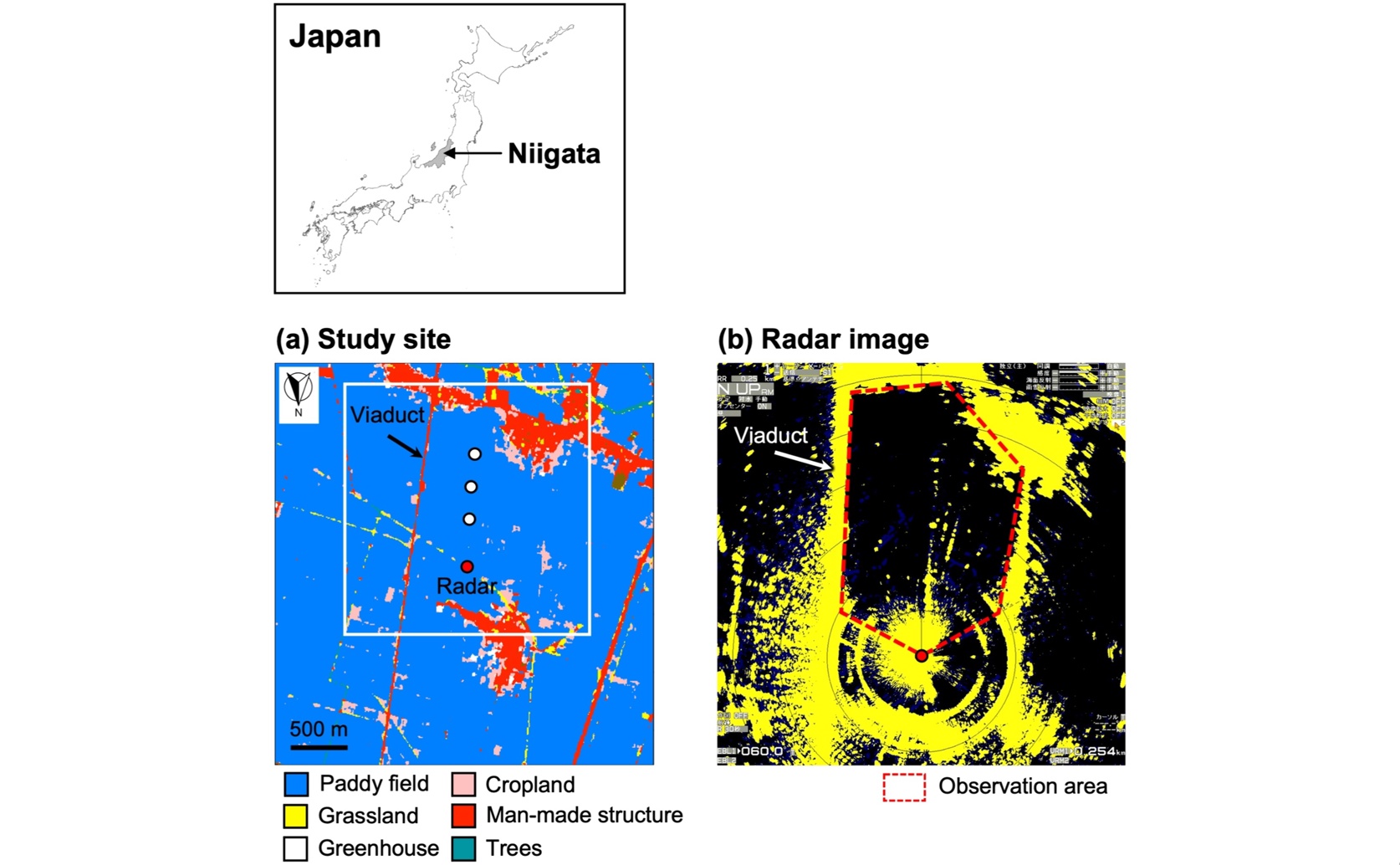
Study site in Niigata, Japan, with the radar observation area (red polygon) positioned to detect Vespertilio sinensis bats emerging from roosts along the nearby viaduct.

Image adapted from: Sato et al. / CC BY (Source)

Key Findings

  • This study, conducted in Niigata, Japan, confirmed marine radar can detect Asian particolored bats up to 1 kilometer away with over 70% reliability
  • Lowering the radar antenna from 2.2 to 0.4 meters significantly reduced ground clutter, increasing the visible area by 2.1 times and improving bat detection
  • Matching radar data with ornithodolite tracking confirmed the radar’s ability to accurately identify bat flights, showing distance slightly reduces detection probability
Wind farms offer a source of renewable energy, but pose a growing threat to bat populations globally. Understanding how bats interact with these structures is crucial for developing effective conservation strategies. Traditional methods for monitoring bat activity, such as acoustic detectors, have limitations in the area they can cover[2][3]. This restricts the ability to fully assess bat movements around wind turbines. Researchers at Tokushima University, Niigata University, and Whale Wave Technology Inc. have been investigating the potential of marine radar systems to overcome these limitations, and to provide a more comprehensive picture of bat flight paths. The study focused on validating the use of commercially available X-band marine radar for detecting Asian particolored bats (Vespertilio sinensis). Marine radar, originally designed for detecting ships and other objects at sea, has the advantage of being able to monitor large areas[2]. However, its effectiveness for detecting relatively small objects like bats hadn’t been thoroughly tested. The research[1] addressed this gap by directly comparing radar detections with independently tracked bat flights. A key challenge with radar is ‘ground clutter’ – unwanted signals reflected from the ground, trees, and other objects. To minimize this interference, the researchers adjusted the height of the radar antenna, finding that lowering it from 2.2 meters to 0.4 meters significantly improved the clarity of radar images, increasing the visible area by a factor of 2.1 across the 1.5 kilometer range. This adjustment allowed for better identification of potential bat targets. To confirm that radar detections actually corresponded to bats, the team used an ornithodolite – a specialized telescope used for tracking moving objects – to simultaneously track bats in flight. This provided ‘ground truth’ data, allowing researchers to directly link radar echoes to known bat trajectories. By manually matching radar signals with ornithodolite tracks, they successfully identified 25 radar tracks as representing actual bat flights. Statistical analysis of these identified tracks revealed that the radar system could reliably detect bats at distances of up to 1 kilometer, with a detection probability exceeding 70%. This demonstrates the potential of marine radar to monitor bat movements over a substantial area, far exceeding the range of typical acoustic detectors[3]. This research builds on earlier work highlighting the increasing mortality of bats at wind turbines[4][5]. Previous studies identified collisions with wind turbines as a leading cause of bat deaths, alongside threats like white-nose syndrome. Understanding how bats approach and interact with turbines is vital for developing mitigation strategies. The ability to track bat movements over larger areas, as offered by radar technology, is a significant step forward in this effort. The findings also complement research into bat behaviour around turbines, suggesting bats may be attracted to air currents similar to those found near trees[5]. The radar data could help to determine if this behaviour contributes to collisions. The study’s findings suggest that X-band marine radar is a viable tool for monitoring bat activity around wind farms, and provides valuable information for establishing optimal radar settings for future surveys. This improved monitoring capability will be essential for assessing the impact of wind energy development on bat populations and for implementing effective conservation measures.

WildlifeEcologyAnimal Science

References

Main Study

1) Detection performance of an X-band marine radar system for free-flying Asian particolored bats (Vespertilio sinensis)

Published 20th November, 2025

https://doi.org/10.1371/journal.pone.0337422


Related Studies

2) Analytical volume model for optimized spatial radar bat detection in onshore wind parks.

https://doi.org/10.1371/journal.pone.0239911


3) Detection and validation of common noctule bats (Nyctalus noctula) with a pulse radar and acoustic monitoring in the proximity of an onshore wind turbine.

https://doi.org/10.1371/journal.pone.0299153


4) Multiple mortality events in bats: a global review.

https://doi.org/10.1111/mam.12064


5) Behavior of bats at wind turbines.

https://doi.org/10.1073/pnas.1406672111


Related Articles

An unhandled error has occurred. Reload 🗙