
Parasitic mites transmit a lethal bacterium to honey bees
Jim Crocker
24th October, 2025


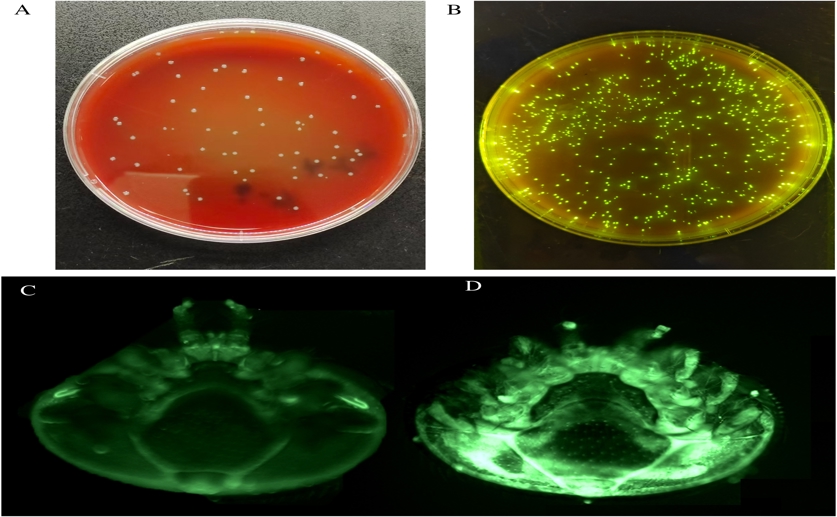
To trace the path of a deadly infection in bees, scientists engineered the M. morganii bacterium (A) to glow green (B), revealing that while mites on healthy bees remain dark (C), those feeding on infected bees light up (D) as they acquire the lethal pathogen.
Key Findings
- Researchers identified a new bacterium, Morganella morganii, within Varroa mites collected from honey bee colonies in Jiangxi, China
- Morganella morganii is highly lethal to bees, causing over 30% mortality in both pupae and adults in lab tests
- Varroa mites are the primary vector for Morganella morganii, efficiently transmitting it between bees with a 92.1% bee-to-mite and 68.49% mite-to-bee transmission rate
References
Main Study
1) Pathogenicity and transmission of Morganella morganii in honey bees
Published 22nd October, 2025
https://doi.org/10.1371/journal.ppat.1013613
Related Studies
2) First large-scale study reveals important losses of managed honey bee and stingless bee colonies in Latin America.
3) Annual Fluctuations in Winter Colony Losses of Apis mellifera L. Are Predicted by Honey Flow Dynamics of the Preceding Year.
4) Varroa destructor feeds primarily on honey bee fat body tissue and not hemolymph.
Related Articles
 1st June, 2025 | Jim Crocker