How feather structure differs between two types of merganser ducks

Jenn Hoskins
29th January, 2026

How feather structure differs between two types of merganser ducks

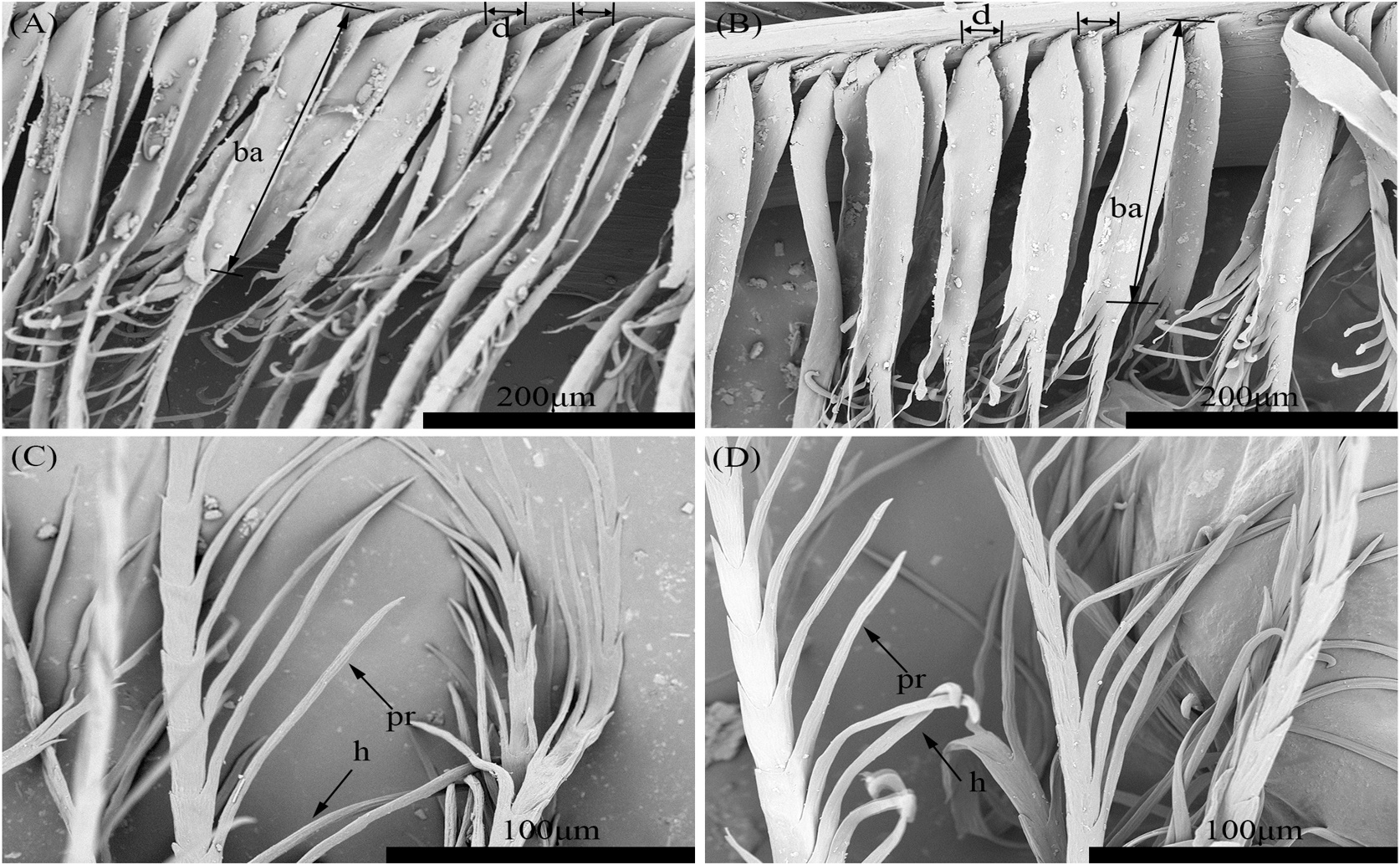
Scanning electron microscopy of rectrices revealed significant microstructural differences, specifically in prong length and hooklet number, between the Scaly-sided Merganser (Mergus squamatus) (A, C) and Common Merganser (Mergus merganser) (B, D), identifying these traits as key discriminators for species classification.

Image adapted from: Li et al. / CC BY (Source)

Key Findings

  • This study, conducted in China, examined feather structures of Scaly-sided and Common Mergansers to aid species identification
  • Rectrice feather characteristics, like hooklet number and prong length, accurately classified 91.3% of feathers to the correct species
  • Down feather barbule length, node number, and distance between nodes perfectly distinguished between the two merganser species with 100% accuracy
Identifying bird species can often be challenging, particularly when relying solely on visual characteristics like plumage color and pattern. This is especially true for species with similar appearances, demanding more precise methods for accurate differentiation. Researchers at Jilin Normal University and Anhui Polytechnic University recently undertook a study[1] to investigate whether microscopic feather structures could provide a more reliable means of distinguishing between the Scaly-sided Merganser ( Mergus squamatus ) and the Common Merganser ( Mergus merganser ). The core of the study involved detailed examination of three feather types – contour feathers (the visible outer feathers), rectrices (tail feathers), and down feathers (the soft feathers providing insulation) – from both merganser species. The researchers employed scanning electron microscopy, a technique that allows for incredibly high-resolution imaging of surface structures, to identify and measure subtle differences in feather morphology. The analysis revealed significant variations between the two species across all three feather types. In rectrices, differences were found in the length of the ‘prongs’ (small projections extending from the barbules), the length of the barbule base, the number of ‘hooklets’ (tiny structures that interlock to create a cohesive feather vane), and the overall number of prongs. Down feathers showed variations in the number of ‘nodes’ (knots along the barbule), the distance between these nodes, the width of the sections between nodes (‘internodes’), and the overall length of the barbules. These observed differences were then tested for their ability to accurately classify feathers as belonging to either species. A statistical method called stepwise discriminant analysis was used, which identifies the most important characteristics for separating the groups. This was validated using a ‘leave-one-out’ cross-validation test, ensuring the results weren’t simply due to chance. The results were promising. Contour feather characteristics, including base length, allowed for correct classification in 56.9% of cases. Rectrice characteristics, specifically hooklet number and prong length, proved more effective, achieving a 91.3% classification rate. However, the most striking results came from the analysis of down feathers. The barbule length, node number, and distance between nodes consistently and perfectly (100% accuracy) distinguished between the two merganser species. This study builds on previous research highlighting the importance of feather microstructure for species identification[2][3]. For example, investigations into the Jungle Crow ( Corvus macrorhynchos ) have shown that subtle differences in the arrangement of melanin granules and barbule structure correlate with gender[2]. While the Jungle Crow study focused on intraspecies variation (differences within a single species), the current research demonstrates interspecies variation (differences between species) can be equally informative. Furthermore, the observation of differing barbule structures between the Jungle Crow and the Black-billed Magpie ( Pica pica sericea )[3] reinforces the idea that even closely related species can exhibit distinct feather microstructures. The findings of suggest that down feather morphology, in particular, could be a powerful tool for distinguishing between the Scaly-sided and Common Merganser. This is especially valuable given the endangered status of the Scaly-sided Merganser[4]. Accurate species identification is crucial for conservation efforts, and the ability to differentiate between these two merganser species based on microscopic feather characteristics offers a reliable and relatively non-invasive method for monitoring populations and tracking their distribution. The study also echoes findings regarding the adaptation of down feather structure to different habitats[5], suggesting that these microscopic differences may reflect underlying ecological adaptations.

WildlifeEcologyAnimal Science

References

Main Study

1) Differences between Scaly-sided Merganser (Mergus squamatus) and Common Merganser (M. merganser) feather microstructure

Published 27th January, 2026

https://doi.org/10.1371/journal.pone.0319144


Related Studies

2) Microstructure of the feather in Japanese Jungle Crows (Corvus macrorhynchos) with distinguishing gender differences.

https://doi.org/10.1007/s12565-009-0022-5


3) Feather microstructure of the black-billed magpie (Pica pica sericea) and jungle crow (Corvus macrorhynchos).

Journal: The Journal of veterinary medical science, Issue: Vol 72, Issue 8, Aug 2010


4) Genetic diversity and shallow genetic differentiation of the endangered scaly-sided merganser Mergus squamatus.

https://doi.org/10.1002/ece3.70011


5) Down feather morphology reflects adaptation to habitat and thermal conditions across the avian phylogeny.

https://doi.org/10.1111/evo.14075


Related Articles

An unhandled error has occurred. Reload 🗙