Jun Protein Needed for Optic Nerve Regrowth in Young Fish

Greg Howard
13th March, 2025

Jun Protein Needed for Optic Nerve Regrowth in Young Fish

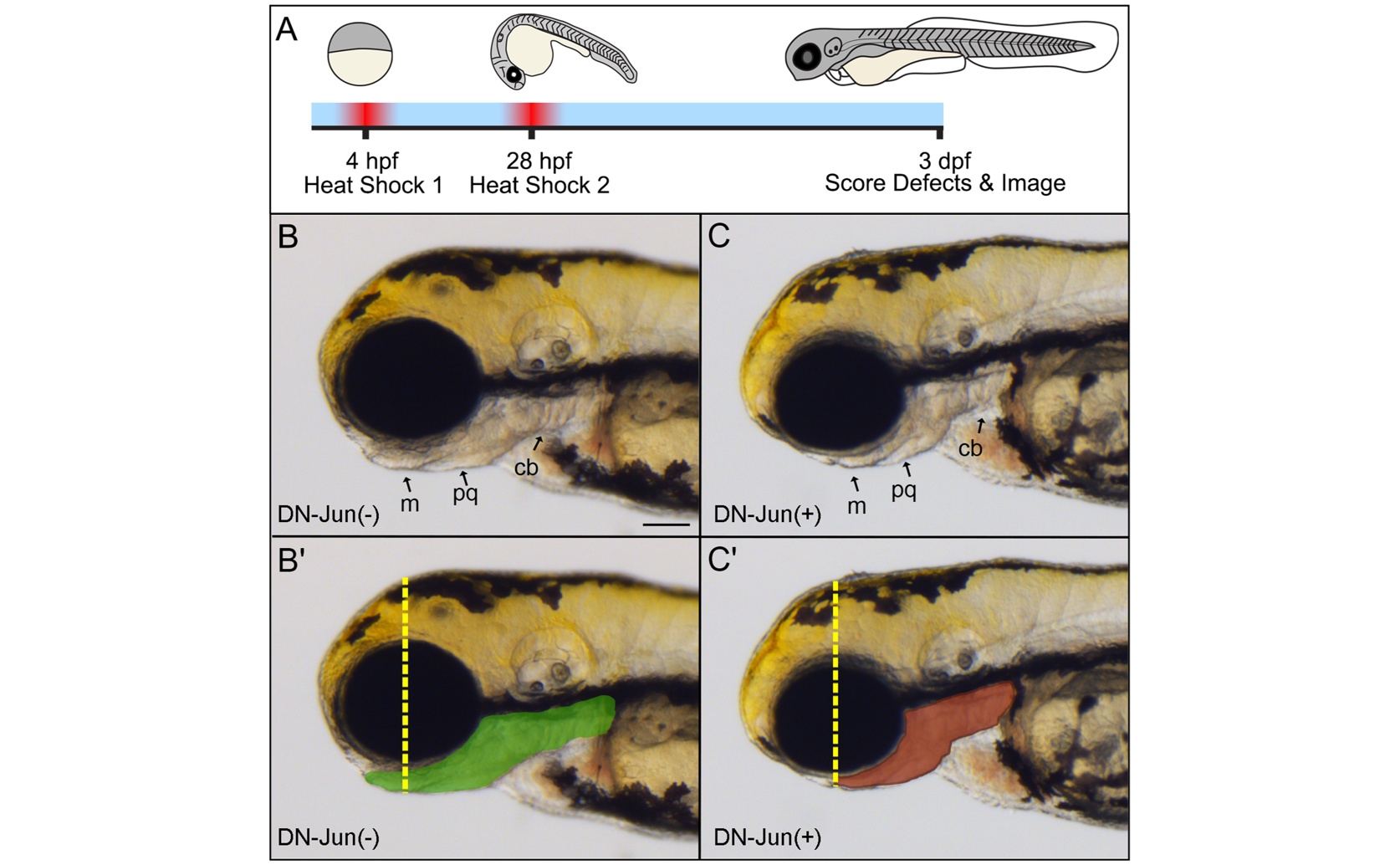
Heat-shock induction of dominant-negative Jun during early embryonic development causes significant craniofacial defects in larval zebrafish, including reduced jaw cartilage and diminished cranial structures (b–c'), confirming that the DN-Jun protein effectively inhibits endogenous Jun function and validating this transgenic model for subsequent optic nerve regeneration studies.

Image adapted from: Sarich et al. / CC BY (Source)

Key Findings

  • Researchers at the University of Wisconsin-Milwaukee discovered that the Jun gene is essential for zebrafish to regrow optic nerve fibers after injury
  • When Jun's function is blocked, zebrafish show impaired nerve regeneration, as other important healing genes are also affected
  • Understanding Jun's role may help develop new treatments to repair human brain and spinal cord injuries
Damage to the central nervous system (CNS), which includes the brain and spinal cord, often leads to permanent loss of function. This is because, unlike some other parts of the body, the adult mammalian CNS has a limited ability to repair itself after injuries such as trauma or diseases like neurodegeneration. Axons, the long projections of neurons that transmit signals, typically fail to regenerate once damaged. However, recent research conducted by the University of Wisconsin-Milwaukee[1] offers promising insights into how regeneration might be achieved by studying zebrafish, a species known for its remarkable ability to regenerate CNS tissues. In previous studies, significant progress has been made in understanding the transcriptional machinery that governs CNS repair after acute injuries[2]. Injured neurons activate intrinsic rescue programs to increase their plasticity, allowing them to reconnect to the synaptic network. This involves re-expressing transcription factors that are also crucial for neural stem cells, suggesting a link between axonal regeneration and the generation of new neurons. Additionally, research has highlighted that axon regeneration and neuronal repair vary across different animal lineages and between the central and peripheral nervous systems[3]. While the peripheral nervous system can self-repair to some extent, the adult mammalian CNS generally does not, although recent findings indicate that regeneration and functional recovery are possible under certain conditions. Building on these foundational studies, the main research by the University of Wisconsin-Milwaukee focuses on the role of specific genes and transcription factors in CNS axon regeneration using zebrafish as a model organism. Zebrafish possess the unique ability to express regeneration-associated genes that revert CNS neurons to a growth-competent state, enabling them to regenerate damaged axons and restore functionality. One well-established model for studying CNS axon regeneration in zebrafish is optic nerve injury. In previous work, it was shown that thousands of genes are activated over time during the regeneration process, suggesting a complex network of genetic regulation. The current study zeroes in on a particular transcription factor known as Jun. Transcription factors are proteins that help turn specific genes on or off by binding to nearby DNA. Jun is of interest because it is believed to play a central role in regulating the genes involved in axon regeneration. To investigate whether Jun is essential for CNS regeneration, researchers developed a transgenic zebrafish line that can express a heat-shock inducible dominant negative form of Jun. This means that they can temporarily inhibit Jun's function by applying heat, allowing them to observe the effects of reduced Jun activity on nerve regeneration. When dominant negative Jun was induced in these zebrafish, the expression of the natural Jun protein was significantly decreased. The larvae with inhibited Jun function showed impaired regeneration of retinal ganglion cell axons, which are crucial for transmitting visual information from the eye to the brain. Further analysis revealed that the knockdown of Jun affected the expression of other genes involved in regeneration. Specifically, genes such as atf3 and ascl1a, which are usually upregulated during optic nerve regeneration in adult zebrafish, were significantly downregulated when Jun was inhibited. Conversely, the expression of sox11a was upregulated at specific time points, indicating that Jun may differentially regulate various aspects of the regeneration process. These findings position Jun as a key regulator in the successful regeneration of optic nerves in zebrafish. By demonstrating that Jun is necessary for the activation of other regeneration-associated genes, the study highlights the intricate genetic orchestration required for CNS repair. Moreover, the research distinguishes the regeneration program from developmental processes, suggesting that different genetic mechanisms are at play when neurons repair themselves after injury compared to how they develop initially. The implications of this study are significant for the development of future therapies aimed at treating CNS damage in humans. Understanding the role of Jun and its target genes could lead to strategies that activate similar regenerative pathways in the adult mammalian CNS, potentially overcoming the current limitations in nerve repair. This aligns with earlier findings that emphasize the importance of transcriptional regulation in CNS repair and the potential for targeting these pathways to enhance regeneration and functional recovery[2][3]. In summary, the University of Wisconsin-Milwaukee's research advances our understanding of the molecular mechanisms underlying CNS axon regeneration. By identifying Jun as a crucial transcription factor and elucidating its role in regulating other genes involved in regeneration, the study provides a valuable framework for developing interventions that could one day restore lost functions following CNS injuries in humans.

BiotechGeneticsAnimal Science

References

Main Study

1) The transcription factor Jun is necessary for optic nerve regeneration in larval zebrafish

Published 10th March, 2025

https://doi.org/10.1371/journal.pone.0313534


Related Studies

2) Waking up the sleepers: shared transcriptional pathways in axonal regeneration and neurogenesis.

https://doi.org/10.1007/s00018-012-1099-x


3) Spatial and temporal arrangement of neuronal intrinsic and extrinsic mechanisms controlling axon regeneration.

https://doi.org/10.1016/j.conb.2016.12.005


Related Articles

An unhandled error has occurred. Reload 🗙