Simple DNA tests can quickly detect diseases in honey bees

Jenn Hoskins
2nd November, 2025

Simple DNA tests can quickly detect diseases in honey bees

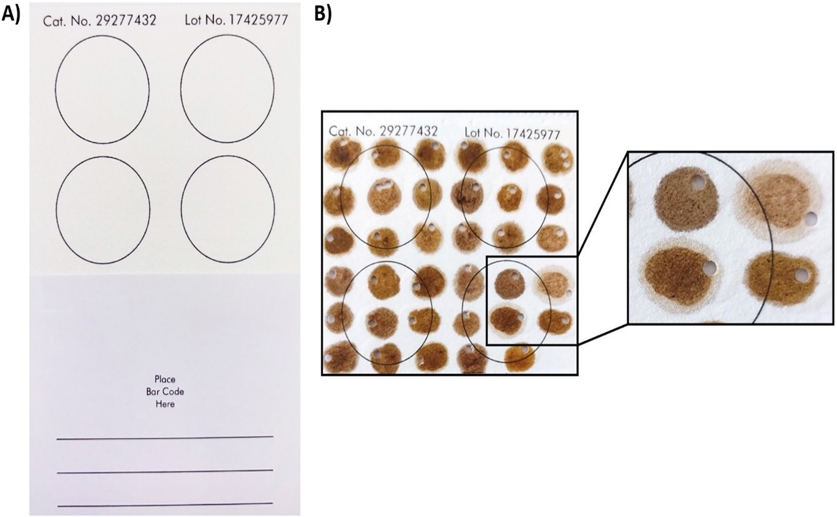
Starting with a blank, chemically-treated card (A), scientists apply samples from 36 different honey bee colonies (B) to create a simple, low-cost tool for detecting widespread pathogens.

Image adapted from: Myslínová et al. / CC BY (Source)

Key Findings

  • This Czech Republic study found FTA® cards are a reliable, cheaper way to test honey bees for common pathogens compared to standard lab kits
  • FTA® cards accurately detected Nosema ceranae – a key parasite linked to bee colony decline – with nearly 100% accuracy, even outperforming traditional methods
  • Pathogen levels in bee colonies varied by season, with Serratia marcescens more common in autumn and N. ceranae dominant in spring, reflecting changing environmental factors
Honey bee populations face numerous threats, including viruses, bacteria, and parasites, leading to significant colony losses globally. Early and accurate detection of these pathogens is vital for effective management and preventing widespread transmission. Traditional methods for identifying these threats, such as laboratory-based DNA analysis, can be time-consuming and expensive, hindering rapid response efforts. Researchers at Palacký University Olomouc and the University of Kwazulu-Natal[1] have investigated a simpler, more efficient method for pathogen detection in honey bees using FTA® cards. The study focused on comparing the effectiveness of FTA® cards – a type of specialized paper – with a standard DNA isolation kit (DNeasy Plant Mini kit) for detecting key honey bee pathogens. These included Nosema ceranae, Nosema apis, Lotmaria passim, Crithidia mellificae, and Serratia marcescens. Nosema ceranae is a microsporidian parasite known to contribute to colony decline, particularly in conjunction with other stressors[2]. Lotmaria passim is another microsporidian parasite, while Crithidia mellificae is a trypanosomatid parasite, and Serratia marcescens is a bacterium increasingly recognized as a bee pathogen[3]. The researchers analyzed 85 honey bee samples collected from colonies in the Czech Republic during autumn and spring. They found that FTA® cards performed exceptionally well in detecting N. ceranae, achieving 97.2% sensitivity (correctly identifying infected colonies) and 100% specificity (correctly identifying uninfected colonies). This level of accuracy is comparable to that of the traditional DNA isolation kit, but FTA® cards offer significant advantages in terms of cost and speed. The study also revealed seasonal variations in pathogen prevalence. A greater diversity of pathogens was observed in autumn, with a substantial proportion of colonies (48%) infected with a single pathogen, and a smaller percentage (4%) harboring three different pathogens. In contrast, spring samples showed a higher percentage of colonies with no detectable pathogens (40%) and a lower prevalence of multiple infections. Serratia marcescens was the most common pathogen detected in autumn (46%), while N. ceranae became dominant in spring (60%). This shift in prevalence aligns with observations that certain pathogens are more problematic during specific times of the year, potentially due to environmental factors or changes in bee behavior. The researchers highlighted the practical benefits of FTA® cards beyond their accuracy and cost-effectiveness. The cards effectively preserve DNA even under harsh conditions – including high temperatures, UV radiation, and exposure to substances that can damage DNA – making them ideal for field use. This is particularly important when collecting samples from remote apiaries or regions with limited access to laboratory facilities. The cards also mitigate the risk of DNA degradation during transport, a common issue when shipping whole bee samples. These findings build upon earlier research identifying multiple pathogens contributing to honey bee colony losses[2]. That study, conducted in Belgium, demonstrated that the presence of Crithidia mellificae and Nosema ceranae were predictive markers of winter mortality, and that the number of pathogen species present correlated with colony losses. The current study provides a more efficient tool for monitoring the prevalence of these and other key pathogens, enabling beekeepers and researchers to respond more quickly to emerging threats. The ability to rapidly screen for pathogens like N. ceranae using FTA® cards could facilitate targeted interventions, such as improved hive management practices or the use of appropriate treatments, to protect bee colonies.

BiotechGeneticsAnimal Science

References

Main Study

1) Efficient pathogen screening in honey bees: Application of FTA® cards for DNA storage and PCR analysis

Published 30th October, 2025

https://doi.org/10.1371/journal.pone.0334066


Related Studies

2) Comprehensive bee pathogen screening in Belgium reveals Crithidia mellificae as a new contributory factor to winter mortality.

https://doi.org/10.1371/journal.pone.0072443


3) Bacterial pathogens of bees.

https://doi.org/10.1016/j.cois.2018.02.008


Related Articles

An unhandled error has occurred. Reload 🗙