Understanding a gene key to leaf development in rapeseed plants

Jenn Hoskins
22nd January, 2026

Understanding a gene key to leaf development in rapeseed plants

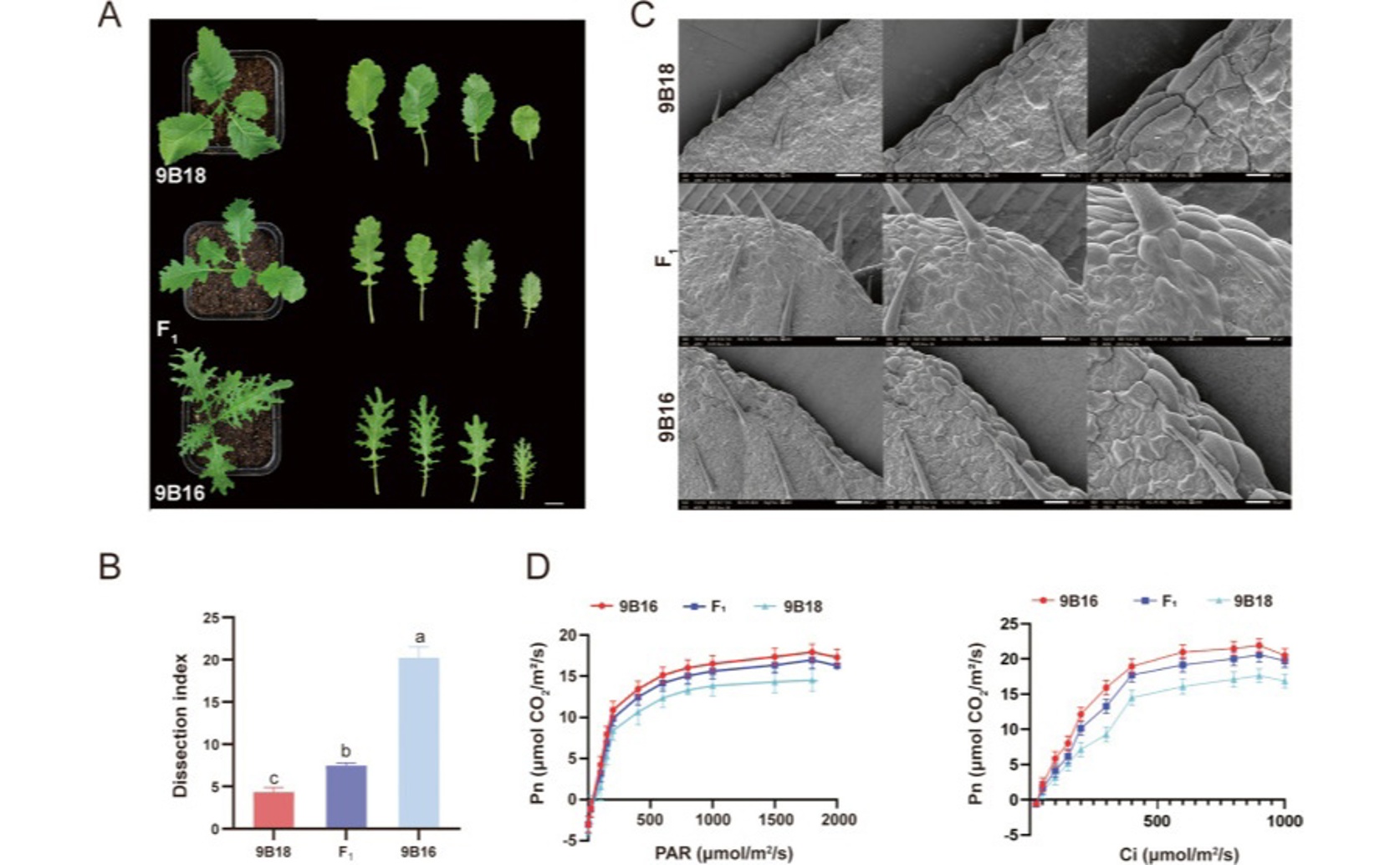
Compared to the entire-leaf parent, the lobed-leaf rapeseed (Brassica juncea line) exhibits a significantly more dissected leaf morphology (a, b), which is associated with meristematic-like cells at the leaf margin (c) and enhanced photosynthetic efficiency (d), establishing the incompletely dominant trait explained by the gene BjA10.LL.

Image adapted from: Liu et al. / CC BY (Source)

Key Findings

  • In rapeseed plants, leaf shape differences are controlled by a single gene, BjA10.LL, showing incomplete dominance
  • BjA10.LL encodes a protein that regulates leaf development, acting as a transcription factor
  • Variations in the regulatory regions of BjA10.LL, not the gene itself, cause differences in leaf lobation, impacting photosynthetic efficiency
Leaf shape is a key characteristic influencing a plant’s ability to capture sunlight and thrive, making it a prime target for agricultural improvement. Breeding programs often focus on traits like leaf margin lobation – the presence of rounded or pointed projections along the leaf edge – as a visible marker for selecting desirable plant varieties. However, the underlying genetic control of lobation in Brassica juncea, an important oilseed crop, remained unknown until recently. Researchers at Northwest A&F University, State Key Laboratory for Crop Stress Resistance, have now identified the gene responsible[1]. The study centered on understanding the genetic basis of leaf margin lobation in B. juncea. Using a combination of RNA sequencing – a technique to measure the activity of all genes in a sample – and map-based cloning, the team pinpointed a gene they named BjA10.LL. This gene encodes a protein belonging to the HD-ZIP I family of transcription factors, which are known to regulate plant development. Transcription factors control which genes are switched on or off, effectively acting as molecular switches for various traits. Interestingly, the researchers found that the differences between lobed and non-lobed leaf varieties weren’t due to changes within the BjA10.LL gene itself. Instead, the variations lay in the regulatory regions of the gene – the sections that control when and how much of the gene is activated. Sequence analysis revealed substantial differences in these regulatory areas between the two leaf types. This is a common theme in plant genetics, where changes in gene regulation, rather than the gene’s coding sequence, can drive significant phenotypic differences. To confirm that BjA10.LL was indeed responsible for lobation, the researchers performed a heterologous expression experiment. They introduced the BjA10.LL gene into Arabidopsis thaliana (thale cress), a model plant widely used in genetic studies. The Arabidopsis plants that received the BjA10.LL gene developed lobed leaves, demonstrating the gene’s ability to induce this trait. Further investigation focused on linking the regulatory variations to the observed differences in gene expression. Promoter activity assays, which measure how strongly a gene is switched on, showed that the variations in the regulatory regions significantly affected the activity of BjA10.LL. The team then developed a co-dominant molecular marker – a DNA sequence used to identify specific gene variants – targeting key insertions and deletions (indels) within a core enhancer region of the BjA10.LL promoter. This marker accurately identified plants with lobed or non-lobed leaves, and importantly, it consistently tracked with the lobation phenotype in subsequent generations. The findings align with, and expand upon, previous research demonstrating the role of HD-ZIP transcription factors in leaf development[2][3]. Specifically, studies in cotton have shown that LMI1-like genes, also belonging to the HD-ZIP family, control leaf shape and that variations in the promoter region of these genes can lead to different leaf morphologies[2][3]. The BjA10.LL gene appears to function similarly, positively regulating the formation of marginal lobes in B. juncea. This study highlights the importance of regulatory variations in driving phenotypic diversity. The identification of BjA10.LL and its associated molecular marker provides valuable tools for breeders aiming to improve rapeseed crops. By selecting for specific variants of this gene, they can more efficiently breed plants with desired leaf characteristics, potentially enhancing yield and quality. The research also underscores the complex interplay between genes and their regulatory elements in shaping plant morphology.

BiotechGeneticsPlant Science

References

Main Study

1) Cloning and functional analysis of the lobed-leaf gene BjA10.LL in Brassica juncea L.

Published 20th January, 2026

https://doi.org/10.1007/s44154-025-00280-3


Related Studies

2) Modifications to a LATE MERISTEM IDENTITY1 gene are responsible for the major leaf shapes of Upland cotton (Gossypium hirsutum L.).

https://doi.org/10.1073/pnas.1613593114


3) Insights into Interspecific Hybridization Events in Allotetraploid Cotton Formation from Characterization of a Gene-Regulating Leaf Shape.

Journal: Genetics, Issue: Vol 204, Issue 2, Oct 2016


Related Articles

An unhandled error has occurred. Reload 🗙