CRISPR Editing Makes Plants Resist Tobacco Virus Infection

Jenn Hoskins
25th February, 2025

CRISPR Editing Makes Plants Resist Tobacco Virus Infection

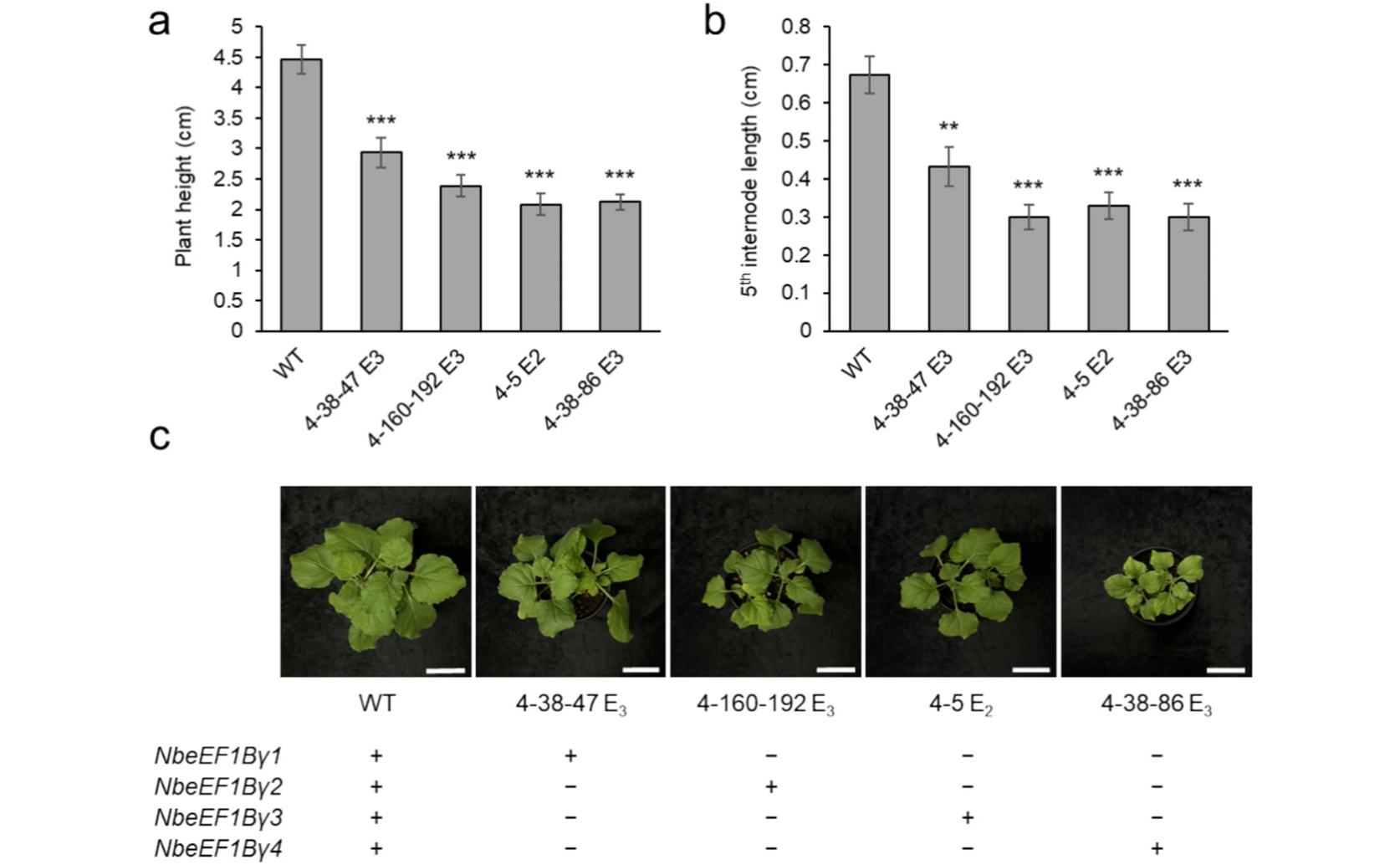
Knocking out three of the four eEF1Bγ homologs in Nicotiana benthamiana resulted in a significant dwarf phenotype, characterized by reduced plant height (a) and internode length (b) and visible stunting (c), demonstrating the essential role of this gene in plant development.

Image adapted from: Kang et al. / CC BY (Source)

Key Findings

  • Researchers at Seoul National University used gene editing on a model plant to target specific genes
  • The modified plants showed significantly less Tobacco etch virus (TEV) but remained susceptible to other viruses
  • This targeted approach demonstrates a promising method for developing virus-resistant crops
Plant viruses pose a significant threat to agricultural productivity, affecting a wide range of crops and leading to substantial economic losses globally. Traditional methods of controlling these viruses, such as pesticides and resistant crop varieties, often fall short due to the rapid evolution of viruses and the limited availability of natural resistance genes. To address these challenges, scientists are turning to advanced genome-editing technologies to develop crops with durable and targeted virus resistance. A recent study conducted by researchers at Seoul National University[1] explores a novel approach to engineering virus-resistant plants by targeting the eukaryotic translation elongation factor gene eEF1Bγ in Nicotiana benthamiana, a model organism widely used in plant biology. This study builds upon previous research that has demonstrated the potential of gene-editing tools like CRISPR/Cas9 in developing virus-resistant plants[2]. Viruses rely on host factors—specific proteins within the host plant—to replicate and spread from cell to cell. By identifying and modifying these host factors, scientists can disrupt the viral life cycle without adversely affecting the plant. Eukaryotic initiation factors, such as eIF4E and eIF4G, have been well-established as critical host factors for viral infection. Studies have shown that loss-of-function mutations in these factors can confer resistance to a variety of viruses[3][4]. However, redundancy among eIF4E genes in some plants can limit the effectiveness of knockout strategies, highlighting the need for alternative targets[3]. In their study, the Seoul National University team focused on eEF1Bγ, another component of the protein synthesis machinery in plants. Protein synthesis is essential for plant growth and development, and it involves the translation of mRNA into proteins by ribosomes. EEF1Bγ plays a role in the elongation phase of translation, facilitating the addition of amino acids to the growing protein chain[5]. The researchers hypothesized that eEF1Bγ might serve as a host factor for Tobacco etch virus (TEV), a significant pathogen affecting various crops. To test this hypothesis, the researchers employed a technique known as virus-induced gene editing (VIGE) using Tobacco rattle virus (TRV) as a delivery vector[2]. TRV is advantageous for genome editing in plants because it can efficiently infect growing points and has a small genome size that simplifies cloning and multiplexing. The team targeted four eEF1Bγ genes in Nicotiana benthamiana, aiming to knock out these genes and assess the resulting impact on viral accumulation. Although the researchers aimed to edit all four eEF1Bγ homologs, they succeeded in knocking out three of them. These edited plants contained 1-base pair insertions or deletions, leading to premature stop codons that effectively rendered the eEF1Bγ proteins nonfunctional. Interestingly, while these gene-edited plants did not show resistance to several other viruses, including Potato virus X (PVX), Tobacco mosaic virus (TMV), or Tomato bushy stunt virus (TBSV), they did exhibit a significant reduction in TEV accumulation compared to wild-type plants. This finding underscores the specificity of host factor interactions with different viruses. Unlike broader targets like eIF4E, which can confer resistance to multiple viruses, eEF1Bγ appears to be a more selective host factor for TEV. This specificity can be advantageous in designing targeted resistance strategies without affecting the plant's overall physiology, as essential proteins like eEF1Bγ are modified without causing detrimental effects on plant growth. The study also highlights the potential of expanding the repertoire of host factors beyond the well-studied initiation factors. By exploring diverse components of the protein synthesis machinery, researchers can identify new targets for engineering virus resistance. This approach not only broadens the scope of resistance but also provides additional layers of protection against a variety of viral pathogens. Moreover, the successful use of TRV-mediated gene editing in this study reinforces the utility of viral vectors in plant genome editing. The ability to deliver multiple gene-editing reagents simultaneously through TRV opens up possibilities for multiplexed editing, where several genes can be targeted in a single experiment. This is particularly useful in cases where redundancy among gene families poses a challenge, as seen with the eIF4E genes[2][3]. In conclusion, the research from Seoul National University represents a significant step forward in the quest to develop virus-resistant crops through precise genome editing. By targeting the eEF1Bγ genes, the study demonstrates a viable strategy for reducing TEV accumulation in plants, thereby enhancing their resilience against this specific virus. Building on previous findings, this work emphasizes the importance of identifying and manipulating a broad range of host factors to achieve comprehensive and durable virus resistance in crops.

BiotechGeneticsPlant Science

References

Main Study

1) CRISPR/Cas9-mediated editing of eukaryotic elongation factor 1B gamma (eEF1Bγ) reduces Tobacco etch virus accumulation in Nicotiana benthamiana

Published 22nd February, 2025

https://doi.org/10.1007/s00299-025-03440-x


Related Studies

2) Activity and specificity of TRV-mediated gene editing in plants.

https://doi.org/10.1080/15592324.2015.1044191


3) eIF4E Resistance: Natural Variation Should Guide Gene Editing.

https://doi.org/10.1016/j.tplants.2017.01.008


4) Mimicking natural polymorphism in eIF4E by CRISPR-Cas9 base editing is associated with resistance to potyviruses.

https://doi.org/10.1111/pbi.13096


5) Mechanism of cytoplasmic mRNA translation.

https://doi.org/10.1199/tab.0176


Related Articles

An unhandled error has occurred. Reload 🗙