Making Useful Enzymes from Seaweed with Marine Bacteria

Jenn Hoskins
26th February, 2024

Making Useful Enzymes from Seaweed with Marine Bacteria

Sargassum

Photo adapted from: Cricket Raspet / CC BY (Source)
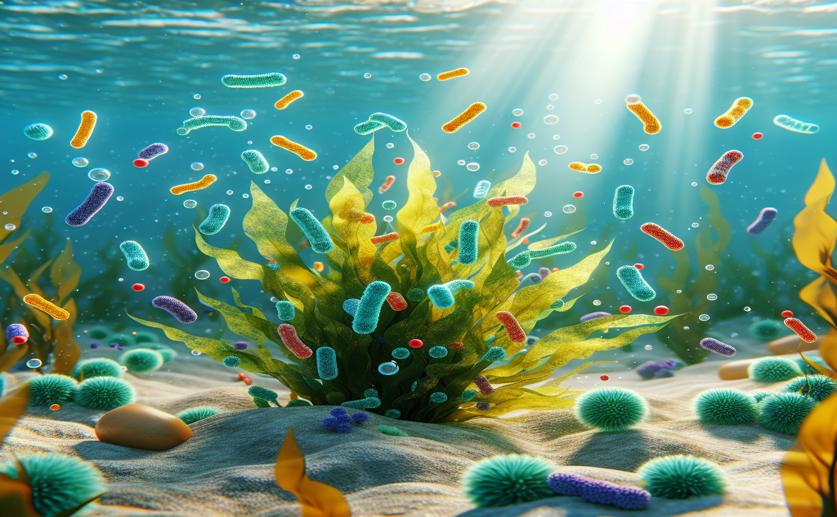
Alginate is a naturally occurring polysaccharide – a type of carbohydrate – found in brown algae, commonly known as seaweed. It has a wide range of industrial and medical applications, including use in wound dressings, food thickening, and increasingly, as a source for biofuels and biologically active compounds. However, breaking down alginate into smaller, useful components requires efficient methods. This is where alginate lyases come in: enzymes that specifically target and degrade alginate. Researchers at Kalasalingam Academy of Research and Education have been investigating ways to produce these enzymes efficiently[1]. The challenge lies in finding cost-effective and sustainable ways to produce alginate lyase. Traditional methods often involve growing bacteria in liquid cultures, which can be energy-intensive and expensive. A promising alternative is solid-state fermentation (SSF), where microorganisms are grown on a solid substrate, like the seaweed itself. This method can reduce energy consumption and utilize waste biomass, making it more environmentally friendly. The study focused on a marine bacterium, Enterobacter tabaci RAU2C, previously identified for its ability to degrade alginate. The researchers used Sargassum swartzii, a type of brown seaweed, as the solid substrate for SSF. They then optimized the process to maximize alginate lyase production, focusing on factors like how long the bacterial culture was grown before being added to the seaweed (inoculum incubation period) and the amount of moisture present. Their work resulted in the production of 33.56 Units per milliliter (U/mL) of alginate lyase after four days, using a static (non-stirred) condition and maintaining 75% moisture content. Increasing the moisture content from 60% to 75% notably improved enzyme activity. They also found that a phosphate buffer at pH 7 and a temperature of 37°C provided optimal conditions for the enzyme to function. This research builds on earlier work identifying and characterizing various alginate lyases. For example, a highly active alginate lyase, AlgA, was previously isolated from a marine bacterium, Bacillus sp. Alg07, exhibiting a specific activity significantly higher than previously recorded[2]. AlgA demonstrated a preference for breaking down poly-β-d-mannuronate (polyM), a component of alginate, into smaller oligosaccharides. The current study, while not directly focused on identifying a novel enzyme with record-breaking activity like AlgA, aims to improve the production of alginate lyases, making them more readily available for applications. Furthermore, the study highlights the potential for utilizing the leftover seaweed biomass after fermentation as a biofertilizer, adding another layer of sustainability to the process. This is particularly relevant given the increasing interest in circular economy approaches, where waste products are repurposed. Interestingly, other research has demonstrated the therapeutic potential of alginate lyases in combating bacterial biofilms, particularly those formed by Pseudomonas aeruginosa in the lungs of cystic fibrosis patients[3]. The enzyme AlyP1400, purified from a marine bacterium, was shown to disrupt biofilms and enhance the effectiveness of antibiotics. The alginate lyase produced through the SSF process described in could potentially be explored for similar applications, offering a novel approach to treating biofilm-related infections. Another study isolated a halophilic (salt-loving) alginate-degrading microorganism, Isoptericola halotolerans CGMCC5336, and purified its alginate lyase, demonstrating its bifunctionality – its ability to break down both polyguluronate and polymannuronate units within alginate[4]. This highlights the diversity of alginate lyases and their varying substrate specificities. The enzyme produced by Enterobacter tabaci RAU2C in could be further characterized to determine its specific substrate preferences and potential applications.

BiotechBiochemMarine Biology

References

Main Study

1) Solid-state fermentation of brown seaweeds for the production of alginate lyase using marine bacterium Enterobacter tabaci RAU2C.

Published 24th February, 2024

https://doi.org/10.1007/s12223-024-01150-7


Related Studies

2) Purification and Characterization of a Novel Alginate Lyase from the Marine Bacterium Bacillus sp. Alg07.

https://doi.org/10.3390/md16030086


3) Disruption of the extracellular polymeric network of Pseudomonas aeruginosa biofilms by alginate lyase enhances pathogen eradication by antibiotics.

https://doi.org/10.1016/j.jcf.2020.04.006


4) Purification and characterisation of a bifunctional alginate lyase from novel Isoptericola halotolerans CGMCC 5336.

https://doi.org/10.1016/j.carbpol.2013.07.050


Related Articles

An unhandled error has occurred. Reload 🗙