How deep-sea corals cope with ocean warming and acidification

Jim Crocker
20th November, 2025

How deep-sea corals cope with ocean warming and acidification

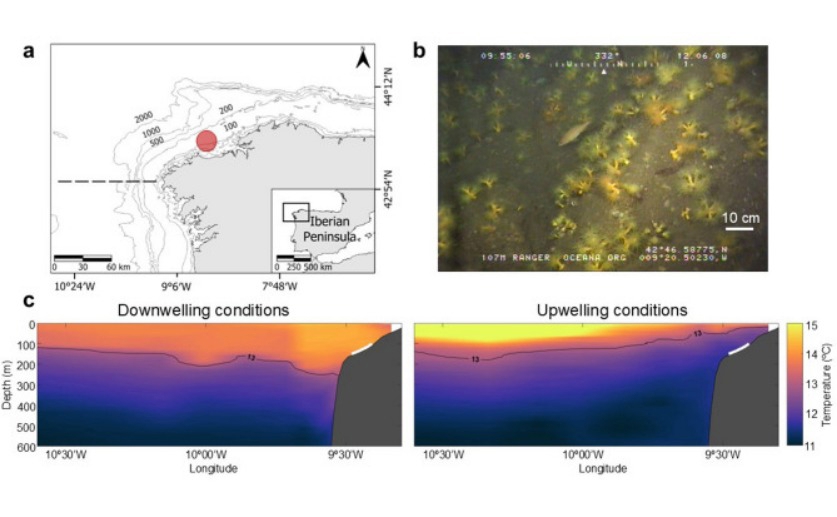
Sampling location of Dendrophyllia cornigera colonies off the NW Iberian Peninsula, alongside a depiction of typical temperature variations in the region during upwelling and downwelling events.

Image adapted from: Gutiérrez-Zárate et al. / CC BY (Source)

Key Findings

  • This study, conducted on deep-sea corals off the Iberian Peninsula, found that Dendrophyllia cornigera showed no significant negative effects from stressors mimicking future ocean conditions
  • The corals maintained normal survival, growth, and tissue health even when exposed to combinations of warming, acidification, and low oxygen levels
  • These findings suggest this coral species is more resilient to climate change than previously predicted by habitat models, potentially aiding deep-sea biodiversity
The deep ocean, while seemingly remote, is heavily impacted by climate change. It absorbs significant amounts of heat and carbon dioxide, mitigating some of the effects on land, but this absorption comes at a cost to the marine ecosystems within[2]. Changes in temperature, acidity, and oxygen levels are all occurring, potentially disrupting deep-sea life. Cold-water corals (CWCs) are particularly important as they create complex habitats that support a wide range of other species, acting as ‘ecosystem engineers’[1]. A recent study by researchers at the Spanish Institute of Oceanography (IEO-CSIC) investigated how one species of CWC, Dendrophyllia cornigera, might respond to these changing conditions. Understanding how deep-sea species will react to climate change is crucial for effective conservation. Previous research has highlighted the vulnerability of many CWCs, predicting significant habitat loss for species like Lophelia pertusa and Paragorgia arborea under future climate scenarios[3]. These models, however, rely on predicting habitat suitability based on environmental factors, and don’t always account for the physiological tolerance of the corals themselves. Furthermore, modelling efforts are hampered by limited data and the challenges of accurately mapping the deep-sea environment[4]. The IEO-CSIC study aimed to directly assess the impact of several key climate change stressors on D. cornigera. The researchers conducted a nine-month experiment, exposing corals to different combinations of elevated temperature, reduced pH (increased acidity), and low oxygen levels. These conditions were based on a particularly high emissions scenario (RCP 8.5) outlined by the Intergovernmental Panel on Climate Change (IPCC), representing a future where greenhouse gas emissions continue to rise rapidly. The researchers monitored several indicators of coral health: survival rate, skeletal growth, the amount of living tissue on the coral, and its respiration rate. Surprisingly, they found no significant negative effects on any of these measures, either when the corals were exposed to single stressors or to combinations of them. This suggests that D. cornigera possesses a considerable degree of resistance to the conditions tested. This finding contrasts with predictions from habitat suitability models, which often indicate substantial declines in suitable habitat for many CWC species[3]. It suggests that some species may be more resilient than previously thought. The study highlights that the response of CWCs to climate change isn’t uniform; some species, like D. cornigera, may be better equipped to cope with changing conditions than others. This resilience could be important for maintaining biodiversity in the deep sea as other, more sensitive species decline. However, the researchers caution that resistance doesn’t necessarily equate to long-term survival. The experiment focused on relatively short-term effects. It’s possible that prolonged exposure to these stressors, or the emergence of other, unforeseen challenges, could eventually compromise the coral’s health. There may be ‘trade-offs’ involved – for example, the coral might maintain its growth rate under stress but experience reduced reproductive success. Further research is needed to investigate these potential long-term consequences and to understand the full extent of D. cornigera’s adaptive capacity.

EnvironmentEcologyMarine Biology

References

Main Study

1) Resistance of the cold-water coral Dendrophyllia cornigera to single and combined global change stressors

Published 17th November, 2025

https://doi.org/10.1038/s41598-025-24028-1


Related Studies

2) The deep ocean under climate change.

https://doi.org/10.1126/science.aad0126


3) Climate-induced changes in the suitable habitat of cold-water corals and commercially important deep-sea fishes in the North Atlantic.

https://doi.org/10.1111/gcb.14996


4) Global habitat suitability for framework-forming cold-water corals.

https://doi.org/10.1371/journal.pone.0018483


Related Articles

An unhandled error has occurred. Reload 🗙