How heat preparation affects coral health: a detailed biomarker study

Jenn Hoskins
8th October, 2025

How heat preparation affects coral health: a detailed biomarker study

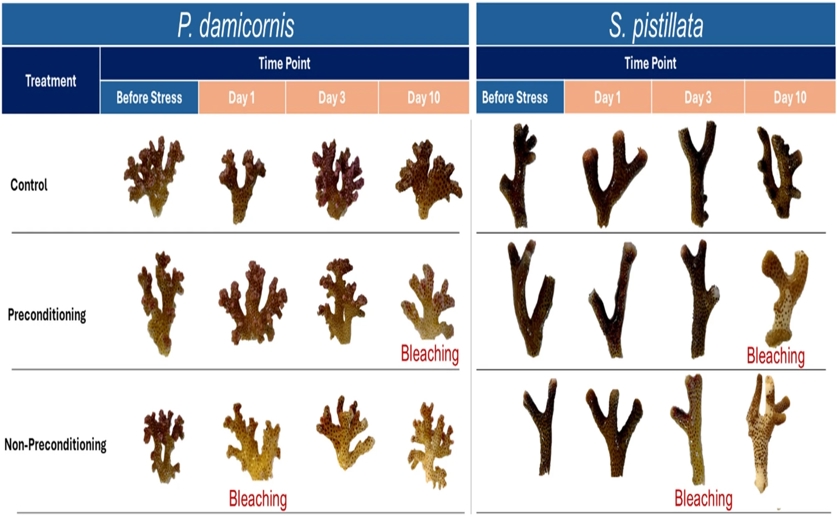
Rapid visual bleaching assessment of P. damicornis and S. pistillata nubbins under three different treatments at specific time intervals.

Image adapted from: Louis et al. / CC BY (Source)

Key Findings

  • This University of Milan-Bicocca study examined how two coral species respond to heat stress after being briefly exposed to slightly warmer temperatures
  • Preconditioned corals delayed bleaching, maintaining essential photosynthetic pigments and symbiotic algae for a longer period than non-preconditioned corals
  • Preconditioning boosted antioxidant enzyme activity in corals, reducing cellular damage from heat stress and supporting longer-term cellular health
Coral reefs are among the most biodiverse ecosystems on Earth, but they are facing a crisis due to climate change and rising ocean temperatures. A major consequence of these warming waters is coral bleaching, where corals expel the symbiotic algae living in their tissues, leading to starvation and potential death. Increasingly frequent and severe bleaching events are predicted[2], threatening the very existence of these vital habitats. While reducing carbon emissions remains the primary solution, scientists are also exploring interventions to help corals survive and recover. One promising approach is thermal preconditioning – essentially ‘training’ corals to withstand higher temperatures. A recent study by researchers at University of Milan-Bicocca[1] investigated the biological processes behind thermal preconditioning in two common coral species, Pocillopora damicornis and Stylophora pistillata. The research aimed to understand how corals become more tolerant to heat stress at a molecular level, which is crucial for developing effective restoration strategies. The study involved exposing corals to a mildly warmer temperature (+3°C above normal) for a period, followed by a more intense heat stress (32°C, an 8°C increase). The researchers then meticulously analyzed various biomarkers – measurable indicators of biological state – within the corals. They found that preconditioned corals experienced delayed bleaching compared to those not preconditioned. Specifically, they maintained higher levels of chlorophyll a and c2, pigments essential for photosynthesis by the symbiotic algae, and retained a greater density of these algae for a longer time. Digging deeper, the team discovered that preconditioned corals exhibited increased activity of antioxidant enzymes. These enzymes protect cells from damage caused by oxidative stress, a common consequence of heat stress. This enhanced protection was linked to lower levels of lipid peroxidation (LPO), a measure of cell membrane damage. Essentially, the preconditioned corals were better equipped to handle the cellular stress caused by the heat. Another key finding revolved around heat shock proteins (Hsp70). These proteins help cells cope with stress by preventing proteins from misfolding and aggregating. Preconditioned corals showed a slower reduction in Hsp70 levels, or sustained elevated levels, during the acute heat stress, suggesting a more stable cellular environment. They also exhibited a delayed or reduced expression of the hsp70 gene itself, implying a less frantic response to the thermal challenge. Interestingly, the study revealed that the benefits of thermal preconditioning lasted longer in P. damicornis than in S. pistillata, demonstrating that different coral species respond to preconditioning in unique ways. This highlights the need for species-specific protocols in restoration efforts. This research builds upon previous work documenting the potential for marine ecosystems to recover with conservation efforts[3]. However, the success of these interventions, including coral restoration, is heavily dependent on mitigating climate change[4]. While restoration can aid in localized recovery, it is not a substitute for addressing the root cause of the problem. The findings of are particularly relevant in light of observations from the Great Barrier Reef, where mass bleaching events are becoming more frequent and widespread[5]. The spatial scale of these events, with isolated reefs facing limited larval dispersal, poses a significant threat to coral resilience. Thermal preconditioning, by enhancing the tolerance of corals, could potentially buy time for reefs to adapt to changing conditions, particularly when combined with targeted restoration efforts. The detailed molecular insights provided by the University of Milan-Bicocca study are crucial for developing more effective and species-specific preconditioning strategies, paving the way for more successful coral reef restoration projects.

EnvironmentEcologyMarine Biology

References

Main Study

1) A multi-molecular biomarker assessment of thermal preconditioning in two scleractinian coral species

Published 6th October, 2025

https://doi.org/10.1038/s41598-025-18617-3


Related Studies

2) Local-scale projections of coral reef futures and implications of the Paris Agreement.

https://doi.org/10.1038/srep39666


4) Coral restoration - A systematic review of current methods, successes, failures and future directions.

https://doi.org/10.1371/journal.pone.0226631


5) The spatial footprint and patchiness of large-scale disturbances on coral reefs.

https://doi.org/10.1111/gcb.15805


Related Articles

An unhandled error has occurred. Reload 🗙