How Well Do Marine Protected Areas Help Fish Populations?

Greg Howard
5th September, 2025

How Well Do Marine Protected Areas Help Fish Populations?

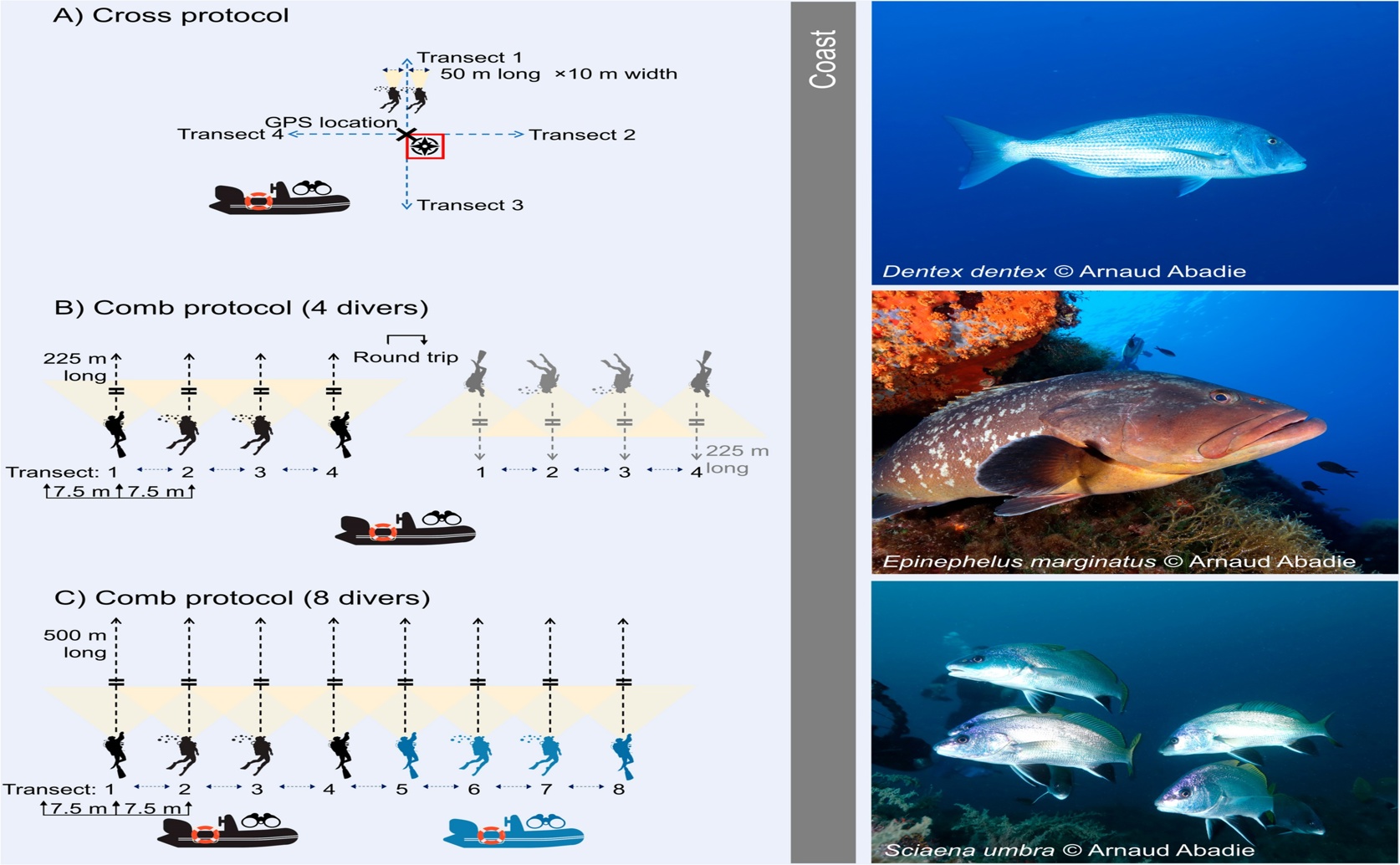
Comparison of survey designs revealed that the simpler cross protocol (a) yielded density estimates comparable to or higher than the logistically intensive comb protocols (b, c) for the common dentex (Dentex dentex), dusky grouper (Epinephelus marginatus), and brown meagre (Sciaena umbra).

Image adapted from: Vanalderweireldt et al. / CC BY (Source)

Key Findings

  • In Corsica’s Marine Natural Park, a no-take zone (NTZ) significantly increased the weight (biomass) of three key predatory fish species
  • The NTZ supported three to four times higher densities of dusky grouper and brown meagre compared to fished areas
  • While common dentex density didn’t differ, the NTZ allowed them to grow larger, increasing their overall biomass
The Mediterranean Sea is facing increasing pressure from overfishing, habitat destruction, and climate change, leading to declines in fish populations and disruption of marine ecosystems[2]. Traditional fisheries management often struggles to adequately protect vulnerable species and restore depleted stocks. Marine Protected Areas (MPAs), specifically “no-take zones” (NTZs) where fishing is prohibited, are increasingly seen as a vital tool for ocean conservation. However, assessing the true effectiveness of these zones, especially at the species level, remains a challenge. A recent study by researchers at ETH Zürich[1] investigated the performance of the Nonza–San Fiurenzu NTZ, located within the Marine Natural Park of Cap Corse and Agriate in the northwestern Mediterranean Sea. The research focused on three key predatory fish species – the common dentex (Dentex dentex), dusky grouper (Epinephelus marginatus), and brown meagre (Sciaena umbra) – to determine whether the NTZ was successfully rebuilding their populations. The study compared fish densities, sizes, and overall biomass inside the NTZ with those in nearby areas where fishing was still permitted. The researchers collected data over a five-year period (2018-2022) using underwater visual censuses (UVC). This involved divers systematically counting and observing fish along predetermined transects. A total of 488 transects were completed. To understand the factors influencing fish populations, the team also considered seasonal changes, water temperature, and chlorophyll-a levels (an indicator of phytoplankton abundance, and thus food availability). Statistical models were then used to analyze the relationship between these factors and fish abundance. The findings were striking. For both the dusky grouper and brown meagre, the NTZ demonstrated a clear positive effect. Mean densities within the no-take zone were three to four times higher than in fished areas. More significantly, the biomass – the total weight of fish in a given area – was six and four times greater, respectively. This indicates that the NTZ wasn't just supporting more individual fish, but also larger, healthier individuals. While the common dentex, a more mobile species, showed no difference in density between the NTZ and fished areas, their biomass was still higher inside the protected zone, suggesting size-selective benefits. This means the NTZ allowed dentex to grow larger, even if it didn't attract more of them to the area. Interestingly, sea surface temperature (SST) had a negative impact on both dentex and meagre populations, highlighting the compounding effects of climate change. Warmer waters appear to be detrimental to these species, even within the protected area. Chlorophyll-a levels, however, did not appear to significantly influence fish populations in this study. The study also addressed a practical aspect of monitoring MPAs. Researchers compared the results of their standard UVC method (using two divers per transect) with a more intensive method involving four to eight divers. They found that the simpler method provided comparable, and sometimes even better, estimates of fish density, suggesting that long-term monitoring programs can be streamlined without sacrificing accuracy. This research builds upon earlier work that identified the Mediterranean Sea as a biodiversity hotspot facing numerous threats, including overexploitation and the invasion of alien species[2]. The findings align with previous studies demonstrating the effectiveness of MPAs in protecting fish assemblages[3], but this study goes further by focusing on specific species and quantifying the recovery of biomass and size structure. The observation that MPAs alone may not be sufficient to counteract the effects of climate change is also consistent with other research highlighting the broader impacts of warming temperatures on species distributions and food webs[4][5]. The success of the Nonza–San Fiurenzu NTZ, as demonstrated in, underscores the importance of well-enforced protection measures in restoring vulnerable Mediterranean predator populations. The study provides valuable evidence for the design and management of future MPAs, not only in the Mediterranean Sea but also in other marine ecosystems worldwide.

EnvironmentEcologyMarine Biology

References

Main Study

1) Assessing the effectiveness of no-take zones on fish populations in the Marine Natural Park of Cap Corse and Agriate, Northwestern Mediterranean Sea

Published 2nd September, 2025

https://doi.org/10.1371/journal.pone.0327641


Related Studies

2) The biodiversity of the Mediterranean Sea: estimates, patterns, and threats.

https://doi.org/10.1371/journal.pone.0011842


3) Large-scale assessment of Mediterranean marine protected areas effects on fish assemblages.

https://doi.org/10.1371/journal.pone.0091841


4) From projected species distribution to food-web structure under climate change.

https://doi.org/10.1111/gcb.12467


5) Climate change, biological invasions, and the shifting distribution of Mediterranean fishes: A large-scale survey based on local ecological knowledge.

https://doi.org/10.1111/gcb.14670


Related Articles

An unhandled error has occurred. Reload 🗙