How Shore Crabs Handle Ship Noise

Jim Crocker
15th August, 2025

How Shore Crabs Handle Ship Noise

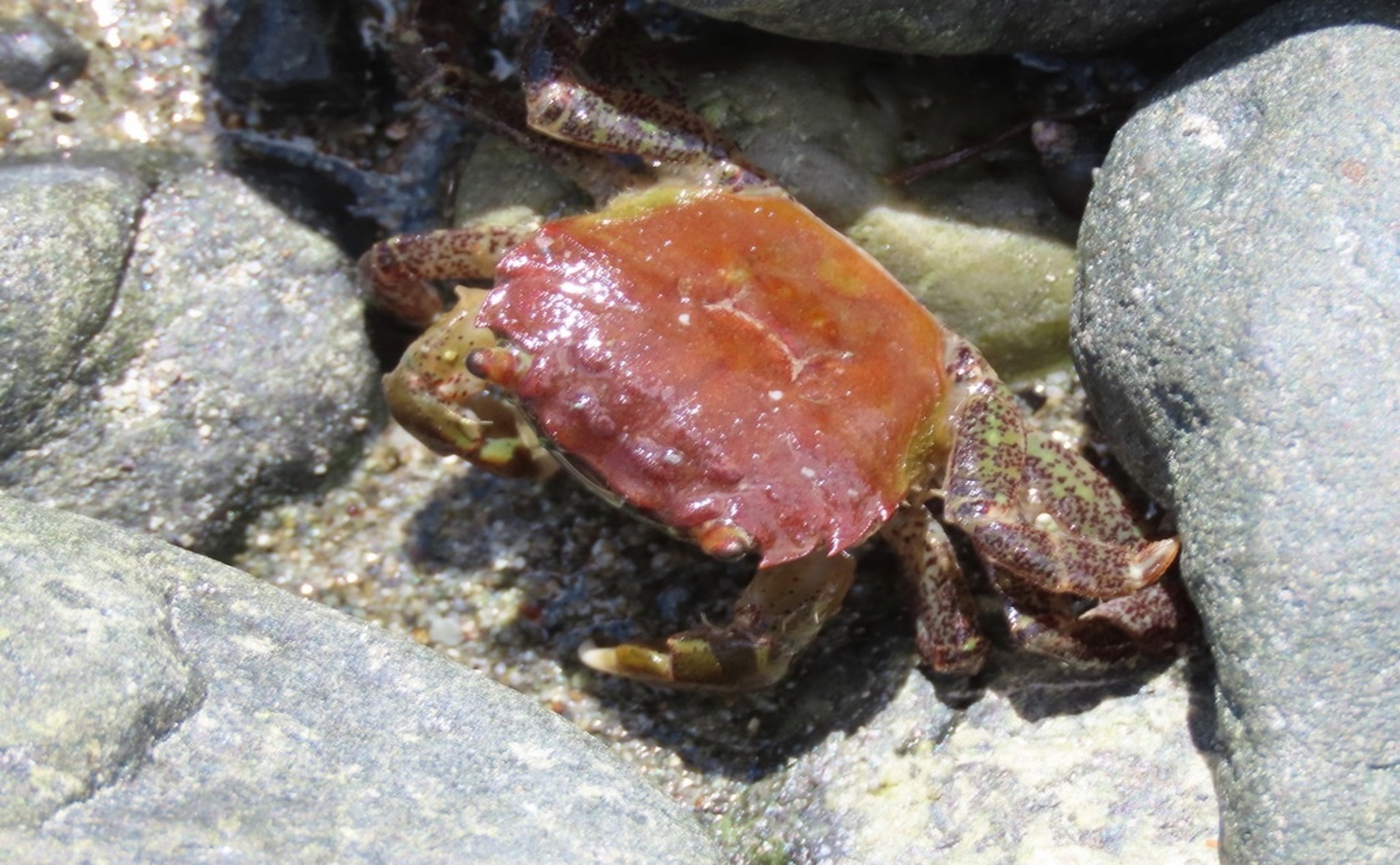
Yellow Shore Crab (Hemigrapsus oregonensis)

Photographer: Erin Springinotic

Key Findings

  • A study on shore crabs in British Columbia found that shipping noise makes them more reactive to simulated predator attacks, causing them to move more often
  • Crabs from naturally noisy areas did not adapt or become tolerant to the sound, and the noise did not affect their shelter-seeking or feeding behaviors
Our oceans are increasingly filled with human-generated sound, a phenomenon now recognized as a significant marine pollutant. This "anthropogenic noise," largely from shipping, has profoundly altered the natural underwater soundscape – the collection of all sounds in an environment. Scientific studies have shown a dramatic rise in ocean noise levels. For instance, measurements in the Northeast Pacific revealed that low-frequency ambient noise, the general background sound, was 10-12 decibels (dB) higher in 2003-2004 than in the mid-1960s[2]. A decibel is a unit used to measure sound intensity, and a 10 dB increase represents a tenfold increase in sound power. This rise, averaging 2.5-3 dB per decade, is closely tied to the doubling of commercial vessels and quadrupling of their gross tonnage globally between 1965 and 2003[2]. The implications of this escalating noise are a growing concern. Research has already demonstrated that this altered soundscape negatively affects marine life. A comprehensive review of studies on fish, for example, found that anthropogenic noise harms their behavior and physiology, impacting crucial aspects like foraging ability, predation risk, and reproductive success[3]. It can also increase their hearing thresholds (meaning they need louder sounds to hear) and elevate stress hormones like cortisol[3]. Similarly, a meta-analysis focusing on aquatic invertebrates – animals without backbones, such as crabs, shrimp, and snails – concluded that human-generated noise has detrimental impacts on their behavior and physiology, with defense responses being particularly affected[4]. This earlier work highlighted that many invertebrate species, especially arthropods and molluscs, are sensitive to these changes[4]. Despite these insights, a critical gap in understanding remained: whether marine invertebrates, often overlooked compared to marine mammals and fish, could develop a tolerance to this constant bombardment of noise. This question was central to a recent study conducted by researchers at the University of British Columbia[1]. Their work focused on the shore crab, Hemigrapsus oregonensis, to investigate the behavioral impacts of shipping noise and whether these crabs could adapt to it. The researchers designed an experiment where they collected cohorts of shore crabs from two distinct locations: one naturally exposed to low noise levels and another to high noise levels. In the laboratory, these crabs were then exposed to playbacks of ship noise, mimicking the real-world acoustic environment. The team measured several key behavioral responses. They observed the crabs' initial reaction to a simulated predator attack, how quickly they sought shelter afterward, and whether their feeding was disrupted by the noise. The findings revealed significant impacts. Crabs exposed to ship noise were 66% more likely to move in response to a simulated predator attack compared to only 32% of crabs in quiet conditions. This suggests that noise can make them more reactive or stressed, potentially affecting their ability to assess threats appropriately. However, the study found that ship noise did not significantly affect how quickly crabs retreated to shelter after an attack, nor did it disrupt their feeding behavior. Crucially, the study found no evidence that crabs from naturally noisy environments had developed a tolerance to the ship noise. The responses of crabs from high-noise sites were not significantly different from those from low-noise sites when exposed to the experimental ship sounds. This suggests that even prolonged exposure to noise in their natural habitat might not equip these creatures with the ability to ignore or adapt to the disturbance, indicating a persistent negative effect. To broaden their understanding, the University of British Columbia team also integrated their results with data from 17 other published studies, performing a meta-analysis specifically on marine arthropods. This larger analysis, building upon the broader invertebrate meta-analysis mentioned earlier[4], confirmed that sound can indeed have a variety of effects on marine arthropods – positive, negative, or neutral – depending on the specific sound source and context. This research underscores the importance of including marine invertebrates in assessments of anthropogenic noise pollution. While previous studies had established the widespread negative effects of noise on fish[3] and aquatic invertebrates generally, including impacts on defense responses[4], this new study provides specific evidence for shore crabs and, importantly, indicates a lack of tolerance. The persistent impact on predator response, even without affecting shelter-seeking or feeding in this specific context, highlights that the consequences of noise pollution can be subtle but still ecologically significant. It emphasizes that the increasing low-frequency noise from shipping[2] is not just a problem for larger marine animals, but also for the smaller, often overlooked, invertebrates that form the base of many marine food webs. Further research is needed to identify the precise conditions under which this pervasive pollutant poses the most severe threats to marine ecosystems.

EnvironmentEcologyMarine Biology

References

Main Study

1) Shipping noise tolerance in invertebrates: A case study of the shore crab Hemigrapsus oregonensis

Published 12th August, 2025

https://doi.org/10.1371/journal.pone.0329098


Related Studies

2) Increases in deep ocean ambient noise in the Northeast Pacific west of San Nicolas Island, California.

Journal: The Journal of the Acoustical Society of America, Issue: Vol 120, Issue 2, Aug 2006


3) Sound the alarm: A meta-analysis on the effect of aquatic noise on fish behavior and physiology.

https://doi.org/10.1111/gcb.14106


4) Marine and Freshwater Sounds Impact Invertebrate Behavior and Physiology: A Meta-Analysis.

https://doi.org/10.1111/gcb.17593


Related Articles

An unhandled error has occurred. Reload 🗙