Using DNA to Track Finless Porpoises and Oceanic Dolphins in the Korean Sea

Jim Crocker
18th May, 2025

Using DNA to Track Finless Porpoises and Oceanic Dolphins in the Korean Sea

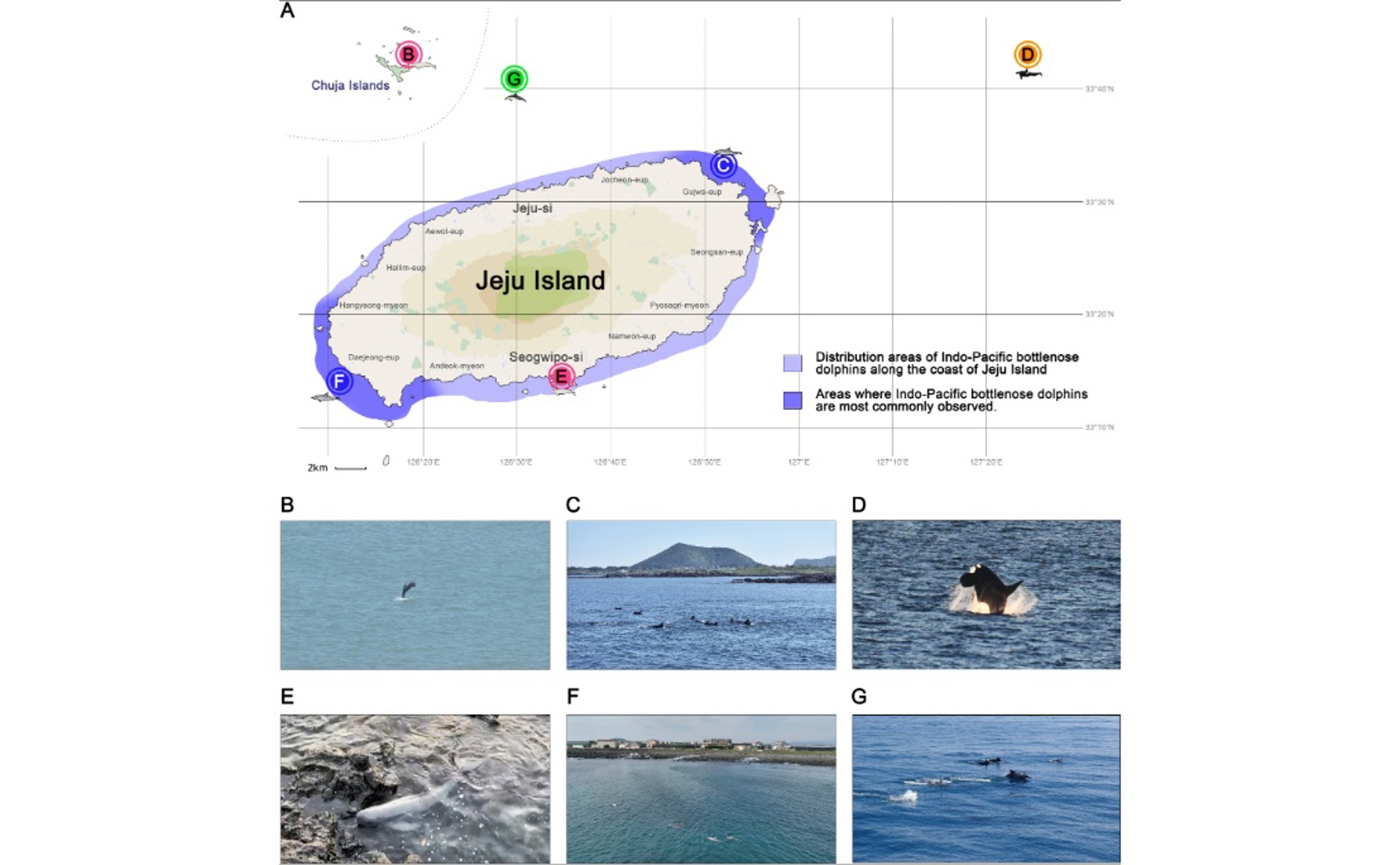
Visual records mapped around Jeju Island (a) corroborate the study's environmental DNA findings by confirming the presence of the narrow-ridged finless porpoise (Neophocaena asiaeorientalis) (b, e), Indo-Pacific bottlenose dolphin (Tursiops aduncus) (c, f), orca (Orcinus orca) (d), and common dolphin (Delphinus delphis) (g) in the surveyed regions.

Image adapted from: Lee et al. / CC BY (Source)

Key Findings

  • Researchers in South Korea successfully detected DNA from finless porpoises and dolphins in the western and southern seas, including around Jeju Island, without needing to see the animals
  • The study confirmed the presence of key marine mammals like finless porpoises, common dolphins, and orcas in areas where they were previously hard to observe
  • Using environmental DNA proved to be an effective, efficient, and non-invasive method for monitoring marine life, enhancing conservation efforts
Environmental DNA (eDNA) is emerging as a valuable tool for monitoring marine life without the need for direct observation. Traditional methods for tracking cetaceans, such as visual surveys and acoustic monitoring, can be time-consuming, expensive, and sometimes ineffective, especially in challenging environments. The recent study conducted by researchers at Seoul National University[1] explores the use of eDNA to monitor cetacean species in the western and southern seas of South Korea, including the waters around Jeju Island. The primary focus of this study was on two key cetaceans found in the Korean Sea: the narrow-ridged finless porpoise (Neophocaena asiaeorientalis sunameri) and various oceanic dolphins belonging to the Delphinidae family. By targeting specific genetic markers, the researchers aimed to detect the presence of these species through the analysis of eDNA collected from seawater samples. eDNA refers to genetic material obtained directly from environmental samples, such as water, without the need to capture or even see the organisms themselves. To identify the most effective genetic markers for detection, the team selected mitochondrial DNA (mtDNA) sequences for the finless porpoise and microsatellite Slo4 regions for oceanic dolphins. These markers were chosen because they were present in high abundance even in low concentration eDNA samples, enhancing the likelihood of accurate detection. A total of 139 water samples were collected from various locations, including the western and southern seas and around Jeju Island. The eDNA was extracted using filter paper with a 5 µm pore size and quantified using quantitative real-time polymerase chain reaction (qPCR), a technique that amplifies DNA sequences to detectable levels. The results were significant. eDNA from finless porpoises was detected in 68% of the samples, indicating a widespread presence, particularly around Jeju Island where visual confirmation of these porpoises had been previously lacking. Oceanic dolphin eDNA was found in 36% of the samples, with specific species such as the common dolphin (Delphinus delphis), orca (Orcinus orca), and Indo-Pacific bottlenose dolphin (Tursiops aduncus) being identified in the Yellow Sea and along the coast of Jeju Island. Notably, the study also identified the presence of bird species, demonstrating the versatility of eDNA in monitoring various forms of wildlife. This approach builds on previous research that has highlighted the potential of eDNA in biodiversity monitoring. For instance, eDNA has been successfully used to estimate fish biodiversity in Korean rivers, identifying numerous species and highlighting the presence of exotic species that could pose conservation challenges[2]. Similarly, studies in marine environments have shown that eDNA can effectively capture a wide range of fish species, often outperforming traditional survey methods[3]. The study by Seoul National University extends these findings to cetaceans, demonstrating that eDNA can be a reliable method for monitoring marine mammals in areas where conventional methods fall short. One of the key advantages of using eDNA is its non-invasive nature, which is particularly important for monitoring endangered or elusive species. Traditional population genetic studies often require the collection of tissue samples, which can be difficult and stressful for the animals involved. eDNA circumvents this issue by allowing researchers to gather genetic material directly from the environment. This method has already proven useful in other contexts, such as tracking the distribution of the Yangtze finless porpoise using eDNA in highly turbid and fast-flowing waters[4]. The current study reinforces the utility of eDNA in diverse and challenging marine settings. The researchers also addressed potential limitations of the eDNA approach. For example, the degradation rate of eDNA in seawater can affect detection probabilities. In the study, experiments showed that small eDNA fragments degrade beyond detectability within days, suggesting that eDNA signals are likely to represent recent presence of the species. This finding aligns with earlier research indicating that eDNA can provide timely insights into species distribution before significant genetic material disperses[5]. Looking forward, the study highlights the need for further development of metabarcoding primers to detect a broader range of cetacean species and to improve the specificity of detection for particular porpoise species. Enhancing the genetic databases used for eDNA analysis will also be crucial for accurately identifying species, especially those that are rare or have similar genetic markers. Overall, the research from Seoul National University demonstrates that eDNA is a promising tool for cetacean monitoring in the Korean Sea. By providing a more efficient and less invasive method for tracking marine mammals, eDNA can significantly contribute to conservation efforts and the sustainable management of marine biodiversity. This study not only confirms the effectiveness of eDNA in detecting cetaceans but also paves the way for its broader application in marine conservation strategies.

EnvironmentEcologyMarine Biology

References

Main Study

1) Distribution analysis of the finless porpoises (Neophocaena sp.) and oceanic dolphins (Delphinidae) in the Korean Sea using environmental DNA

Published 16th May, 2025

https://doi.org/10.1371/journal.pone.0322148


Related Studies

2) Assessment of fish biodiversity in four Korean rivers using environmental DNA metabarcoding.

https://doi.org/10.7717/peerj.9508


3) Detection of a diverse marine fish fauna using environmental DNA from seawater samples.

https://doi.org/10.1371/journal.pone.0041732


4) Investigating the distribution of the Yangtze finless porpoise in the Yangtze River using environmental DNA.

https://doi.org/10.1371/journal.pone.0221120


5) Beyond Biodiversity: Can Environmental DNA (eDNA) Cut It as a Population Genetics Tool?

https://doi.org/10.3390/genes10030192


Related Articles

An unhandled error has occurred. Reload 🗙