Link Between Oyster Deaths and Rising Levels of Harmful Bacteria in Water

Jim Crocker
5th February, 2025

Link Between Oyster Deaths and Rising Levels of Harmful Bacteria in Water

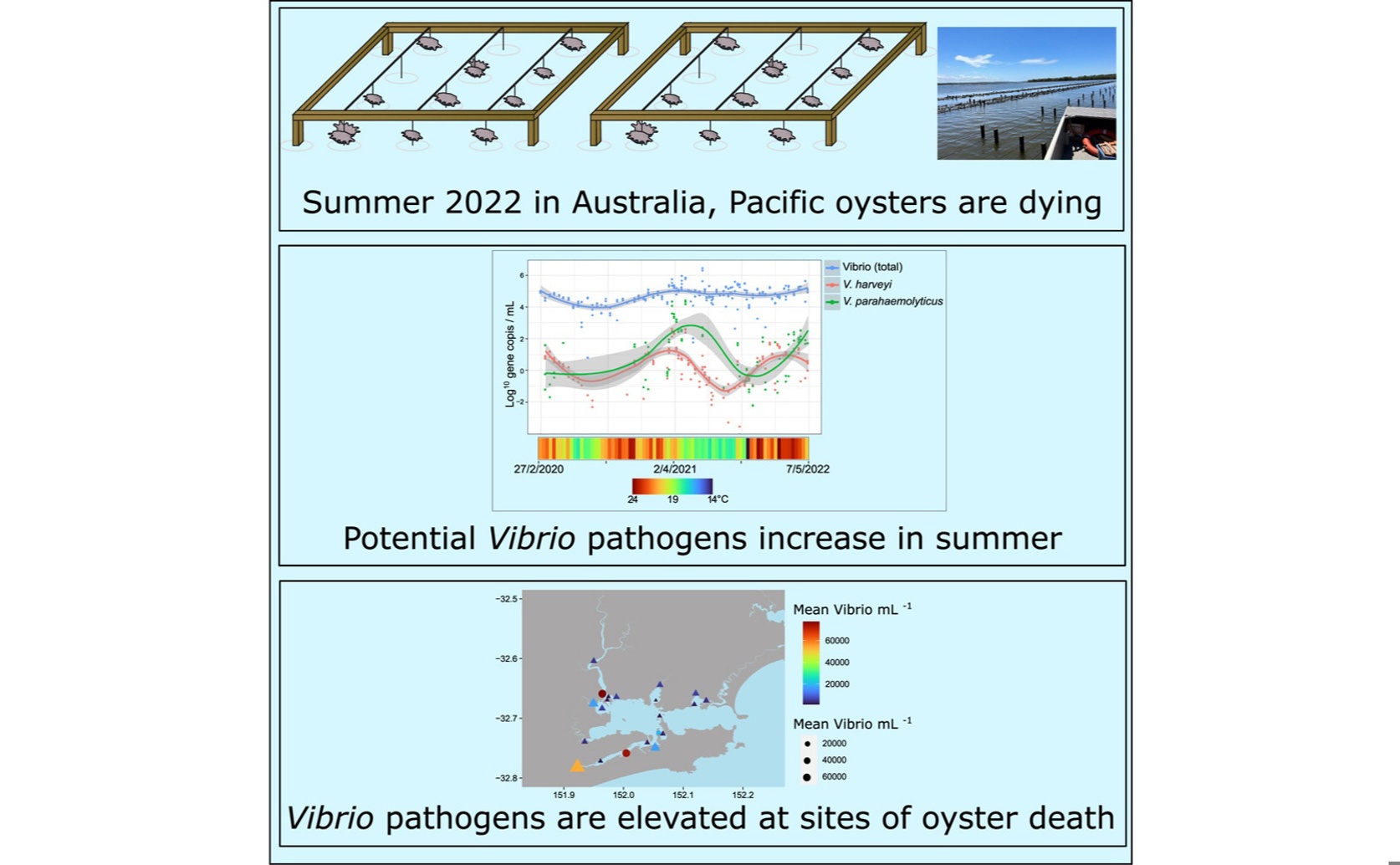
Graphical Abstract from study.

Image adapted from: Scanes et al. / CC BY (Source)

Key Findings

  • A 27-month study in Port Stephens, Australia, found that Vibrio bacteria levels in seawater peak during summer when water temperatures are higher
  • Sites with high oyster mortality had significantly elevated Vibrio levels, which dropped five-fold in the weeks following the mortality event
  • Oysters may act as reservoirs for Vibrio, releasing bacteria into the environment as they die, linking environmental dynamics to disease outbreaks
The Pacific oyster, Crassostrea gigas, is a cornerstone of global aquaculture, representing over 98% of oyster production[2]. However, this species faces significant challenges from diseases such as Pacific Oyster Mortality Syndrome (POMS), a polymicrobial disease that has become a global threat since 2008[2]. POMS involves an initial infection by the Ostreid herpesvirus type 1 µVar (OsHV-1 µVar), which compromises the oyster's immune system, followed by secondary bacterial infections that lead to death[2][3]. While much research has focused on the role of OsHV-1 and bacterial dynamics within oysters, a new study from the University of Technology Sydney provides critical insights into the environmental dynamics of Vibrio bacteria, a group of pathogens implicated in both oyster mortality and human food poisoning[1]. The study conducted a 27-month analysis of seawater microbial communities in Port Stephens, Australia, alongside investigations of oysters during and after a mortality event. Researchers quantified the abundance of Vibrio species, including Vibrio harveyi and Vibrio parahaemolyticus, in seawater and oysters. These bacteria are known to cause diseases in marine organisms and are also linked to foodborne illnesses in humans. The findings revealed that Vibrio populations exhibit seasonal patterns, peaking during the summer months when water temperatures are higher. Moreover, sites with high oyster mortality showed significantly elevated levels of total Vibrio and Vibrio harveyi in the surrounding seawater, with these levels decreasing five-fold in the weeks following the mortality event. These results align with earlier studies showing the critical role of environmental factors, such as temperature, in disease dynamics. For instance, POMS outbreaks have been shown to be influenced by temperature and other environmental variables, which can affect pathogen proliferation and oyster susceptibility[2]. The new study expands on this by directly linking Vibrio abundance in seawater to oyster mortality events, suggesting that elevated temperatures and increased phytoplankton—common during summer months—may stimulate the growth of Vibrio pathogens. This finding is consistent with prior research indicating that the interplay between host, pathogen, and environment is crucial in understanding disease outbreaks[3]. The study's methodology involved a combination of long-term microbial monitoring and targeted sampling during and after oyster mortality events. This approach allowed researchers to capture the temporal dynamics of Vibrio populations and their relationship with oyster health. Notably, the decline in Vibrio levels following mortality events suggests that oysters may act as reservoirs for these bacteria, releasing them into the environment as they succumb to disease. This observation builds on earlier findings that highlighted the rapid transmission of pathogens like OsHV-1 and Vibrio spp. in cohabitation experiments, where pathogen levels in seawater peaked within the first 48 hours of exposure[4]. By linking these environmental dynamics to oyster mortality, the new study provides a more comprehensive understanding of the factors driving disease outbreaks. The implications of these findings are significant for both aquaculture and public health. For oyster farmers, understanding the environmental triggers of Vibrio proliferation could inform management practices, such as monitoring water temperature and phytoplankton levels to predict and mitigate disease outbreaks. Additionally, the study underscores the potential risks to human health, as Vibrio parahaemolyticus is a known cause of foodborne illness. The seasonal peaks in Vibrio abundance observed in the study highlight the need for stricter monitoring and regulation of oyster harvesting during high-risk periods. In conclusion, this research from the University of Technology Sydney advances our understanding of the environmental dynamics of Vibrio bacteria and their role in oyster mortality. By linking microbial community changes to disease events, it complements earlier studies on POMS[2][3][4] and underscores the importance of a holistic approach to managing multifactorial diseases. These findings pave the way for improved strategies to safeguard both aquaculture sustainability and public health in the face of changing environmental conditions.

EnvironmentEcologyMarine Biology

References

Main Study

1) Temporal and spatial co-occurrence of pacific oyster mortality and increased planktonic Vibrio abundance.

Published 21st February, 2025 (future Journal edition)

https://doi.org/10.1016/j.isci.2024.111674


Related Studies

2) The Pacific Oyster Mortality Syndrome, a Polymicrobial and Multifactorial Disease: State of Knowledge and Future Directions.

https://doi.org/10.3389/fimmu.2021.630343


3) Immune-suppression by OsHV-1 viral infection causes fatal bacteraemia in Pacific oysters.

https://doi.org/10.1038/s41467-018-06659-3


4) Fine-scale temporal dynamics of herpes virus and vibrios in seawater during a polymicrobial infection in the Pacific oyster Crassostrea gigas.

https://doi.org/10.3354/dao03384


Related Articles

An unhandled error has occurred. Reload 🗙