Ecosystem Health Index Could Improve Marine Resource Management

Greg Howard
5th September, 2025

Ecosystem Health Index Could Improve Marine Resource Management

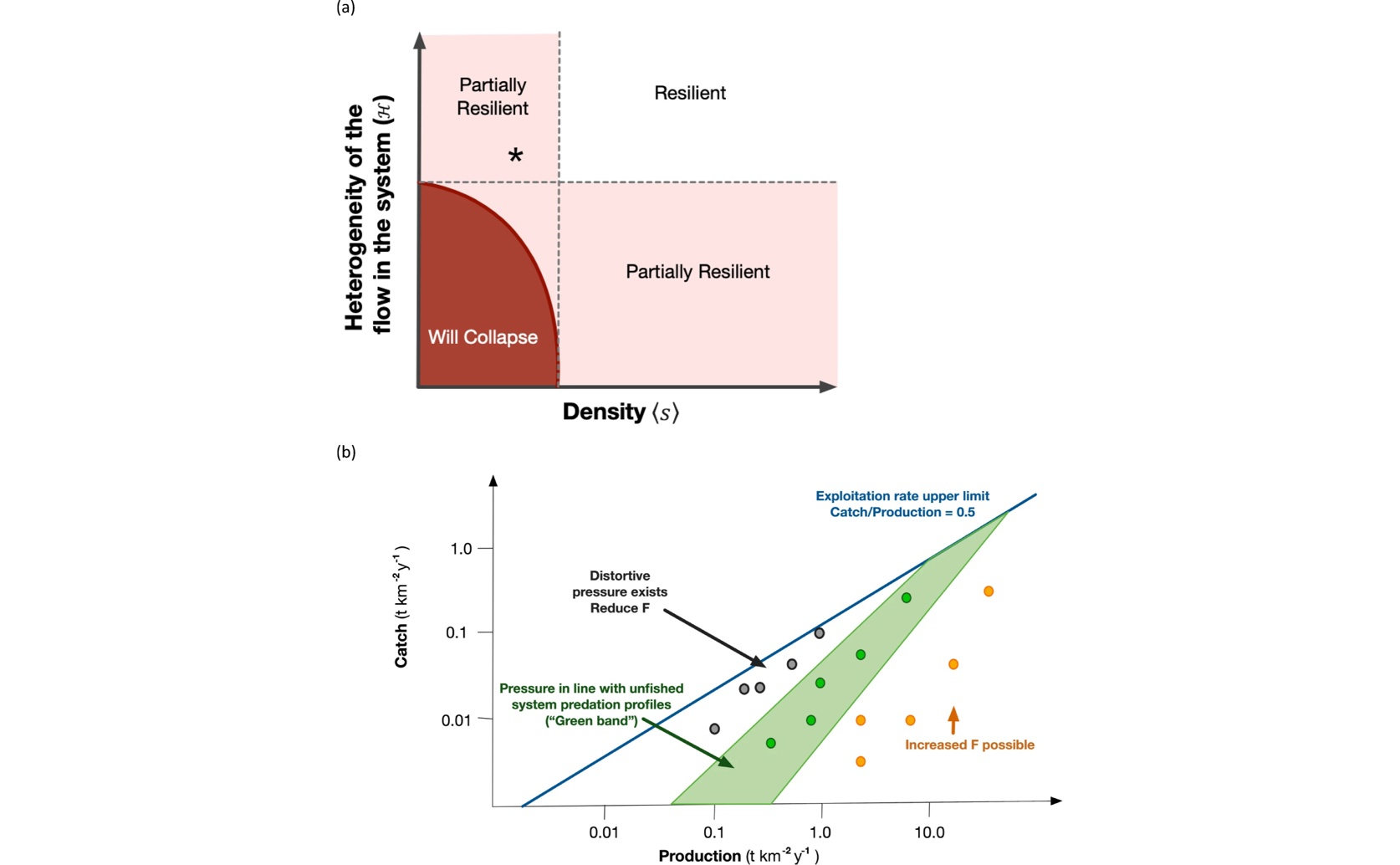
As a composite measure of ecosystem robustness, the Ecosystem Traits Index gauges structural integrity against a network resilience frontier defined by connection density and heterogeneity (a) and assesses the sustainability of fishing mortality relative to a production-based "Green Band" (b).

Image adapted from: Fulton et al. / CC BY (Source)

Key Findings

  • This study, conducted across various marine ecosystems, developed a new method using network theory to assess ecosystem health beyond traditional stock assessments
  • The “Ecosystem Traits Index” (ETI) combines three key indicators—Hub index (critical species), Gao’s resilience score (system stability), and Green Band (human impact)—to rate overall ecosystem state
  • The ETI effectively detected changes in ecosystem health in simulations, responding to both fishing pressure and environmental changes, though it couldn’t pinpoint the specific cause of those changes
Maintaining healthy ecosystems is a global priority, yet traditional methods for assessing ecosystem health often fall short of capturing the complex interactions that underpin a functioning environment. International agreements and national policies frequently aim to conserve ecosystems, but the tools used to measure progress often lack the nuance needed to effectively track structural integrity and function. This is particularly true in fisheries management, where the removal of species can have cascading effects throughout the entire food web. Researchers at CSIRO Environment[1] have developed a new approach using network theory to address this gap, creating a practical set of indicators to measure ecosystem structure and resilience. The core of the new method is an “Ecosystem Traits Index” (ETI). This index isn’t a single measurement, but rather a combination of three key indicators designed to paint a comprehensive picture of ecosystem state. The first, the “Hub index,” identifies species that are critical to the functioning of the ecosystem – those with a disproportionately large number of connections to other species in the food web. Removing these ‘hub’ species can disrupt the entire network. The second indicator, “Gao’s resilience score,” measures the system’s ability to withstand disturbances. A higher score indicates a more resilient ecosystem, characterized by dense connections and efficient flow of energy and resources. Finally, the “Green Band” index quantifies the pressure on the ecosystem structure caused by human activities, specifically mortality rates from harvesting like fishing. This approach builds upon existing research highlighting the importance of understanding how biodiversity influences ecosystem functioning[2][3]. Earlier studies demonstrated that species richness – the number of different species – isn’t the only important factor. Instead, the specific traits of species and their interactions within the food web are crucial. The CSIRO study takes this further by focusing on the network structure itself, recognizing that how species are connected is just as important as which species are present. For example,[3] found that dominance within a food web can play a major role in determining biomass levels, and that generalist species (those with broad diets) can maintain functioning with fewer total species. The Hub index directly addresses this by identifying the most influential species, regardless of their abundance. The researchers tested the ETI in a variety of marine ecosystems, demonstrating its applicability across different environments. The results showed that each ecosystem’s unique state is a result of a combination of factors, including fishing pressure, environmental changes, and the inherent robustness of its structure. Importantly, the indicators were sensitive to changes in ecosystem state, responding rapidly to simulated disturbances. While the ETI can detect that an ecosystem is changing, it doesn't pinpoint the exact cause. It cannot, for instance, distinguish between the effects of overfishing, habitat destruction, or climate change. The utility of this network-based approach extends beyond fisheries management. The principles behind the ETI – focusing on critical species, resilience, and pressure from human activities – can be applied to any marine ecosystem, and potentially to terrestrial and freshwater systems as well. By providing a practical and informative way to measure ecosystem structure, the CSIRO study offers a valuable tool for conservation efforts and resource management.

EnvironmentEcologyMarine Biology

References

Main Study

1) The ecosystem traits index is proposed as a composite index of ecosystem robustness for use in marine resource management

Published 2nd September, 2025

https://doi.org/10.1038/s41598-025-15322-z


Related Studies

2) Parsing human and biophysical drivers of coral reef regimes.

https://doi.org/10.1098/rspb.2018.2544


3) Biodiversity and ecosystem functioning in dynamic landscapes.

https://doi.org/10.1098/rstb.2015.0267


Related Articles

An unhandled error has occurred. Reload 🗙