Root rot fungus uses RNA interference to adapt and survive

Jenn Hoskins
2nd February, 2026

Root rot fungus uses RNA interference to adapt and survive

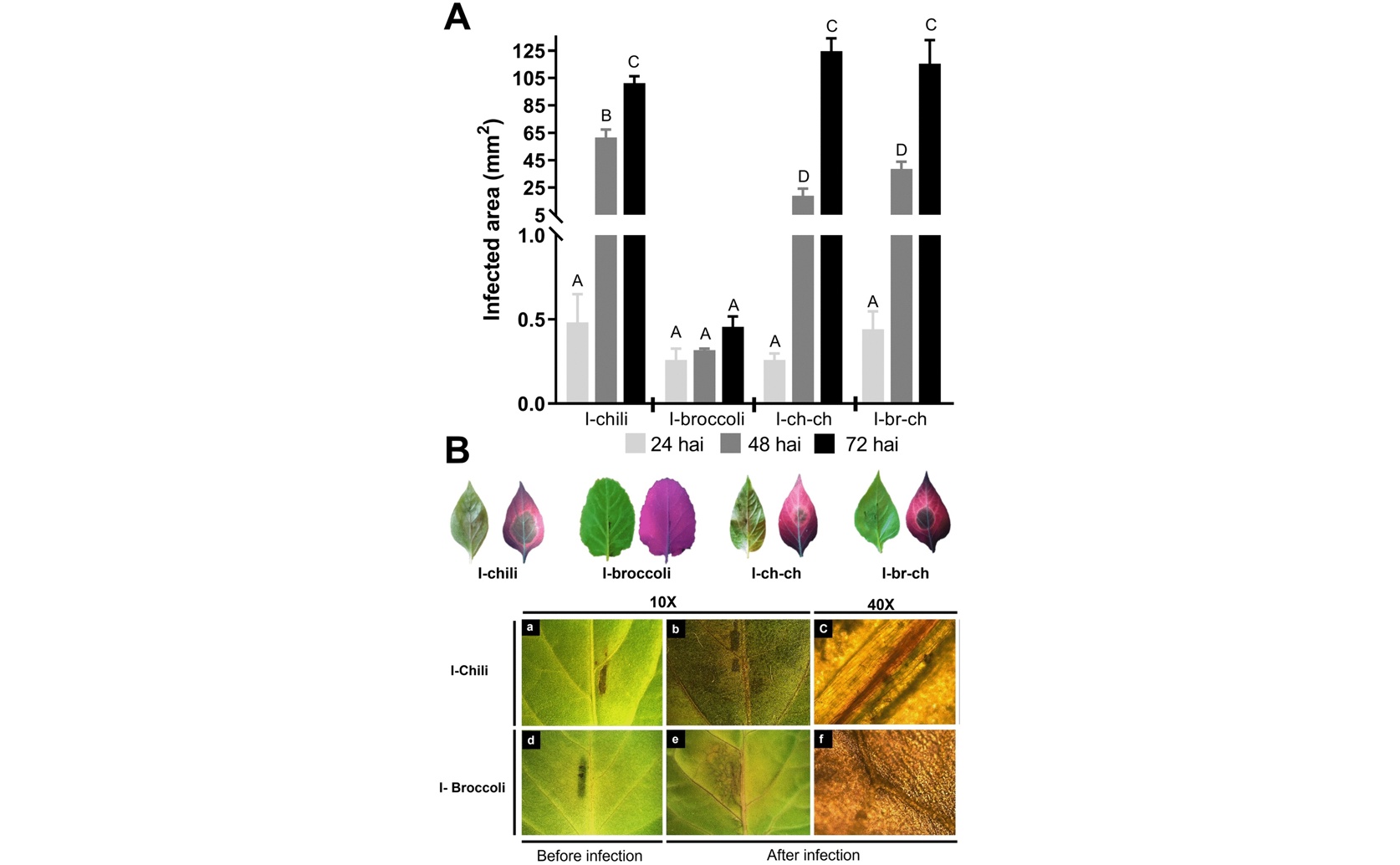
Phytophthora capsici exhibited greater virulence on chili pepper than broccoli leaves across all timepoints (a), with distinct infection phenotypes characterized by necrosis and biotrophic zones visible under natural and UV light (b).

Image adapted from: Sevillano-Serrano et al. / CC BY (Source)

Key Findings

  • Researchers at UNAM identified key genes in P. capsici responsible for RNA interference, a process regulating gene activity
  • P. capsici possesses a complete RNAi system with components similar to those found in other Phytophthora species, suggesting a conserved function
  • Expression of these RNAi-related genes varied depending on whether P. capsici had previously infected chili pepper or broccoli plants, indicating host influence on pathogen gene regulation
Phytophthora capsici is a widespread plant pathogen capable of infecting a large number of economically important crops, including beans, cucurbits (squashes, melons, cucumbers), and peppers[2]. It causes significant damage through root rot, stem blight, and fruit rot, leading to substantial yield losses. Controlling this pathogen is challenging due to its adaptability and rapid evolution. Traditionally, farmers have relied on fungicides, but the development of resistance and environmental concerns necessitate new strategies. Recent research has focused on understanding the pathogen’s internal mechanisms to identify potential targets for novel control methods. A study conducted by researchers at UNAM, Benemérita Universidad Autónoma de Puebla[1], investigated the RNA interference (RNAi) pathway in P. capsici. RNAi is a natural process within cells where genetic information is regulated or silenced. It’s a complex system involving small RNA molecules (sRNAs) that can control which genes are active. Understanding this pathway in P. capsici could reveal how the pathogen controls its virulence – its ability to cause disease – and potentially offer a way to disrupt this process. The research team began by analyzing the P. capsici genome and its proteins (proteome) using computational methods. This allowed them to identify genes predicted to be involved in the RNAi pathway. They discovered that P. capsici possesses all the key components expected for a fully functional RNAi system, including proteins like Dcl1, Dcl2, Exportin-5, Rdr, and six Ago proteins. These proteins play specific roles: Dcl proteins are responsible for cutting RNA into smaller pieces, Exportin-5 transports these small RNAs around the cell, Rdr amplifies the RNAi signal, and Ago proteins are central to silencing gene expression. The fact that these genes were similar to those found in other Phytophthora species suggests a conserved role for RNAi within this genus. To understand how the RNAi pathway functions during infection, the researchers examined the activity (expression levels) of these genes in P. capsici after it infected chili pepper and broccoli plants across two successive generations of infection. They found that the expression of these RNAi-related genes varied depending on whether the pathogen had previously infected a host. This suggests that the host plant influences the activity of the RNAi pathway in P. capsici. Interestingly, the study identified and characterized the EXPORTIN-5 gene in P. capsici for the first time, not only in this species but also within other oomycetes. This finding is significant because Exportin-5 is crucial for transporting small RNA molecules, making it a central player in the RNAi pathway. This work builds on previous understanding of oomycete virulence mechanisms[3], which highlights the importance of protein toxins and cell-entering effectors. The discovery of a complete RNAi pathway in P. capsici adds another layer of complexity to this picture. Furthermore, P. capsici’s position as a significant plant pathogen, ranking fifth in importance among plant-pathogenic oomycetes[4], underscores the relevance of this research. The study also resonates with findings from earlier work showing that P. capsici can infect bean cultivars, previously thought to be safe rotations for susceptible crops[2], highlighting its adaptability and the need for innovative control strategies. The research team’s work is a first step towards understanding the role of RNAi in P. capsici virulence. Future studies will focus on experimentally confirming the function of these genes and exploring whether manipulating the RNAi pathway can reduce the pathogen’s ability to cause disease. The identification of these genes provides potential new targets for developing environmentally friendly control methods, such as using RNA-based technologies to silence virulence genes in the pathogen.

GeneticsBiochemPlant Science

References

Main Study

1) Phytophthora capsici carries and differentially expresses genes for the RNA interference pathway

Published 30th January, 2026

https://doi.org/10.1371/journal.pone.0333769


Related Studies

2) Characterization of Phytophthora capsici Causing Foliar and Pod Blight of Snap Bean in Michigan.

https://doi.org/10.1094/PDIS-92-2-0201


3) Mechanisms and evolution of virulence in oomycetes.

https://doi.org/10.1146/annurev-phyto-081211-172912


4) The Top 10 oomycete pathogens in molecular plant pathology.

https://doi.org/10.1111/mpp.12190


Related Articles

An unhandled error has occurred. Reload 🗙