Plant hormone production is linked to daily rhythms and carbon dioxide levels

Greg Howard
10th December, 2025

Plant hormone production is linked to daily rhythms and carbon dioxide levels

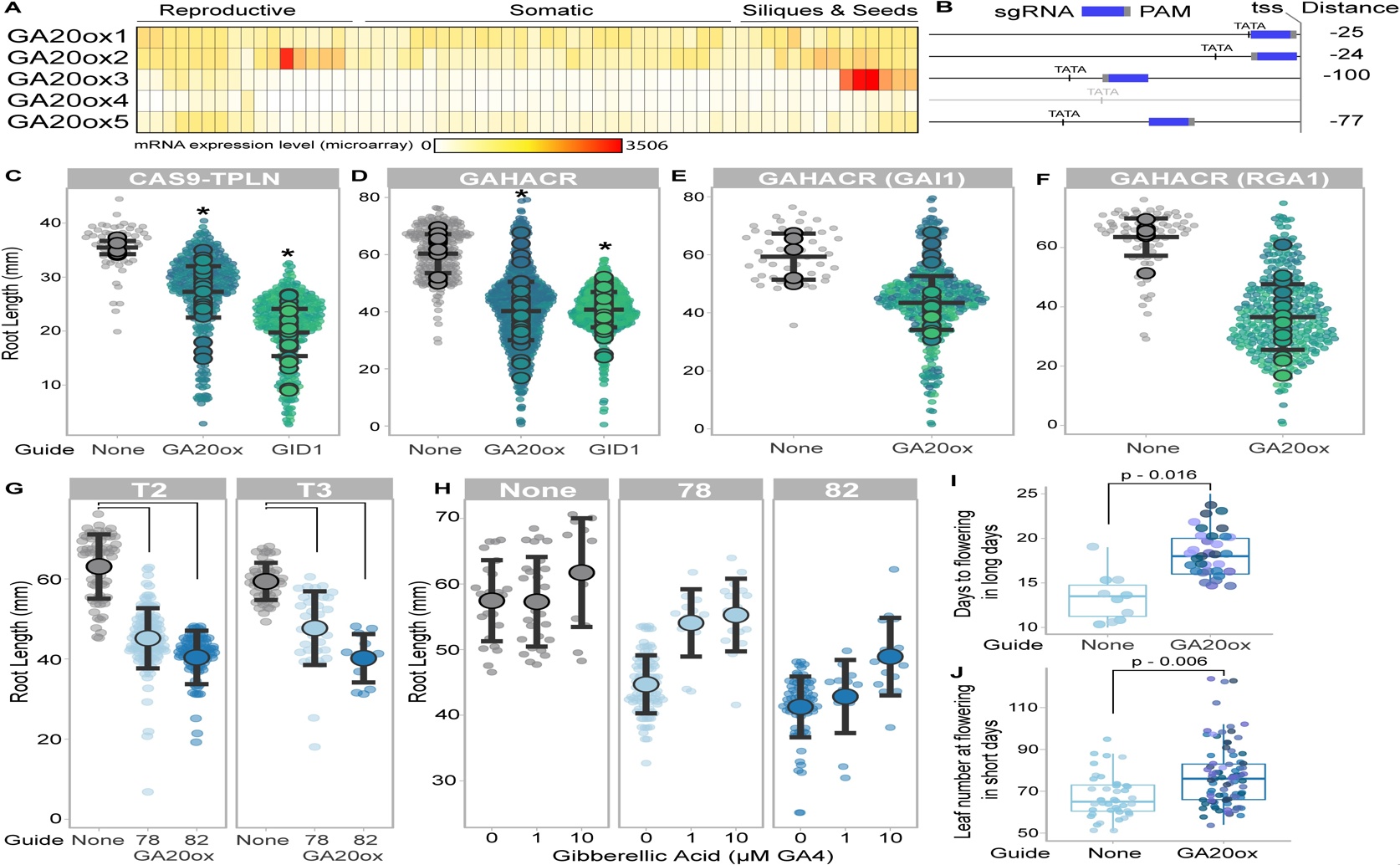
Repressing gibberellin biosynthesis genes (GA20ox) in Arabidopsis thaliana using a synthetic GAHACR system results in predictably shorter roots and delayed flowering (c–g, i–j), phenotypes confirmed to be GA-dependent by their rescue with external hormone application (h).

Image adapted from: Leydon et al. / CC BY (Source)

Key Findings

  • Researchers engineered a tool to precisely control gibberellin (GA) levels in Arabidopsis plants to study GA signaling
  • Reducing GA levels altered root growth and flowering time, consistent with GA’s known roles in plant development
  • Lowering GA signaling disrupted the plant’s internal clock, with this effect lessened when plants were grown in higher carbon dioxide levels
Gibberellins (GAs) are plant hormones crucial for growth and development, and breeders have long exploited their influence to improve crop yields. Understanding how plants regulate GA levels is therefore vital for continued agricultural progress. Researchers at the University of Washington, Colorado State University, and the Yunnan Academy of Agricultural Sciences have now developed a new tool to precisely control GA levels within plants and have used it to uncover a surprising link between GA signaling and the plant’s internal clock. The team built upon previous work demonstrating a “Hormone Activated CAS9-based Repressor” (GAHACR) system[1]. This system allows scientists to selectively reduce the activity of genes regulated by GA. Unlike traditional methods of altering GA levels, which can be difficult to fine-tune, GAHACRs offer a targeted approach. To understand how this system works, it’s important to understand that genes don’t act in isolation; they often participate in feedback loops, where the product of a gene influences its own production. The researchers aimed to determine how important these feedback loops are to GA signaling. They started by using mathematical models to predict the effect of reducing GA levels at different points in the GA biosynthesis pathway – the series of steps plants use to create GA. The models pointed to two key targets: GA20 oxidase (GA20ox), an enzyme involved in GA production, and GID1, the GA receptor, which is responsible for detecting GA. They then engineered Arabidopsis thaliana plants, a common model organism, to reduce the activity of either GA20ox or GID1 using their GAHACR system. By lowering GA levels in this way, they observed changes in several key plant characteristics: primary root length and flowering time. These findings align with the known roles of GA in promoting growth and flowering[2][3][4]. However, the most unexpected discovery came from analyzing the plants’ transcriptomes – the complete set of RNA molecules present, which provides a snapshot of gene activity. The analysis revealed a strong connection between GA signaling and the plant’s circadian clock – the internal timing mechanism that regulates daily rhythms. Plants with reduced GA signaling showed disruptions in the expression of genes normally controlled by the circadian clock. Interestingly, this connection was significantly weakened when the plants were grown in elevated carbon dioxide levels. This is particularly noteworthy because atmospheric carbon dioxide levels are rising due to human activity. The researchers’ findings suggest that increased CO2 could potentially counteract the effects of GA manipulation, meaning that gains achieved through breeding efforts to optimize GA signaling may be reversed in the future. Previous studies have established that GA plays a complex role in plant development, influencing processes such as seed germination, stem elongation, and flower initiation[2][3][4][5]. For instance, it’s known that GA is essential for the transition from a dark-grown seedling state to a light-grown state, repressing photomorphogenesis in darkness, and that this regulation involves interactions with other hormones like brassinosteroids[2]. Furthermore, GA coordinates with ethylene to regulate hook development, a process crucial for seedling emergence from the soil[5], and influences embryo development by interacting with key regulators like LEC1[3]. The current study builds on this knowledge by identifying a specific node – the GA signaling pathway itself – that can be engineered to modulate plant size and flowering time. It also highlights a previously unappreciated link between GA signaling and the circadian clock, adding a new layer of complexity to our understanding of plant hormone regulation.

BiochemEcologyPlant Science

References

Main Study

1) Reprogramming feedback strength in gibberellin biosynthesis highlights conditional regulation by the circadian clock and carbon dioxide

Published 9th December, 2025

https://doi.org/10.1371/journal.pone.0337439


Related Studies

2) Gibberellins repress photomorphogenesis in darkness.

Journal: Plant physiology, Issue: Vol 134, Issue 3, Mar 2004


3) Gibberellins play an essential role in late embryogenesis of Arabidopsis.

https://doi.org/10.1038/s41477-018-0143-8


4) Gibberellin as a factor in floral regulatory networks.

https://doi.org/10.1093/jxb/erp040


5) Coordinated regulation of apical hook development by gibberellins and ethylene in etiolated Arabidopsis seedlings.

https://doi.org/10.1038/cr.2012.29


Related Articles

An unhandled error has occurred. Reload 🗙