Plants' Defense Strategy: Start Cheap, Then Stronger

Jenn Hoskins
15th August, 2025

Plants' Defense Strategy: Start Cheap, Then Stronger

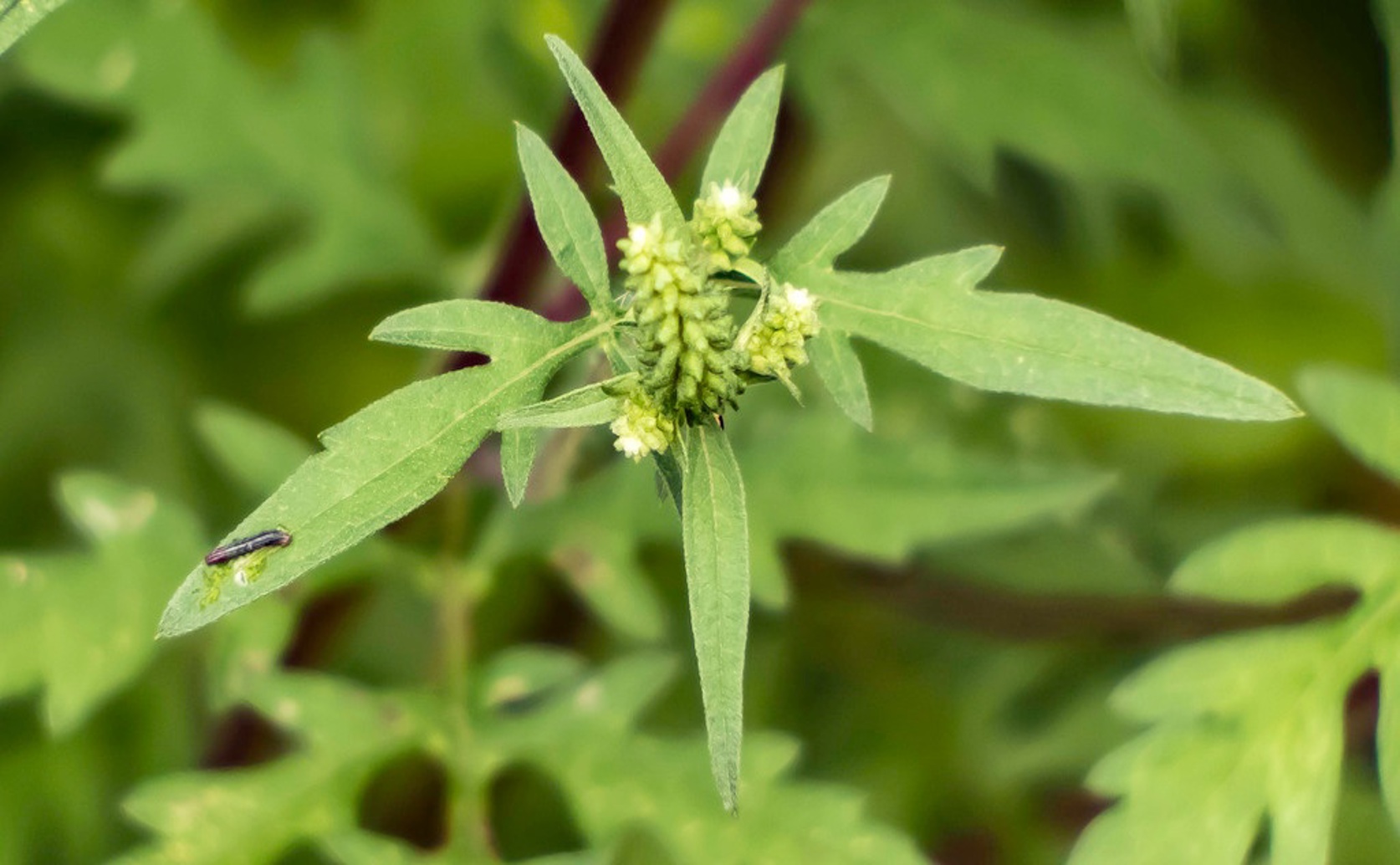
Common ragweed (Ambrosia artemisiifolia)

Photo adapted from: David Hebert / CC BY (Source)

Key Findings

  • Researchers in Wuhan, China, found that common ragweed uses six defense traits against insects, with some like tough leaves and certain chemicals being more costly to produce than others
  • The plant activates its cheaper defenses first, even for minor insect damage, only deploying more costly defenses when attacks become severe
  • This "cheaper first" strategy consistently helps plants save energy by only using stronger defenses when truly necessary, optimizing their survival
Plants face a constant battle for survival against a myriad of threats, particularly from insect herbivores that feed on their tissues. To defend themselves, plants have evolved a diverse arsenal of defense mechanisms. However, producing these defenses is not without cost. Resources invested in defense, such as energy and nutrients, cannot be simultaneously used for growth, reproduction, or other vital functions. This fundamental trade-off, where an increase in one beneficial trait (like defense) comes at the expense of another (like growth), is a well-established concept in plant biology[2][3]. Understanding how plants manage these inherent costs, especially when faced with varying levels of threat, is crucial to comprehending their survival strategies in natural environments. A recent study by researchers from Wuhan Botanical Garden, Chinese Academy of Sciences, University of Chinese Academy of Sciences, School of Life Sciences, Henan University, Department of Biosciences, Rice University, Institute of Plant Sciences, University of Bern, and Cornell University sheds light on this very challenge[1]. The research explored a hypothesis known as the "cheaper first" strategy, which proposes that plants might activate their less costly defense mechanisms initially, reserving more resource-intensive defenses for situations involving more severe or persistent damage. While this idea makes intuitive sense from an evolutionary perspective, concrete evidence for such a finely tuned, cost-dependent sequential defense strategy in plants has been scarce. To test this hypothesis, the scientists focused on Ambrosia artemisiifolia, a common annual plant. They identified and measured six different defense traits that the plant employs against insect herbivores. These traits could include anything from physical barriers like tough leaves to chemical compounds that deter feeding or are toxic to insects. A key part of their investigation involved determining the effectiveness of each trait against various insect herbivores and, crucially, quantifying the "growth costs" associated with producing them. Growth costs refer to the negative impact a defense trait has on the plant's ability to grow, accumulate biomass, or develop normally. Their initial findings confirmed that all six traits were indeed effective in deterring or harming insect herbivores, but three of these traits significantly reduced plant growth, indicating they were more costly to produce. This aligns with previous research highlighting that the size of a plant's molecular defense repertoire can negatively correlate with its growth in wild species[2], underscoring the pervasive nature of these defense costs. The core of the study involved observing how Ambrosia artemisiifolia responded to different levels of damage inflicted by insect herbivores. They challenged the plants with 12 different herbivore species from three distinct insect orders, simulating a wide range of natural attacks. The results provided compelling evidence for the "cheaper first" strategy. They found that the less costly defense traits were activated first, even when the plants experienced only the lowest levels of damage. It was only when the damage reached higher thresholds that the more costly defense traits were deployed. This sequential activation, where defenses are triggered based on specific damage levels, is an example of a "threshold trait" in action. Theoretical models of prey defenses, which also consider trade-offs between defense and other vital functions like reproduction, suggest that such threshold-based strategies can emerge as evolutionarily stable solutions[4]. This cost-dependent sequential pattern was not a one-off observation; it was consistently seen across all 12 different herbivore species used in the experiment. This consistency suggests that the "cheaper first" strategy is a robust and adaptive mechanism for Ambrosia artemisiifolia to manage its defense budget. The findings from this study provide significant new insights into how plants fine-tune their defense responses under variable antagonistic pressures. By employing a "cheaper first" sequential induction defense strategy, plants can potentially minimize the overall fitness costs associated with defense. This allows them to optimize their resource allocation, deploying only the necessary level of defense for a given threat, thereby maximizing their overall fitness and chances of survival and reproduction. This sophisticated approach demonstrates that defense trade-offs are not merely passive constraints but often the result of active "regulatory decisions" by the plant, enabling it to fine-tune its phenotype in response to diverse environmental challenges[3]. The study expands our understanding of how plants actively manage the fundamental growth-defense trade-off, moving beyond simply acknowledging its existence to revealing the intricate strategies plants employ to navigate this ecological dilemma.

BiochemEcologyPlant Science

References

Main Study

1) Plants respond to herbivory through sequential induction of cheaper defenses before more costly ones

Published 14th August, 2025

Journal: PLOS Biology

Issue: Vol. 23, Iss. 8


Related Studies

2) A trade-off between investment in molecular defense repertoires and growth in plants.

https://doi.org/10.1126/science.adn2779


3) Trade-Offs Between Plant Growth and Defense Against Insect Herbivory: An Emerging Mechanistic Synthesis.

https://doi.org/10.1146/annurev-arplant-042916-040856


4) Inducible defenses: continuous reaction norms or threshold traits?

https://doi.org/10.1086/661250


Related Articles

An unhandled error has occurred. Reload 🗙