How plant hormones trigger sex change and new growth in ferns

Jenn Hoskins
27th January, 2026

How plant hormones trigger sex change and new growth in ferns

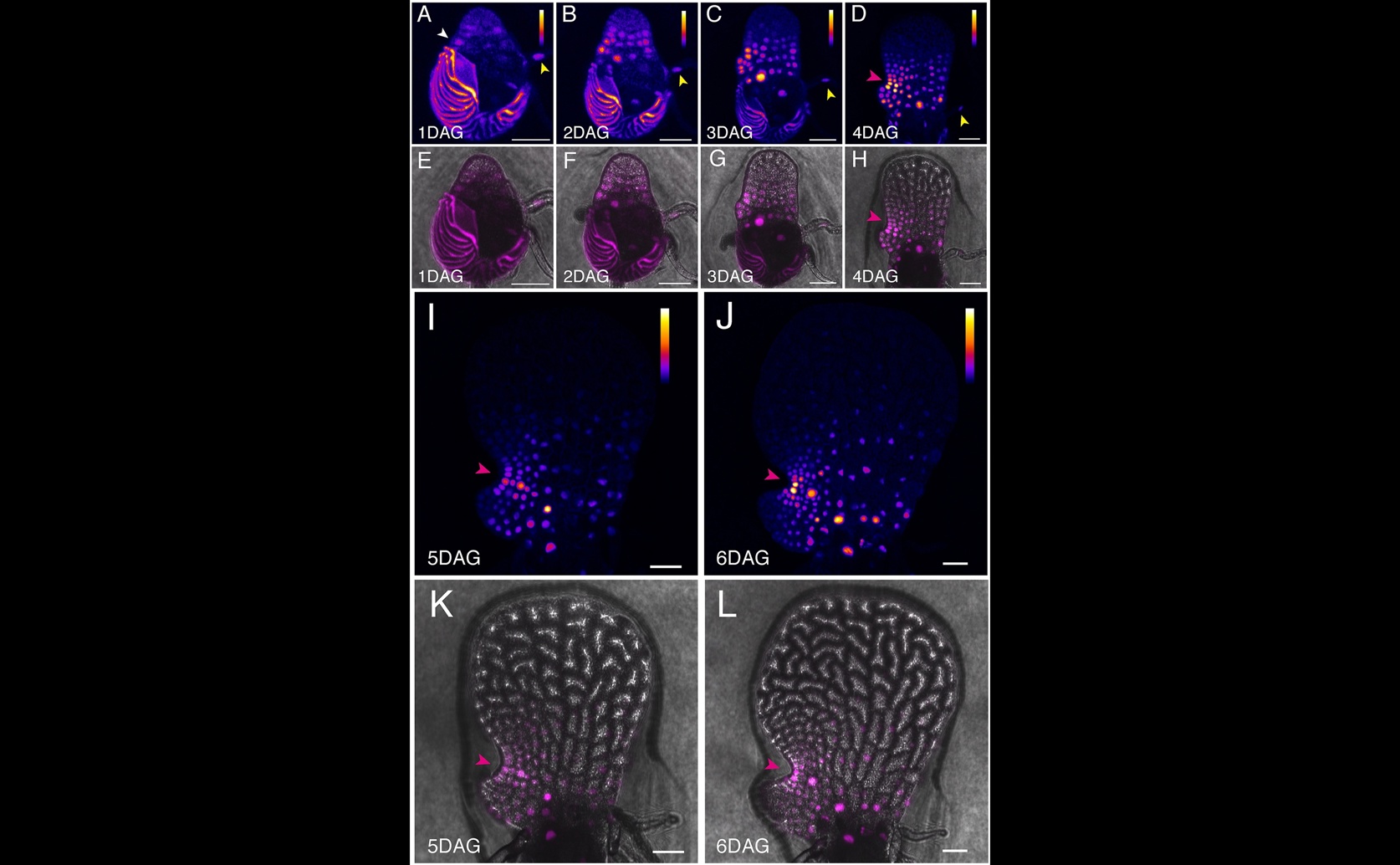
During the normal development of a Ceratopteris hermaphrodite, auxin signaling progressively concentrates into a distinct peak at the center of the proliferating multicellular meristem (d, h, i–l), establishing the key molecular pattern that drives de novo meristem formation during male-to-hermaphrodite conversion.

Image adapted from: Lai et al. / CC BY (Source)

Key Findings

  • In ferns grown in Purdue, male gametophytes can convert to hermaphrodites when antheridiogen is absent
  • This conversion requires localized auxin production, creating a peak of auxin signaling at the site of new growth
  • The CrTAA1 gene is essential for initiating this auxin production and successful male-to-hermaphrodite transition
Land plants exhibit alternating generations between an asexual sporophyte phase and a sexual gametophyte phase. While seed plants have a reduced gametophyte generation, ferns possess free-living gametophytes capable of independent growth. These gametophytes of the model fern Ceratopteris richardii can exist as either hermaphrodites or males, and their development is influenced by chemical signaling[1]. Understanding how these gametophytes switch between sex types is a key question in plant developmental biology. Traditionally, shoot development studies have focused on flowering plants (angiosperms)[2]. However, these studies may not fully represent the evolutionary history of shoot development, as angiosperms are the most recently diverged plant lineage. Non-seed plants, like mosses, develop shoots differently, making direct comparisons difficult. Ferns, as the sister group to seed plants, offer a valuable middle ground for understanding the evolution of these developmental mechanisms[2][3]. Ceratopteris richardii has recently emerged as a powerful model system for fern research due to advancements in genetic tools, allowing scientists to directly test gene function[3]. The research conducted by scientists at Purdue University and Caltech investigated the molecular signals driving the conversion of male Ceratopteris gametophytes into hermaphrodites. This conversion is a striking example of developmental plasticity – the ability of an organism to alter its development in response to environmental cues. Specifically, when the pheromone antheridiogen is absent, males can initiate new growth centers called meristems, ultimately transforming into hermaphrodites. The study’s focus was to identify the signals that trigger this meristem formation. The researchers discovered that local production of the plant hormone auxin plays a critical role in this process. Auxin is known to be important for plant growth and development, and the study showed that its production is dynamically regulated during sex-type conversion. Upon removal of antheridiogen, auxin signaling is activated specifically at the site where the new meristem will form. This signaling creates localized “maxima” of auxin concentration, which are essential for initiating and promoting the growth of a single cell known as the meristem progenitor cell (MPC). To investigate this further, the team used time-lapse imaging to observe the process at single-cell resolution, reconstructing the lineage and division patterns of cells during conversion. They found that the MPC originates from a single non-antheridium cell, and its proliferation (rapid cell division) is crucial for establishing the meristem. This builds on previous research demonstrating that male gametophytes can convert to hermaphrodites via de novo meristem formation[4]. The researchers then used a computational model to understand the dynamics of gametophyte growth. This model suggested that random variations in cell division, combined with inhibitory signals from dividing cells, could explain the observed patterns. To test this, they chemically inhibited the activity of a gene called CrTAA1, which is involved in auxin biosynthesis. Blocking CrTAA1 disrupted the dynamic auxin patterns, preventing the MPC lineage from initiating and halting meristem formation. Further confirmation came from genetic experiments using CRISPR-Cas9 technology to knock out the CrTAA1 gene. Gametophytes with a non-functional CrTAA1 gene exhibited the same phenotype as those treated with the chemical inhibitor – they were unable to form new meristems and failed to convert from male to hermaphrodite. These results provide strong evidence that auxin biosynthesis, regulated by CrTAA1, is essential for orchestrating cell fate and proliferation during meristem formation and sex-type conversion. This study highlights the importance of auxin signaling in regulating developmental plasticity in land plants and provides a molecular mechanism for understanding how gametophytes respond to environmental cues. It also reinforces the value of Ceratopteris richardii as a model system for bridging the knowledge gap between angiosperms and non-vascular plants[3].

BiochemEcologyPlant Science

References

Main Study

1) Dynamic auxin maxima regulate male-to-hermaphrodite conversion and de novo meristem formation in the fern Ceratopteris gametophytes

Published 23rd January, 2026

https://doi.org/10.1371/journal.pbio.3003592


Related Studies

2) Ferns: the missing link in shoot evolution and development.

https://doi.org/10.3389/fpls.2015.00972


3) An ontogenetic framework for functional studies in the model fern Ceratopteris richardii.

https://doi.org/10.1016/j.ydbio.2019.08.017


4) Single cell-derived multicellular meristem: insights into male-to-hermaphrodite conversion and de novo meristem formation in Ceratopteris.

https://doi.org/10.1242/dev.204411


Related Articles

An unhandled error has occurred. Reload 🗙