How Viral Proteins 3 and 5 Interact with Human Fat-Making Enzyme

Jenn Hoskins
25th March, 2025

How Viral Proteins 3 and 5 Interact with Human Fat-Making Enzyme

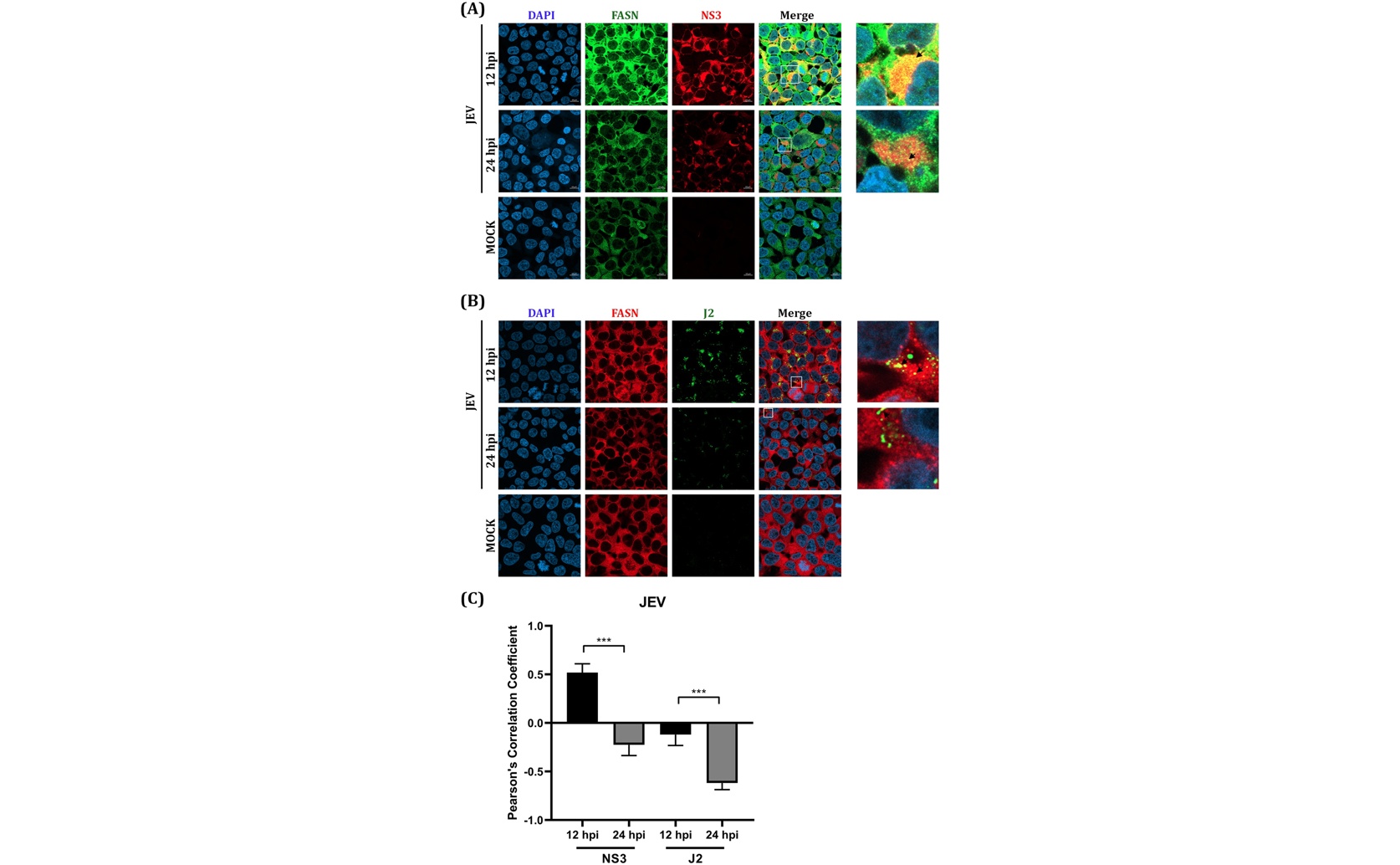
In cells infected with Japanese encephalitis virus (JEV), the host enzyme FASN is recruited to the viral replication machinery, as shown by its transient colocalization with the viral protein NS3 (a) and a dynamic association with the replication complex marker dsRNA (b, c).

Image adapted from: Sornprasert et al. / CC BY (Source)

Key Findings

  • *Researchers in Thailand and México identified that the enzyme FASN interacts with dengue, zika, and Japanese encephalitis viruses.*
  • *FASN assists these viruses in replicating by partnering with their proteins NS3 and NS5.*
  • *Targeting FASN could pave the way for developing treatments against multiple mosquito-borne diseases.*
Mosquito-transmitted viruses in the Orthoflavivirus genus, including dengue virus (DENV), Zika virus (ZIKV), and Japanese encephalitis virus (JEV), continue to pose significant public health challenges in tropical and subtropical regions worldwide[2]. Despite their impact, there are currently no approved therapeutic drugs to treat infections caused by these viruses, underscoring the urgent need for a deeper understanding of their replication mechanisms. Researchers at Mahidol University in Thailand and Instituto Nacional de Salud Pública in México conducted a study to explore potential targets for developing treatments against these viruses[1]. Flaviviruses like DENV, ZIKV, and JEV rely on the host's cellular machinery to replicate. Previous studies have indicated that lipid metabolism, particularly the synthesis of fatty acids, is altered during viral infection[2]. Fatty acid synthase (FASN) is a crucial enzyme in the biosynthesis of fatty acids, which are essential components of cell membranes and are involved in various cellular processes. It has been reported that FASN interacts with the NS3 protein of DENV and is located within the viral replication complex, a hub where the virus replicates its genetic material[2]. Building on this knowledge, the recent study investigated how FASN interacts with two viral proteins, NS3 and NS5, across different Orthoflaviviruses. Using techniques such as coimmunoprecipitation and indirect immunofluorescent assays, the researchers discovered that FASN interacts independently with both NS3 and NS5 proteins in DENV, ZIKV, and JEV. Interestingly, while FASN and NS3 were found to colocalize—meaning they occupy the same space within the cell—for all three viruses, the interaction between FASN and NS5 did not result in colocalization. This suggests that FASN may play distinct roles in the replication processes mediated by these viral proteins. Further analysis revealed that FASN colocalizes with double-stranded RNA (dsRNA), a marker indicative of the viral replication complex. This finding highlights FASN's essential role not only in fatty acid biosynthesis but also in the formation and functioning of the replication complex and the remodeling of cellular membranes necessary for viral replication. By associating with both NS3 and NS5, FASN appears to be a pivotal factor in the life cycle of Orthoflaviviruses, making it a promising target for therapeutic intervention. Understanding the interaction between viral proteins and host enzymes like FASN aligns with broader efforts to map and mitigate the global burden of diseases such as dengue. Previous research has mapped the global distribution and public health impact of dengue, estimating hundreds of millions of infections annually and highlighting the influence of factors like rainfall, temperature, and urbanization on its spread[3]. By identifying key host factors involved in viral replication, such as FASN, the current study provides new avenues for developing treatments that could complement existing vector control strategies and potentially reduce the incidence of these infections. Moreover, the study's findings resonate with the challenges outlined in the context of emerging and re-emerging pathogens, as discussed in recent analyses of neurotropic viruses like West Nile virus and Zika virus[4]. The expansion of these viruses' geographic distribution and their capacity to cause severe neurological damage emphasize the need for targeted therapies. By pinpointing FASN as a common factor in the replication of multiple Orthoflaviviruses, the research offers a unifying target that could be exploited to develop broad-spectrum antiviral drugs, thereby addressing the versatility and resilience of these pathogens. The implications of this study are significant for public health strategies aimed at controlling mosquito-borne diseases. Targeting FASN could disrupt the replication of various Orthoflaviviruses, potentially leading to effective treatments that are applicable across different viruses within this genus. This approach could help mitigate the substantial health burden these viruses impose, as highlighted by global infection estimates and the ongoing challenges in disease containment[2][3][4]. In summary, the research conducted by Mahidol University and Instituto Nacional de Salud Pública provides critical insights into the molecular interactions between Orthoflaviviruses and host cellular machinery. By identifying FASN as a key player in viral replication, the study opens new pathways for therapeutic development, offering hope for combating some of the most pressing mosquito-borne diseases affecting millions worldwide.

MedicineBiotechBiochem

References

Main Study

1) The interaction of Orthoflavivirus nonstructural proteins 3 and 5 with human fatty acid synthase

Published 25th March, 2025

https://doi.org/10.1371/journal.pone.0319207


Related Studies

2) The continued threat of emerging flaviviruses.

https://doi.org/10.1038/s41564-020-0714-0


3) The global distribution and burden of dengue.

https://doi.org/10.1038/nature12060


4) Acute neurologic emerging flaviviruses.

https://doi.org/10.1177/20499361221102664


Related Articles

An unhandled error has occurred. Reload 🗙