Improving Enzyme Stability and Efficiency with a Temperature-Sensitive Gel

Jenn Hoskins
24th March, 2025

Improving Enzyme Stability and Efficiency with a Temperature-Sensitive Gel

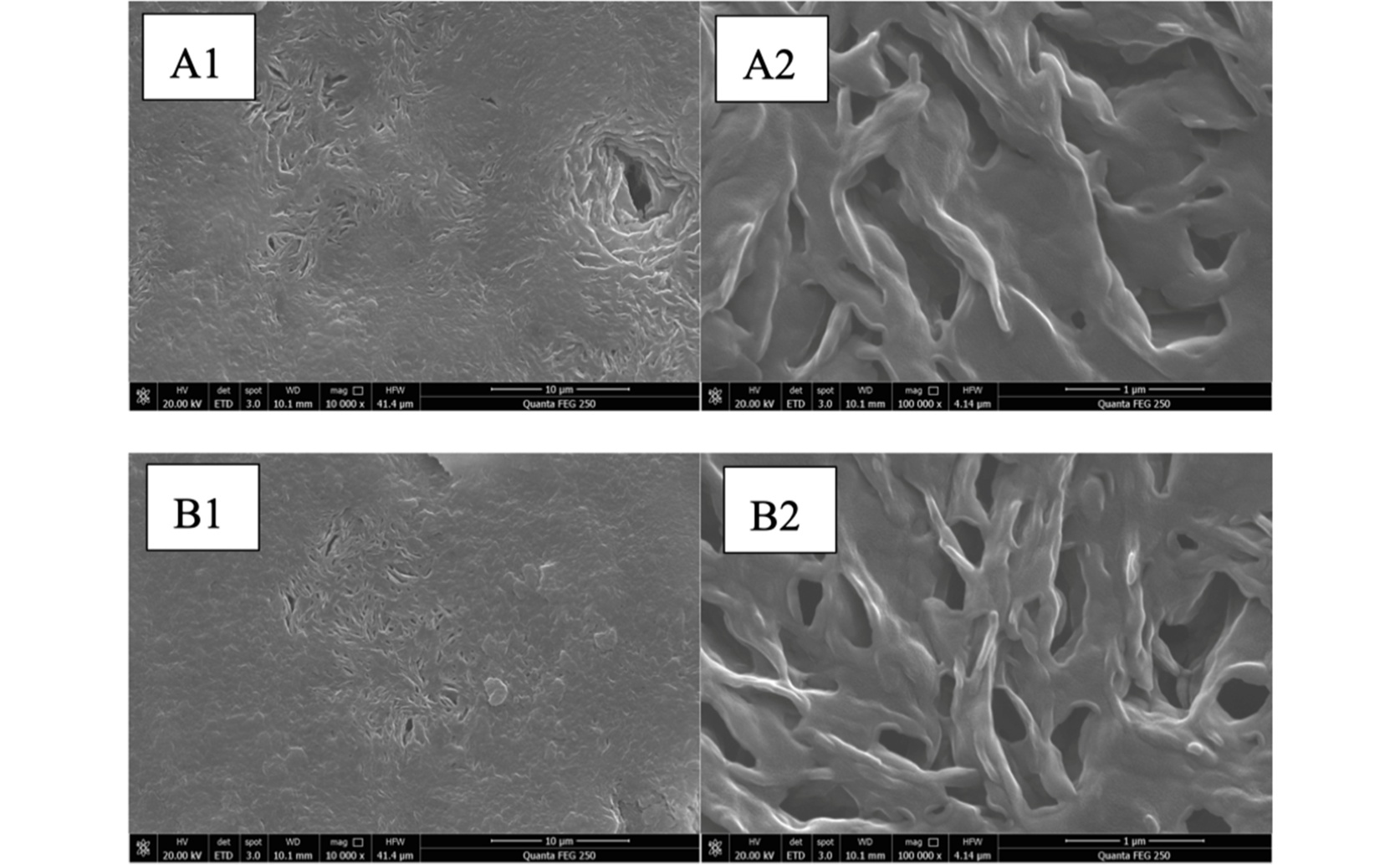
Scanning electron microscopy reveals that the reticulated porous morphology of the Dha A-loaded gel (A1, A2) is comparable to the blank temperature-sensitive gel (B1, B2), confirming that the encapsulation of the enzyme does not significantly alter the structural properties of the poloxamer carrier.

Image adapted from: Zhu et al. / CC BY (Source)

Key Findings

  • In a recent study from the Academy of Military Science, scientists created a gel containing an enzyme that breaks down mustard gas
  • Encapsulating the enzyme in a special temperature-sensitive gel made it more stable and efficient at degrading harmful agents
  • This improved enzyme gel works faster, lasts longer, and can be used in protective gear or coatings for enhanced safety
Chemical warfare agents (CWAs) like mustard gas pose significant threats due to their high toxicity and persistence in the environment. Effective detection and detoxification of these agents are crucial for safety and security. While previous research has made strides in these areas, challenges remain, particularly in enhancing the stability and efficiency of detoxification agents. A recent study from the Academy of Military Science and collaborating institutions[1] addresses these challenges by improving a key biocatalyst used in degrading mustard gas. Dha A is a biocatalyst known for its ability to break down mustard gas mimics, such as bis(2-chloroethyl) ether. However, its practical application has been limited by inherent instability, which reduces its effectiveness over time and under varying environmental conditions. To overcome this limitation, the research team developed a novel approach by encapsulating Dha A within a poloxamer-based thermosensitive hydrogel. Poloxamers are polymers widely used as protein carriers due to their ability to form gels in response to temperature changes. The encapsulated Dha A, referred to as Dha A@TSG, demonstrated significant improvements in both stability and catalytic performance. The interaction between Dha A and the poloxamer molecules occurs through hydrogen bonding, creating a stable environment for the enzyme. This encapsulation was optimized to gel at 25°C, ensuring that the Dha A remained active under typical ambient conditions. As a result, Dha A@TSG exhibited enhanced solubility and catalytic efficiency compared to free Dha A solutions, effectively degrading the mustard gas simulant more rapidly. One of the standout features of Dha A@TSG is its improved thermal and storage stability. At 32°C, the poloxamer molecules within the hydrogel form a tightly packed stereostructure, which protects Dha A from denaturation and degradation. This structural arrangement ensures that the biocatalyst remains effective over extended periods, even when exposed to higher temperatures. Such stability is crucial for practical applications, where the detoxification agent may be stored and used in various environments. The enhanced performance of Dha A@TSG not only addresses the stability issues associated with Dha A but also surpasses previous catalytic systems. For instance, a study on copper tetrazolate metal-organic frameworks (MOFs) demonstrated effective detoxification of nerve agent simulants like 2-chloroethyl ethyl sulfide (2-CEES)[2]. While MOF-based catalysts are robust, the encapsulation of Dha A in a thermosensitive gel offers a complementary approach, potentially allowing for more versatile and long-lasting detoxification solutions. Furthermore, the use of poloxamer-based hydrogels opens up possibilities for integrating Dha A into various delivery systems. The thermosensitive nature of the hydrogel means that Dha A@TSG can be easily applied in different formats, such as coatings or embedded in protective gear, enhancing the practical deployment of the biocatalyst in the field. This adaptability is a significant advancement, making the detoxification process more accessible and efficient in real-world scenarios. The research also highlights the importance of molecular interactions in enhancing enzyme performance. The hydrogen bonding between Dha A and poloxamer molecules not only stabilizes the enzyme but also maintains its active conformation, ensuring that it remains catalytically efficient. This insight into enzyme-polymer interactions can inform the design of future biocatalysts, potentially leading to broader applications beyond CWA detoxification. In addition to improving enzymatic stability, the study demonstrates the effectiveness of Dha A@TSG in degrading mustard gas mimics more efficiently than its free counterpart. The enhanced catalytic activity means that lower concentrations of Dha A@TSG are required to achieve the same level of detoxification, making the process more cost-effective and scalable. This improvement is particularly important for large-scale applications where the volume of CWAs that need to be neutralized can be substantial. Overall, the encapsulation of Dha A in a poloxamer-based thermosensitive hydrogel represents a significant advancement in the field of CWA detoxification. By addressing the stability and efficiency limitations of Dha A, the study provides a viable solution for the practical use of biocatalysts in mitigating the threats posed by chemical warfare agents. This development not only builds on previous research but also sets the stage for further innovations in the safe and effective handling of hazardous substances.

EnvironmentBiotechBiochem

References

Main Study

1) Enhancing the stability and catalytic efficiency of alkyl halide dehalogenase through poloxamer temperature-sensitive gel

Published 21st March, 2025

https://doi.org/10.1371/journal.pone.0319810


Related Studies

2) Cooperative Catalysis between Dual Copper Centers in a Metal-Organic Framework for Efficient Detoxification of Chemical Warfare Agent Simulants.

https://doi.org/10.1021/jacs.2c05176


Related Articles

An unhandled error has occurred. Reload 🗙