Uncovering New Ways Cells Fix Broken DNA Replication

Jim Crocker
2nd April, 2025

Uncovering New Ways Cells Fix Broken DNA Replication

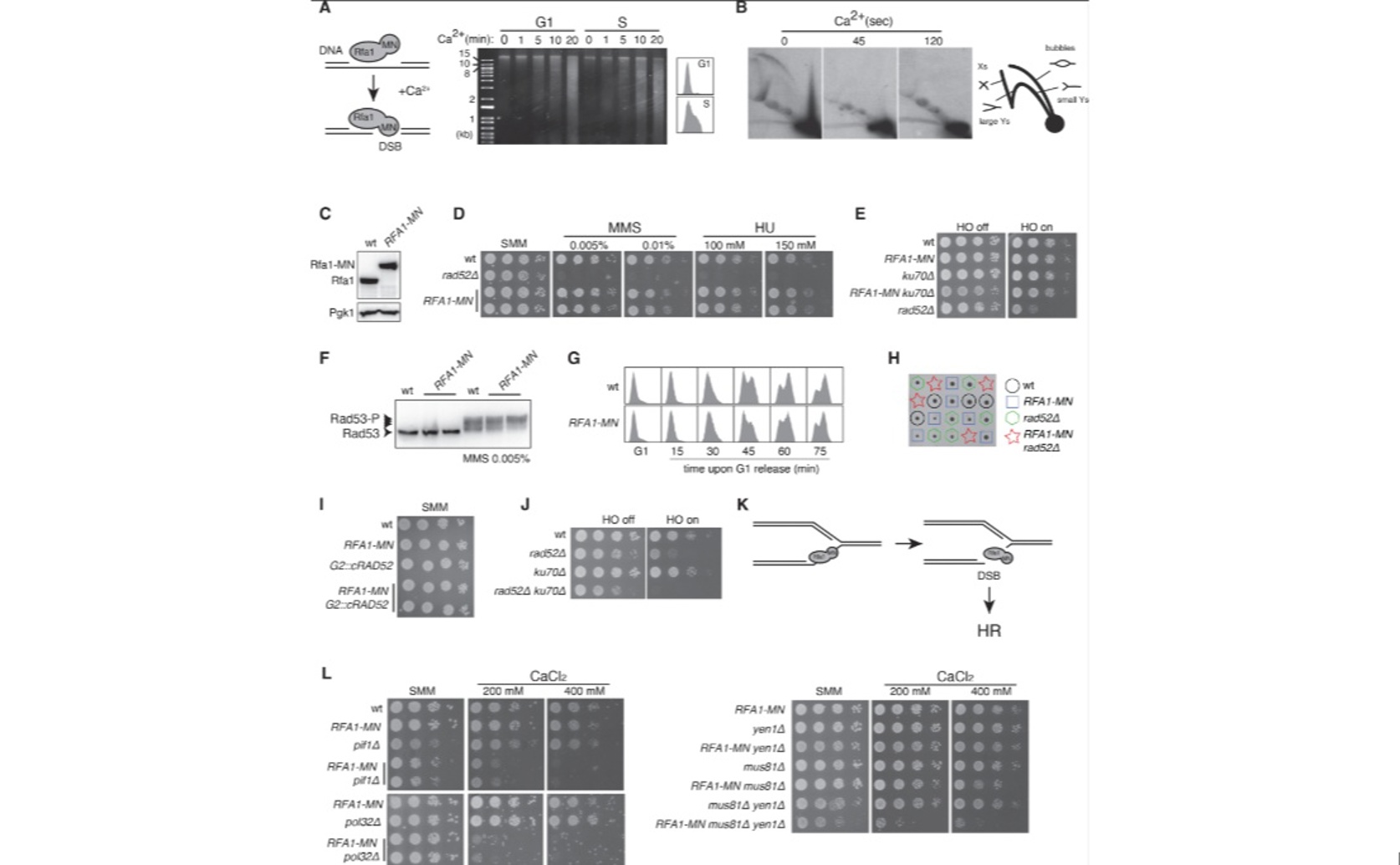
An engineered Rfa1-MN protein preferentially generates double-strand breaks at replication forks (a, b), establishing a genetic system where cell viability becomes critically dependent on the homologous recombination pathway to repair these breaks (h, l).

Image adapted from: Amiama-Roig et al. / CC BY (Source)

Key Findings

  • Researchers from Spain and the US discovered how cells repair broken DNA replication sites, which is vital for preventing cancer-related genome issues
  • They identified key proteins essential for fixing DNA breaks at replication forks, ensuring the genome remains stable
  • The study showed that controlling the cell cycle's timing helps cells efficiently repair DNA, offering new targets for cancer therapies
Genome duplication is a fundamental process that ensures each cell receives an accurate copy of an organism's genetic material. However, this process is fraught with challenges. Errors or interruptions during DNA replication can lead to genome instability, a hallmark of cancer[2]. Understanding how cells manage and repair these interruptions is crucial for unraveling the mechanisms behind tumor development and for identifying potential targets for cancer therapy. A recent study conducted by researchers at the Consejo Superior de Investigaciones Científicas, Universidad de Sevilla, Universidad Pablo de Olavide, and the National Institute of Environmental Health Sciences in the United States[1] sheds light on how cells repair broken replication forks—critical structures where DNA is unwound and copied. The integrity of replication forks is essential for the accurate and timely completion of genome duplication. When replication forks break, they can lead to double-strand breaks (DSBs), which are among the most lethal types of DNA damage. To investigate how cells handle broken replication forks, the research team developed a novel system using yeast cells. They engineered a chimera protein combining the largest subunit of the single-stranded DNA binding complex RPA with micrococcal nuclease (referred to as Rfa1-MN). This chimera induces DSBs specifically at replication forks, allowing the researchers to study the repair mechanisms involved. The study found that core homologous recombination (HR) proteins, which are essential for forming the single-stranded DNA/Rad51 filament, play a crucial role in repairing DSBs at replication forks. Unlike HR, the nonhomologous end joining (NHEJ) pathway does not contribute to this repair process. This distinction aligns with previous findings that highlight the importance of HR in maintaining genome stability, particularly under conditions of replication stress[2][3]. Further investigation revealed that the repair process involves not only HR proteins but also specific endonucleases, Mus81 and Yen1, which are responsible for cutting DNA strands to facilitate repair. Additionally, factors associated with break-induced replication (BIR) and components of the replisome— the molecular machine responsible for DNA replication—are involved in ensuring sister chromatid cohesion and fork stability during repair. This suggests that after the initial repair by BIR, the replication forks are restored to continue DNA replication accurately. An interesting aspect of the study was the identification of factors that control the length of the G1 phase of the cell cycle. The G1 phase is a period before DNA replication begins, and its regulation appears to influence the number of active replication origins. A minimal number of active origins can facilitate repair by allowing replication forks to converge, thereby enhancing the efficiency of DSB repair. This finding builds on earlier research showing that replication fork plasticity—the ability of replication forks to adapt to obstacles such as DNA damage or tightly packed chromatin structures—is vital for maintaining genome integrity[3]. The researchers also highlighted the role of checkpoint functions, including the synthesis of Dun1-mediated deoxyribonucleotide triphosphates (dNTPs), which are the building blocks of DNA. Checkpoints are surveillance mechanisms that ensure each phase of the cell cycle is completed accurately before the next phase begins. The synthesis of dNTPs is crucial for DNA repair and replication, and its regulation ensures that the necessary materials are available for accurate genome duplication. Interestingly, the study found that the loss of certain chromatin factors had minimal impact on the repair process. Chromatin, which consists of DNA wrapped around proteins called histones, can influence the accessibility of DNA to various proteins and enzymes. The minimal impact suggests that the partially disassembled nucleosome structure at the replication fork may naturally facilitate the accessibility of the repair machinery, allowing efficient DSB repair without the need for extensive chromatin remodeling. This observation complements previous studies that discussed how cells handle DNA replication through structured DNA and compact chromatin by modulating replication origin firing and replication fork architecture[3]. Understanding the mechanisms of replication fork repair has significant implications for cancer research. Since genome instability is a key feature of cancer cells[2], targeting the proteins and pathways involved in replication fork repair could offer new avenues for cancer therapy. By disrupting the repair mechanisms that cancer cells rely on to manage replication stress, it may be possible to selectively kill cancer cells while sparing normal cells. Moreover, the study's findings contribute to a broader understanding of how cells maintain genome integrity. Homologous recombination, already known for its role in repairing DNA double-strand breaks[4], is shown here to be essential specifically at replication forks. This specificity underscores the complex and highly regulated nature of DNA repair processes, where different pathways are employed depending on the type and context of the DNA damage. In summary, the research conducted by the team at Consejo Superior de Investigaciones Científicas and collaborating institutions provides valuable insights into the cellular mechanisms that repair broken replication forks. By highlighting the essential role of homologous recombination and identifying key factors involved in this process, the study advances our understanding of genome maintenance and its implications for cancer development and treatment[2][3][4][5].

BiotechGeneticsBiochem

References

Main Study

1) A Rfa1-MN–based system reveals new factors involved in the rescue of broken replication forks

Published 1st April, 2025

https://doi.org/10.1371/journal.pgen.1011405


Related Studies

2) Replication stress and cancer.

https://doi.org/10.1038/nrc3916


3) The plasticity of DNA replication forks in response to clinically relevant genotoxic stress.

https://doi.org/10.1038/s41580-020-0257-5


4) Playing the end game: DNA double-strand break repair pathway choice.

https://doi.org/10.1016/j.molcel.2012.07.029


5) Homologous Recombination: To Fork and Beyond.

https://doi.org/10.3390/genes9120603


Related Articles

An unhandled error has occurred. Reload 🗙