Engineered RNA Tool Detects When Molecules Are Close Together

Jenn Hoskins
13th February, 2025

Engineered RNA Tool Detects When Molecules Are Close Together

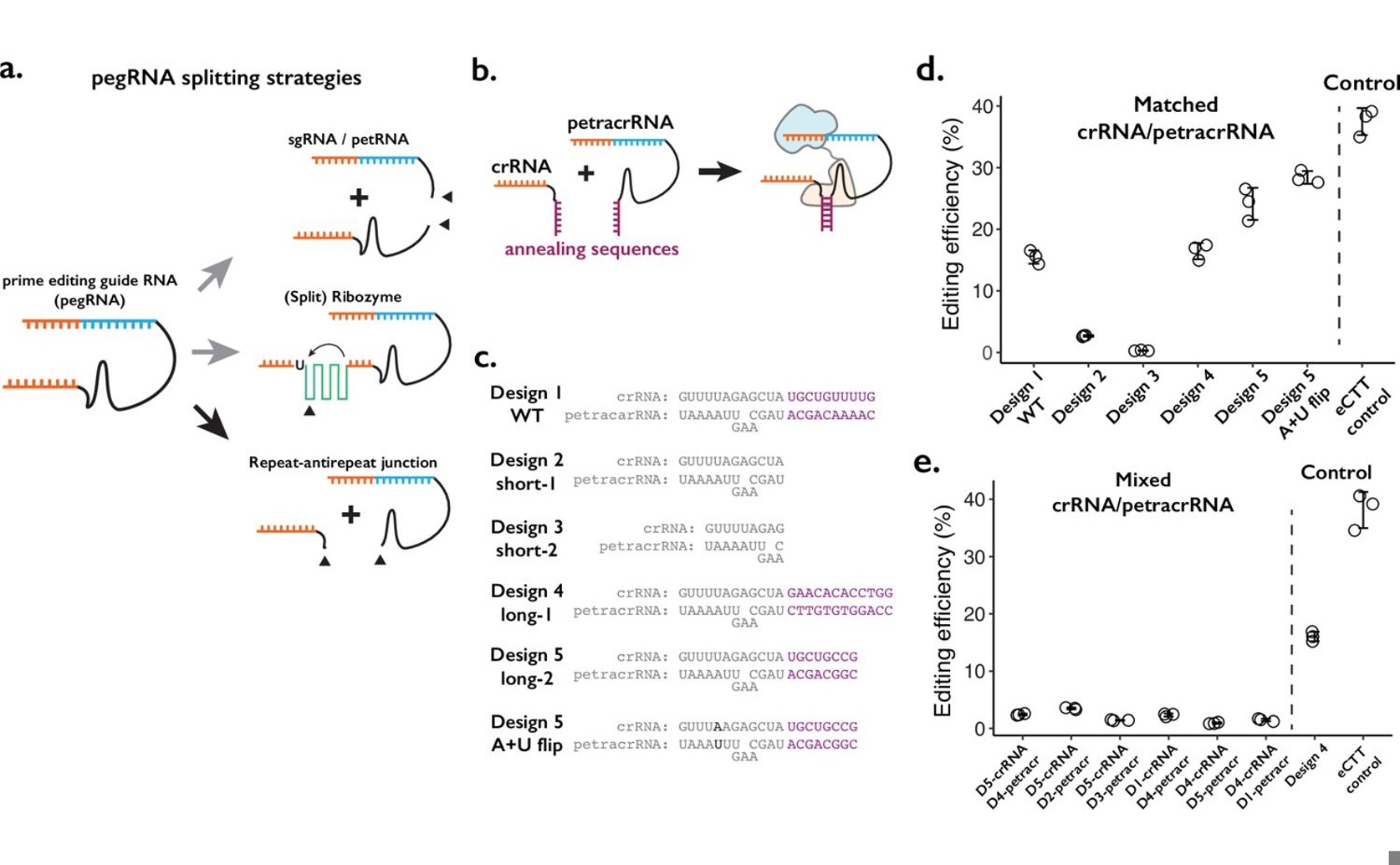
Splitting the prime editing guide RNA into two separate components, a crRNA and a petracrRNA (a–c), enables efficient and highly specific genome editing that is dependent on the re-association of matching complementary sequences (d), with mismatched pairs showing almost no activity (e).

Image adapted from: Choi et al. / CC BY (Source)

Key Findings

  • Researchers at the University of Washington developed P3 editing, a new method that enhances CRISPR-based genome editing in living cells
  • P3 editing links specific protein interactions to activate precise genetic changes, allowing cells to respond to various signals
  • This approach improves editing accuracy and reduces unintended effects, making it safer for potential medical therapies
Advancements in synthetic biology have paved the way for the creation of complex molecular circuits that can perform programmable tasks within living cells. One of the critical tools enabling these advancements is genome editing, which allows precise modifications to an organism's DNA. A recent study by researchers at the University of Washington introduced a novel method called P3 editing, which enhances the controllability of CRISPR-based genome editing within synthetic molecular circuits[1]. Genome editing technologies, such as CRISPR-Cas9, have revolutionized our ability to alter genetic material with high precision. The CRISPR system relies on guide RNA molecules that direct the Cas9 enzyme to specific DNA locations, where it makes cuts to enable targeted genetic modifications. Previous studies have demonstrated the potential of these tools; for instance, prime editing, a method described in earlier research, allows for the insertion, deletion, and substitution of genetic sequences without causing harmful double-strand breaks in DNA[2]. This precision minimizes unintended byproducts and expands the range of possible genetic corrections, making it a powerful tool for treating genetic diseases. Despite these advancements, integrating genome editing into more sophisticated cellular functions remains challenging. Synthetic biology aims to design molecular circuits that mimic electronic systems, enabling cells to process information and respond to environmental cues in predictable ways. Proteins, with their ability to interact and modify each other rapidly, offer a versatile means to build these circuits[3]. However, harnessing protein-protein interactions to control genome editing events has been difficult due to the complexity and diversity of proteins involved. The P3 editing strategy addresses this challenge by linking protein-protein proximity to the activation of CRISPR-Cas9 editing. Specifically, researchers engineered the interaction between two components of the CRISPR system: the CRISPR RNA (crRNA) and the trans-activating CRISPR RNA (tracrRNA). By splitting the guide RNA into two parts and attaching RNA adaptors that bind to specific proteins, they created a system where the interaction of these proteins brings the RNA components together, thereby activating the genome editing process. This approach was tested in human kidney cells, demonstrating that various protein-protein interactions, including those that are chemically induced, could effectively trigger prime editing or base editing. This flexibility allows for the incorporation of different signals into the editing process, making it possible to design more responsive and adaptable molecular circuits. For example, the study showed that when two proteins interacted, the reassembled guide RNA could direct the Cas9 enzyme to make precise genetic changes, such as correcting mutations or inserting new genetic information. Additionally, the P3 editing method explored the integration of ADAR-based RNA sensors, which detect specific RNA molecules and translate that information into genome edits. This capability opens the door to creating circuits that can respond to a variety of cellular conditions and external signals by making targeted genetic modifications. By recording these interactions directly into the DNA, researchers can trace the history of molecular events within a cell, providing valuable insights into cellular behavior and regulation. The development of P3 editing builds upon the foundation laid by previous genome editing techniques. For instance, prime editing[2] demonstrated the ability to make precise genetic edits with fewer byproducts, while the principles outlined in synthetic biology research[3] provided strategies for constructing complex protein-based circuits. By combining these approaches, P3 editing enhances the precision and functionality of genome editing within synthetic circuits, enabling more sophisticated control over cellular processes. One of the significant advantages of P3 editing is its potential to integrate seamlessly with existing synthetic biology frameworks. The ability to program genome editing based on specific protein interactions or RNA signals allows for the creation of dynamic and responsive cellular systems. This integration could lead to breakthroughs in various applications, including targeted therapies for genetic disorders, engineered cells that can adapt to changing environments, and advanced diagnostic tools that record cellular events for later analysis. Moreover, the P3 editing method offers improved specificity and reduced off-target effects compared to traditional CRISPR-Cas9 systems. By requiring the proximity of specific proteins to activate the editing process, P3 editing minimizes unintended genetic alterations, enhancing the safety and reliability of genome editing applications. This precision is crucial for therapeutic applications, where off-target effects could have serious consequences. The research conducted by the University of Washington team highlights the potential of P3 editing to advance the field of synthetic biology and genome editing. By linking molecular signals to precise genetic modifications, P3 editing provides a versatile tool for designing complex cellular behaviors. This innovation not only improves our ability to edit genomes accurately but also expands the capabilities of synthetic molecular circuits, allowing for more intricate and controlled interactions within living cells. Future developments of P3 editing will focus on increasing its efficiency and reliability in various cell types. Enhancing the delivery systems to ensure that P3 editing components reach their target cells effectively will be a critical next step. Additionally, expanding the range of protein-protein interactions and RNA sensors that can be integrated into the P3 editing framework will further increase its versatility and applicability in diverse synthetic biology applications. In conclusion, the introduction of P3 editing represents a significant advancement in the integration of genome editing with synthetic molecular circuits. By enabling precise and controllable genetic modifications in response to specific molecular interactions, P3 editing opens new avenues for engineering complex cellular functions and developing innovative therapeutic strategies. This method builds upon the progress made by prime editing and synthetic biology, demonstrating the ongoing evolution of genome editing technologies and their expanding role in modern biology.

BiotechGeneticsBiochem

References

Main Study

1) A molecular proximity sensor based on an engineered, dual-component guide RNA.

Published 12th February, 2025

https://doi.org/10.7554/eLife.98110


Related Studies

2) Search-and-replace genome editing without double-strand breaks or donor DNA.

https://doi.org/10.1038/s41586-019-1711-4


3) Programmable protein circuit design.

https://doi.org/10.1016/j.cell.2021.03.007


Related Articles

An unhandled error has occurred. Reload 🗙