
New Tool Speeds Up Protein Function Discovery in Photosynthetic Organisms
Jim Crocker
8th February, 2025


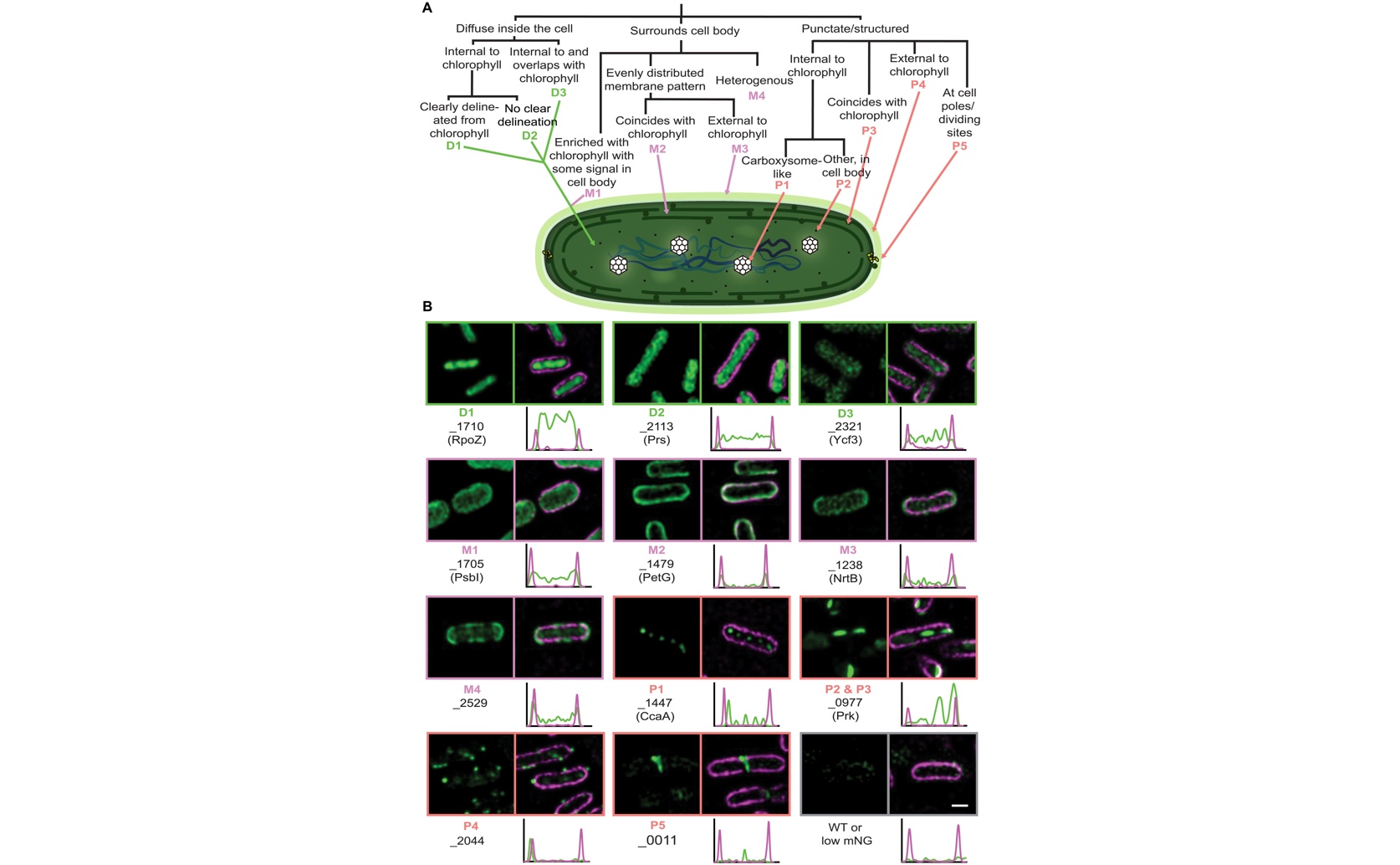
The high-throughput CyanoTag pipeline successfully mapped a wide array of distinct subcellular protein localizations in Synechococcus elongatus, as exemplified by proteins showing diffuse, membrane-associated, and punctate patterns (b).
Key Findings
- Researchers at the University of York developed a method to tag and study over 330 proteins in the cyanobacterium Synechococcus elongatus, advancing our understanding of its cellular processes
- The study identified new proteins involved in photosynthesis and revealed how cyanobacteria rapidly adapt to light changes, enhancing knowledge of their environmental responses
- These findings could accelerate bioengineering efforts, such as improving crop photosynthesis, and provide tools for studying protein functions in living cells
References
Main Study
1) CyanoTag: Discovery of protein function facilitated by high-throughput endogenous tagging in a photosynthetic prokaryote.
Published 7th February, 2025
https://doi.org/10.1126/sciadv.adp6599
Related Studies
2) Present and future global distributions of the marine Cyanobacteria Prochlorococcus and Synechococcus.
3) Engineering α-carboxysomes into plant chloroplasts to support autotrophic photosynthesis.
4) A carboxysome-based CO2 concentrating mechanism for C3 crop chloroplasts: advances and the road ahead.
5) The emergence of proteome-wide technologies: systematic analysis of proteins comes of age.
Related Articles
 13th July, 2024 | Greg Howard