Untangling Genetic Code: A New Way to Fix Data Errors

Greg Howard
23rd March, 2025

Untangling Genetic Code: A New Way to Fix Data Errors

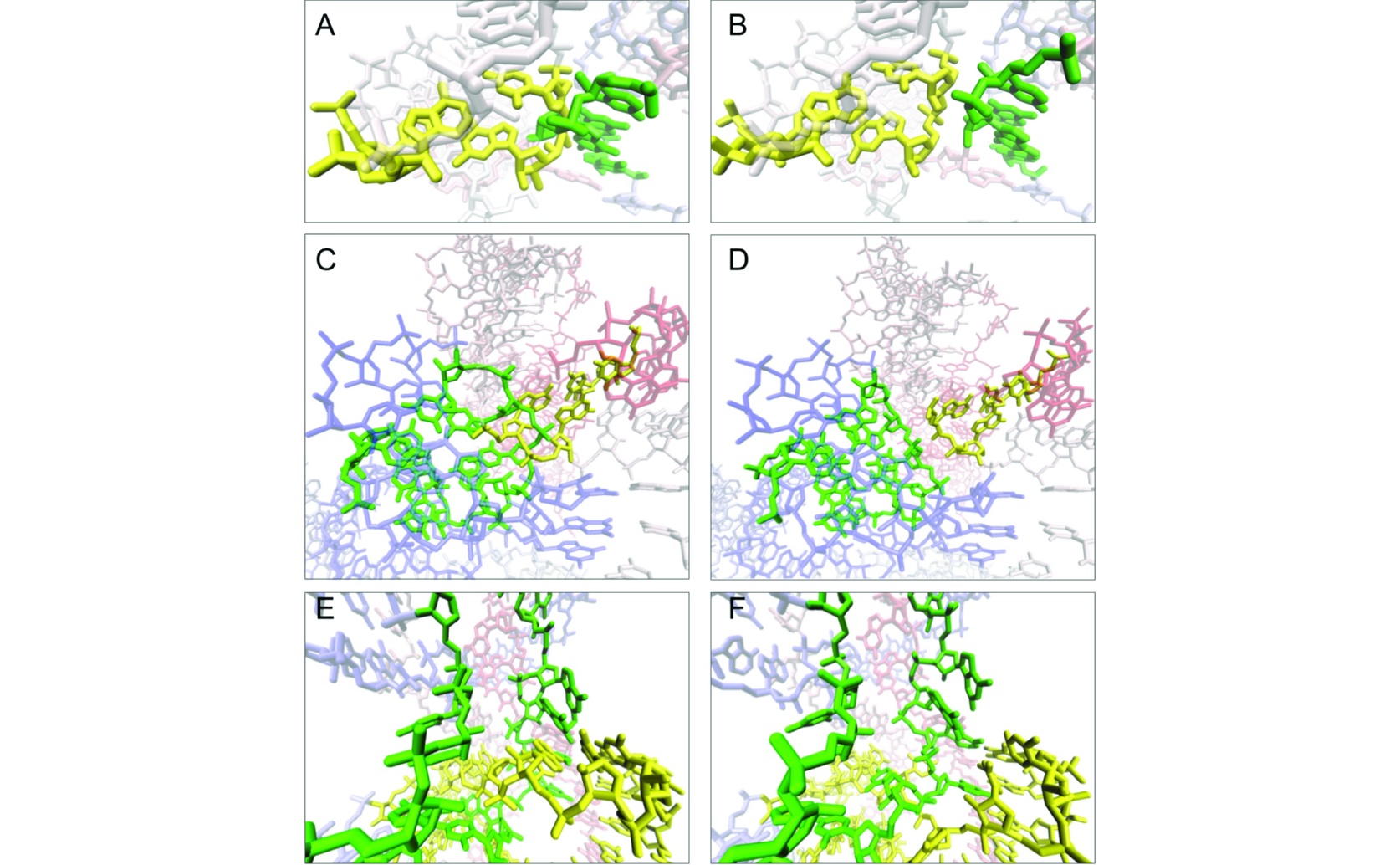
The SPQR-based disentanglement protocol successfully resolves different types of interlace entanglements in predicted RNA 3D structures, as demonstrated for dinucleotide step–dinucleotide step (a, b), dinucleotide step–loop (c, d), and loop–loop (e, f) interlaces.

Image adapted from: Poblete et al. / CC BY (Source)

Key Findings

  • In Santiago, Chile, researchers developed a new method to remove unrealistic knots from computer-predicted RNA structures
  • Their technique successfully untangled over 70% of problematic models while keeping the RNA’s overall shape intact
  • Improved RNA models can enhance drug design and disease research by providing more accurate molecular insights
RNA, or ribonucleic acid, plays a crucial role in various biological functions, from protein synthesis to the regulation of gene expression. Understanding its three-dimensional (3D) structure is essential because the shape of RNA molecules determines how they interact with other molecules in the cell. However, experimentally determining RNA structures is challenging and time-consuming. To address this, scientists have been developing computational methods to predict RNA 3D structures. A recent study conducted by researchers at Universidad San Sebastián in Santiago, Chile[1] has made significant advancements in this field. The study tackles a common problem in RNA 3D structure prediction: entanglements. Entanglements are computational artifacts that create knots or loops in the predicted RNA models, making them unrealistic and difficult to analyze further. These issues often lead researchers to discard potentially accurate models, despite parts of the structure being correctly predicted. The researchers introduced a new protocol designed to resolve these entanglements without compromising the overall accuracy of the RNA model. Their approach uses the SPQR coarse-grained model, a simplified representation of the RNA that captures essential structural features while reducing computational complexity. By applying short Molecular Dynamics (MD) simulations, the protocol imposes specific energy terms that guide the RNA structure into a less tangled form. This selective modification helps disentangle the RNA without causing significant distortions to its original geometry. To test the effectiveness of their method, the team applied it to 195 entangled RNA models sourced from the CASP15 and RNA-Puzzles projects[2]. RNA-Puzzles is a community-wide initiative that challenges scientists to predict RNA structures, fostering collaboration and innovation in the field. The results were promising: the protocol successfully resolved over 70% of interlaces (crossings where the RNA strands loop around each other) and about 40% of lassos (tight loops within the structure). Importantly, these improvements came with minimal impact on the overall geometry of the RNA models, as indicated by a notable improvement in ClashScore, a metric that assesses the quality of a 3D structure by identifying and quantifying steric clashes between atoms. The efficiency of the protocol in untangling structures classified as artifacts reached 81%. This high success rate demonstrates the potential of the method to refine RNA models that were previously considered unsuitable for further study. However, the researchers also noted certain limitations. Models with densely packed atoms or complex secondary structures still posed challenges, reducing the method's effectiveness in those cases. Despite these challenges, the study provides a viable approach for improving RNA structure predictions, making more models available for biological and medical research. This work builds on earlier studies, such as the computational pipeline introduced by Universidad San Sebastián for reference-free high-throughput comparative analysis of RNA 3D structures[2]. The previous pipeline was instrumental in analyzing models from the RNA-Puzzles challenge, identifying common structural motifs that could be important for understanding RNA function. The current study expands on this foundation by addressing one of the critical issues—entanglements—that hinder the utility of these computational models. By refining the RNA structures, the new protocol enhances the quality and reliability of the predictions, thereby supporting more accurate biological interpretations and applications. The implications of this research are significant for both basic science and medical applications. Accurate RNA structure prediction is vital for drug design, as many medications target RNA molecules. Improved models can lead to better-targeted therapies with fewer side effects. Additionally, understanding RNA structures can aid in the study of various diseases, including viral infections like COVID-19, where RNA plays a key role in the virus's life cycle. By making more accurate RNA models available, researchers can gain deeper insights into these processes and develop more effective treatments. Furthermore, the open-access nature of the tools and models used in this protocol promotes collaboration and transparency in the scientific community. Other researchers can utilize and build upon this work, accelerating progress in RNA structural biology. The study also highlights the importance of interdisciplinary approaches, combining computational techniques with molecular biology to solve complex biological problems. In summary, the study from Universidad San Sebastián presents a significant advancement in RNA 3D structure prediction. By effectively resolving computational entanglements, the protocol enhances the quality of RNA models, making them more useful for scientific and medical research. This work not only addresses a major challenge in the field but also builds on previous efforts to improve RNA structure analysis, paving the way for future innovations and discoveries.

BiotechGeneticsBiochem

References

Main Study

1) Unknotting RNA: A method to resolve computational artifacts

Published 20th March, 2025

https://doi.org/10.1371/journal.pcbi.1012843


Related Studies

2) Computational Pipeline for Reference-Free Comparative Analysis of RNA 3D Structures Applied to SARS-CoV-2 UTR Models.

https://doi.org/10.3390/ijms23179630


Related Articles

An unhandled error has occurred. Reload 🗙