Combining Trees with Small Corn Farms Boosts Soil Health

Jenn Hoskins
9th April, 2025

Combining Trees with Small Corn Farms Boosts Soil Health

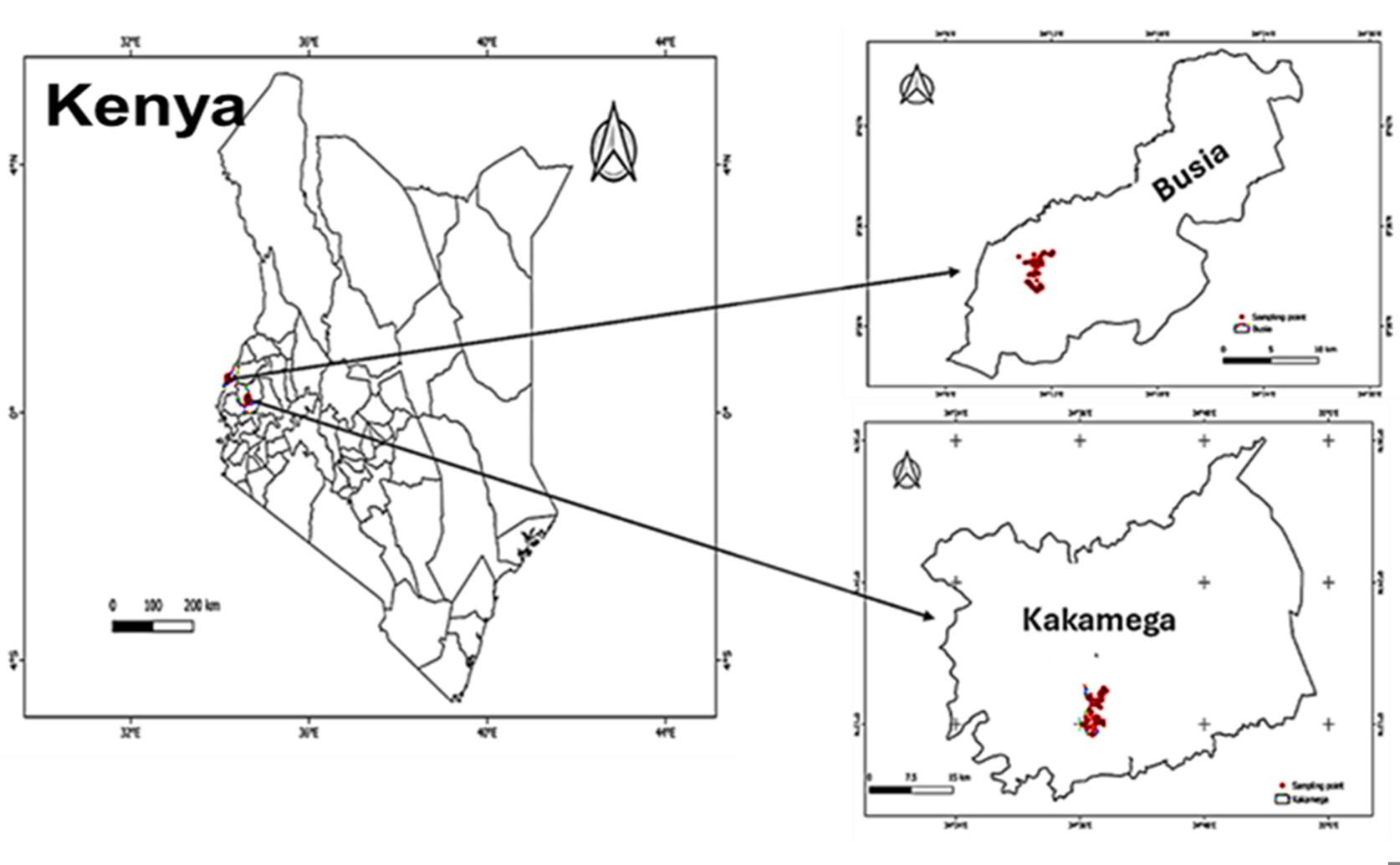
The map of Kenya showing the study locations and sampling points (red dots).

Image adapted from: Nyuma et al. / CC BY (Source)

Key Findings

  • In western Kenya, adding trees to maize farms boosted soil nutrients and made the soil less compact
  • Trees like Sesbania and Leucaena were especially good at improving important soil qualities for maize growth
  • This shows that agroforestry can help small farmers maintain healthy soil and increase their crop yields
Soil quality is fundamental to agricultural productivity and sustainability, especially in regions reliant on smallholder farming. In western Kenya, where maize farming is a critical livelihood, maintaining fertile soil is a constant challenge. To address this, agroforestry—a practice that integrates trees with crops—was introduced in the early 1990s as a strategy to replenish soil fertility. However, the long-term effects of this practice on soil quality had not been thoroughly evaluated until a recent study conducted by researchers at the University of Eldoret[1]. The study compared soil characteristics between areas adopting agroforestry and those that did not. Soil samples were taken from two counties, Busia and Kakamega, at a depth of 0–30 cm. A total of 90 samples were collected from agroforestry-adopted lands and 30 from non-adopted lands. The analysis revealed significant improvements in soil properties where agroforestry was practiced. Specifically, soil organic carbon (SOC) increased by 75%, phosphorus (P) by 80%, exchangeable potassium (K) by 256%, calcium (Ca) by 100%, sulfur (S) by 50%, and copper (Cu) by 18%. Additionally, bulk density (BD), which influences root growth and water infiltration, decreased by 21% in agroforestry plots. These enhancements in soil quality can be attributed to the types of trees used in agroforestry systems. The study highlighted that Sesbania sesban and Leucaena leucocephala were particularly effective in improving soil BD, pH, and essential nutrients like P, K, magnesium (Mg), and manganese (Mn). Calliandra calothyrsus also played a significant role but was effective only in increasing SOC in Kakamega. These findings suggest that specific tree species can be strategically selected to enhance various soil properties, thereby supporting better crop yields. This research builds on earlier studies that have examined the factors affecting soil quality and fertility management. For instance, a study from the University of Liberia[2] found that land use changes, particularly the shift from natural vegetation to agricultural land, led to significant declines in soil nutrients such as total organic carbon, magnesium, and boron over five decades. The current study corroborates these findings by showing that agroforestry can counteract such declines, offering a sustainable alternative to traditional farming practices that degrade soil health. Another relevant study from Makerere University[3] explored soil fertility management among smallholder farmers in Mount Kenya East. It emphasized the importance of integrated soil fertility management (ISFM) practices, including the use of fertilizers, manure, agroforestry, and minimal tillage. The effectiveness of agroforestry in the main study aligns with the recommendations from this research, highlighting the interconnectedness of various soil management practices in improving soil health. Furthermore, research on the application of organic manure and crop residues in highly weathered tropical soils[4] provides additional context. It explains how organic matter can influence phosphorus availability—both enhancing and reducing it—depending on soil conditions. The main study’s findings that agroforestry improves phosphorus levels suggest that the trees used may help optimize phosphorus availability, making it more accessible for maize growth without increasing environmental loss. The methods used in the main study were robust, involving both soil sampling and statistical analysis to ensure the reliability of the results. By comparing agroforestry and non-agroforestry plots across different locations, the researchers could isolate the effects of agroforestry from other variables such as soil type and climate. This comprehensive approach strengthens the study’s conclusions about the benefits of agroforestry for soil quality. The implications of this study are significant for agricultural policy and practice in Kenya and similar regions. The clear benefits of agroforestry in enhancing soil fertility support the need for policies that promote its adoption among smallholder farmers. Such policies could include incentives for planting specific tree species, training programs on agroforestry techniques, and support for integrating agroforestry with other ISFM practices. Additionally, the study underscores the importance of selecting appropriate tree species to maximize soil health benefits, as demonstrated by the effectiveness of Sesbania sesban in improving multiple soil properties. In conclusion, the research conducted by the University of Eldoret provides strong evidence that agroforestry is a viable and effective strategy for improving soil quality in smallholder maize systems in western Kenya. By enhancing essential soil nutrients and reducing bulk density, agroforestry contributes to more sustainable and productive agricultural practices. Integrating these findings with previous research highlights a comprehensive approach to soil fertility management, emphasizing the role of agroforestry alongside other practices. As soil degradation remains a critical issue for agricultural communities, adopting agroforestry could be a key step toward ensuring long-term soil health and food security.

AgricultureEnvironmentSustainability

References

Main Study

1) Agroforestry adoption and its influence on soil quality under smallholder maize production systems in western Kenya

Published 8th April, 2025

https://doi.org/10.1371/journal.pone.0313385


Related Studies

2) The effect of land use change on soil fertility parameters in densely populated areas of Kenya.

https://doi.org/10.1016/j.geoderma.2019.02.033


3) Soil fertility management among smallholder farmers in Mount Kenya East region.

https://doi.org/10.1016/j.heliyon.2021.e06488


4) On the tropical soils; The influence of organic matter (OM) on phosphate bioavailability.

https://doi.org/10.1016/j.sjbs.2022.02.056


Related Articles

An unhandled error has occurred. Reload 🗙