Research finds Fanya Juu terraces improve soil health

Greg Howard
22nd February, 2026

Research finds Fanya Juu terraces improve soil health

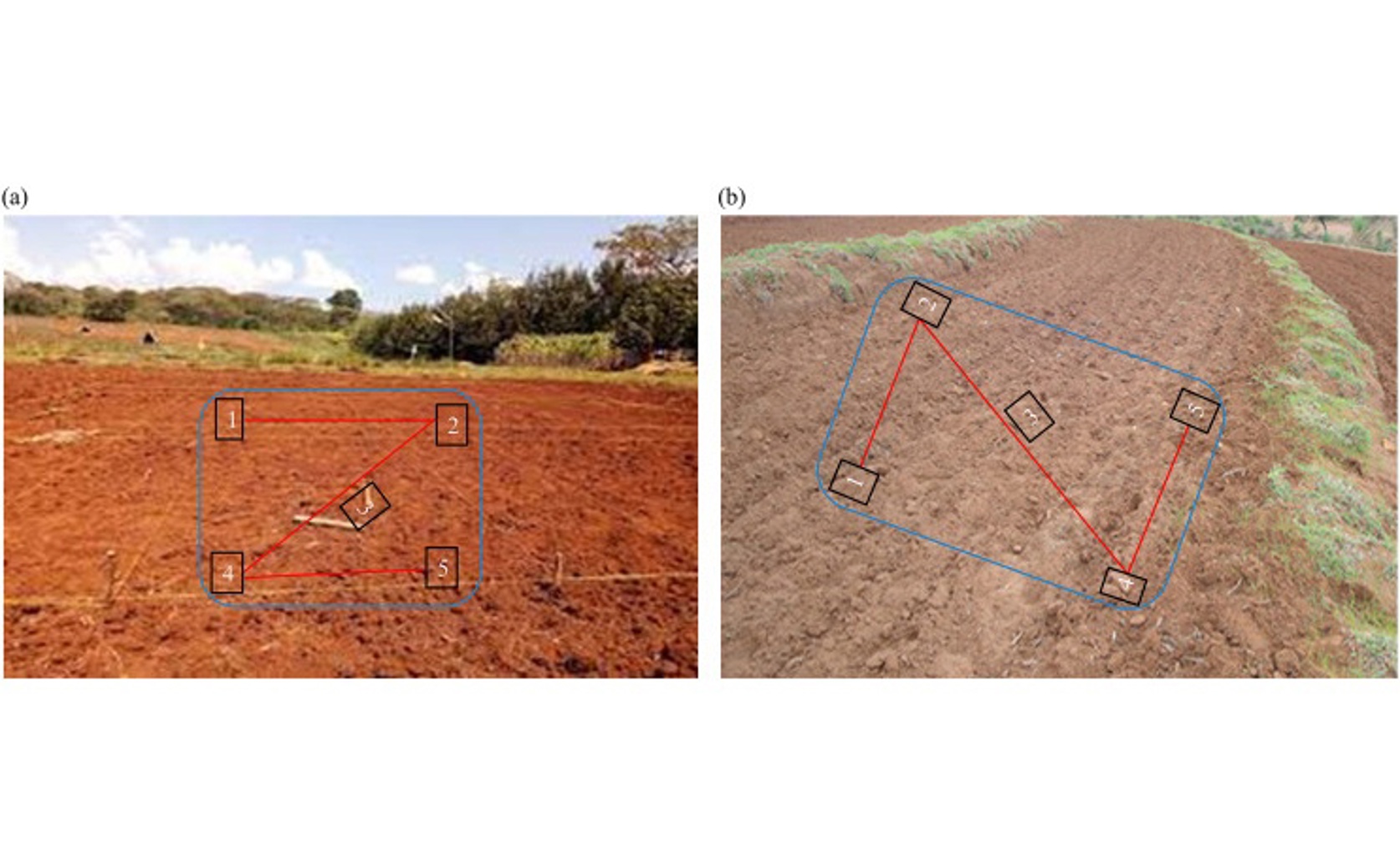
To evaluate the soil health benefits of Fanya Juu terraces, this study compared composite soil samples collected from non-conserved control plots (a) with samples taken from between the terrace structures (b).

Image adapted from: Falta et al. / CC BY (Source)

Key Findings

  • In Ethiopia’s Magera sub-watershed, Fanya Juu terraces improve soil health on farmland prone to erosion
  • After 10 years, these terraces significantly increased organic carbon, nitrogen, phosphorus, and water retention
  • The effectiveness of Fanya Juu depends on slope position, with lower slopes showing greater improvements in soil structure and nutrient levels
Soil erosion poses a significant threat to farmland, reducing its fertility and long-term productivity. While various soil and water conservation (SWC) measures exist, understanding their effectiveness under different conditions is crucial for sustainable agriculture. A recent study by researchers at Wolaita Sodo University and Northwest A&F University[1] investigated the impact of Fanya Juu terraces – a common erosion control technique – focusing on how the age of the terrace and its position on a slope affect soil recovery. Previous research has demonstrated the positive impact of physical SWC measures like Fanya Juu on soil properties[2]. This earlier work showed improvements in clay, silt, sand content, pH levels, and key nutrients like organic carbon and nitrogen in conserved lands compared to non-conserved areas. However, these studies often lacked detailed analysis of how these benefits varied across different parts of a field and over time. The new study aimed to fill this gap by examining soil characteristics in relation to both slope position and the age of the Fanya Juu structures. The research team collected soil samples from 27 plots within a watershed, comparing areas with Fanya Juu terraces aged 5 and 10 years to areas without any conservation measures. They analyzed the soil at a depth of 0-20cm, focusing on several key indicators of soil health. These included organic carbon content, total nitrogen, available phosphorus, cation exchange capacity (CEC – a measure of the soil's ability to hold nutrients), soil moisture, silt content, and aggregate stability (how well soil particles clump together, important for water infiltration and resistance to erosion). The analysis revealed significant improvements in soil health with both increasing conservation age and favorable slope position. After ten years, the Fanya Juu terraces led to a substantial increase in organic carbon (28% increase), total nitrogen (66% increase), available phosphorus (43% increase), and CEC (39% increase). They also observed increased soil moisture (14% increase) and improved soil structure, indicated by higher silt content (44% increase) and aggregate stability (51% increase). Importantly, the terraces also reduced bulk density (19% decrease), meaning the soil was less compacted and more able to support plant growth. These findings build upon earlier work highlighting the detrimental effects of lacking physical SWC measures on soil properties[2][3]. The study goes further by demonstrating that the effectiveness of Fanya Juu isn’t uniform; it depends on where on the slope the terrace is located and how long it has been in place. This is consistent with observations in other regions where surface conditions and conservation practices are dominant factors in controlling erosion[4]. The researchers used statistical methods, including two-way ANOVA and Tukey’s Least Significant Difference (LSD) test, to ensure the observed differences were statistically significant. These tests confirmed that the improvements were not due to random variation. The results provide quantitative data supporting the optimization of terrace design and long-term soil and water conservation planning in areas prone to erosion. The study suggests that focusing on strategic placement and maintaining terraces for longer periods will maximize their benefits.

AgricultureEnvironmentSustainability

References

Main Study

1) Restoring degraded soils: The transformative impact of Fanya Juu terraces on soil characteristics in the erosion-prone Magera watershed, Southern Ethiopia

Published 19th February, 2026

https://doi.org/10.1371/journal.pone.0342826


Related Studies

2) Fanya Juu terraces improve soil properties of cultivated land in erosion-prone semi-arid area of Ethiopia.

https://doi.org/10.1038/s41598-024-77229-5


3) Assessing soil erosion and farmers' decision of reducing erosion for sustainable soil and water conservation in Burji woreda, southern Ethiopia.

https://doi.org/10.1038/s41598-024-59076-6


4) Effects of vegetation and climate on the changes of soil erosion in the Loess Plateau of China.

https://doi.org/10.1016/j.scitotenv.2021.145514


Related Articles

An unhandled error has occurred. Reload 🗙