Creating a Health Index for Stranded Marine Animals

Jim Crocker
1st April, 2025

Creating a Health Index for Stranded Marine Animals

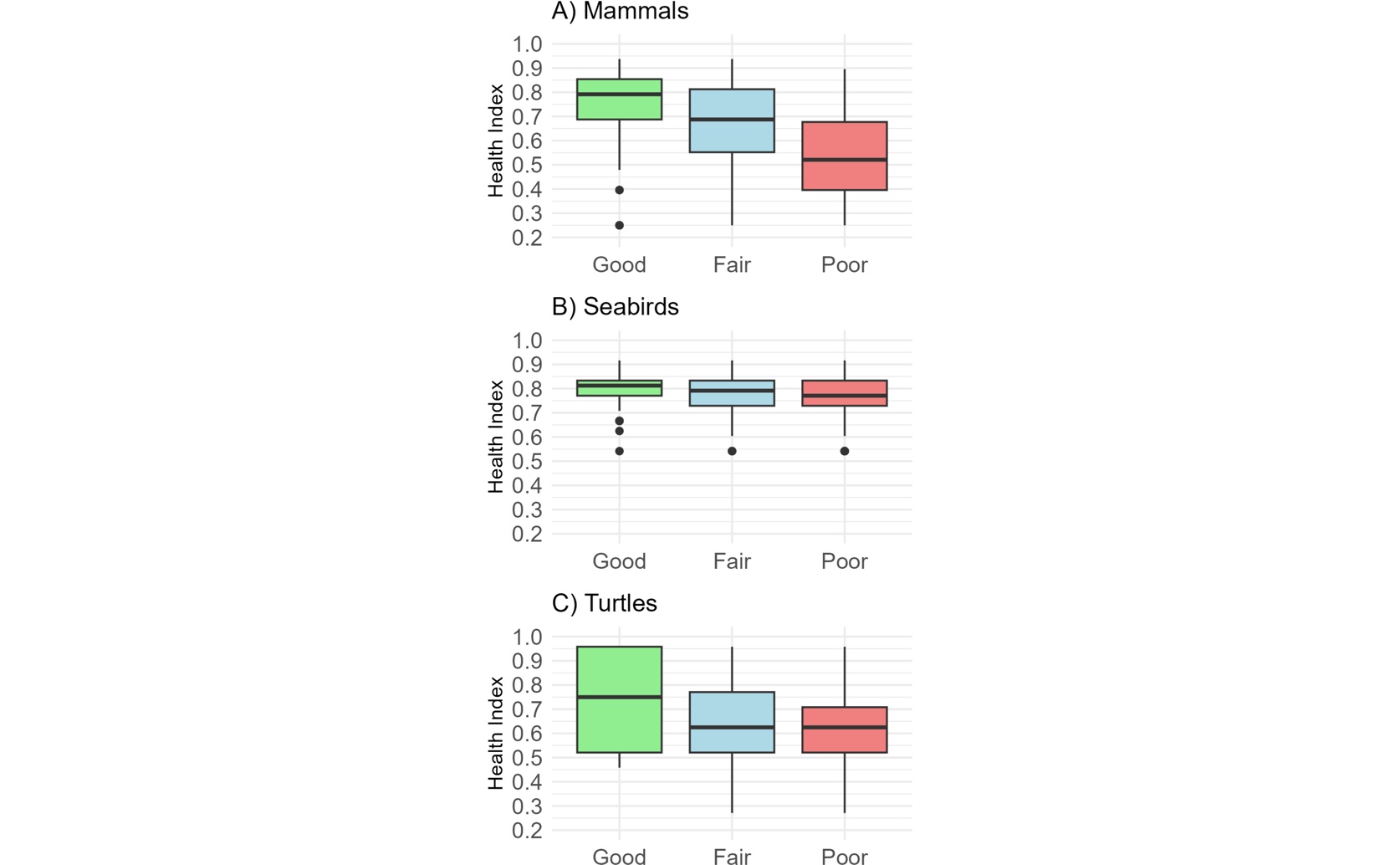
The calculated Health Index (HI) was validated as an effective measure of animal health, as scores for marine mammals (A), seabirds (B), and sea turtles (C) significantly decreased in alignment with veterinarians' subjective health ratings of 'good,' 'fair,' and 'poor'.

Image adapted from: Barreto et al. / CC BY (Source)

Key Findings

  • *Brazilian researchers created a Health Index to evaluate over 6,300 stranded seabirds, sea turtles, and marine mammals.*
  • The Health Index effectively categorized animals into good, fair, or poor health, matching veterinarians' assessments
  • Sea turtles consistently showed poorer health than seabirds and marine mammals, highlighting their greater vulnerability
Assessing the health of marine tetrapods is crucial for understanding the overall state of marine ecosystems and the impacts of environmental changes. A recent study conducted by researchers at the Marine and Environmental Sciences Centre (MARE) developed and validated a Health Index (HI) designed to evaluate the health of stranded marine tetrapods, including seabirds, sea turtles, and marine mammals[1]. The HI was created using various parameters collected during necropsies (animal autopsies) and histopathological analyses (microscopic examination of tissues). These parameters included body condition, systemic conditions observed both macroscopically and microscopically, cutaneous injuries, organized lesions, parasitic infections, lymphoid depletion, and thyroid alterations. By integrating these factors, the HI provides a comprehensive assessment of an individual animal's health status. The study applied the HI to a substantial dataset of 6,332 marine tetrapods stranded along the Brazilian coast. The results demonstrated that the HI effectively categorized the animals into good, fair, and poor health states, aligning well with independent veterinary evaluations. Notably, sea turtles consistently showed the lowest average HI scores, indicating poorer health conditions compared to seabirds and marine mammals. This finding highlights the particular vulnerability of sea turtles, which may be influenced by factors such as habitat degradation and disease prevalence[2]. Integrating the HI into marine health monitoring aligns with the need for enhanced basic research and systematic surveillance programs as emphasized in earlier studies[3]. By providing a quantitative measure of health, the HI allows researchers to track spatial and temporal variations in the health of marine tetrapod populations. This capability is essential for identifying subtle impacts that might not be immediately apparent, such as the effects of pollutants or emerging diseases. Moreover, the HI supports the goals of the Marine Strategy Framework Directive (MSFD) by offering a tool to assess the environmental status of marine ecosystems using large marine vertebrates as indicators[4]. The ability to quantitatively measure health helps bridge gaps in existing monitoring programs, particularly concerning contaminants and pollution effects. The use of biomarkers within the HI framework further enhances its effectiveness in detecting "undesirable biological effects," aligning with the MSFD's qualitative descriptors. The study by MARE also builds on the concept of using sentinel species to gauge ecosystem health, as discussed in previous research[5]. By systematically assessing the health of marine tetrapods, the HI serves as a sentinel indicator for broader environmental issues that affect both marine life and human populations. For example, marine mammals, which are part of the HI assessment, can reflect the presence of chemical pollutants and emerging pathogens that may also pose risks to human health. Overall, the development of the Health Index represents a significant advancement in marine biology and conservation. It provides a standardized method for evaluating the health of key marine species, facilitating more informed decision-making and targeted conservation efforts. By leveraging data from a large number of stranded animals, the HI offers a robust tool for monitoring the health of marine ecosystems and responding to emerging environmental threats.

WildlifeHealthMarine Biology

References

Main Study

1) Development of a health index for stranded marine tetrapods

Published 31st March, 2025

https://doi.org/10.1371/journal.pone.0319250


Related Studies

2) A review of fibropapillomatosis in Green turtles (Chelonia mydas).

https://doi.org/10.1016/j.tvjl.2015.10.041


3) Global climate change and implications for disease emergence.

https://doi.org/10.1177/0300985809354465


4) The role of large marine vertebrates in the assessment of the quality of pelagic marine ecosystems.

https://doi.org/10.1016/j.marenvres.2012.03.003


5) Marine mammals as sentinel species for oceans and human health.

https://doi.org/10.1177/0300985810388525


Related Articles

An unhandled error has occurred. Reload 🗙