Eye Pressure Affects Lens Movements: A Computer Simulation Study

Greg Howard
26th March, 2025

Eye Pressure Affects Lens Movements: A Computer Simulation Study

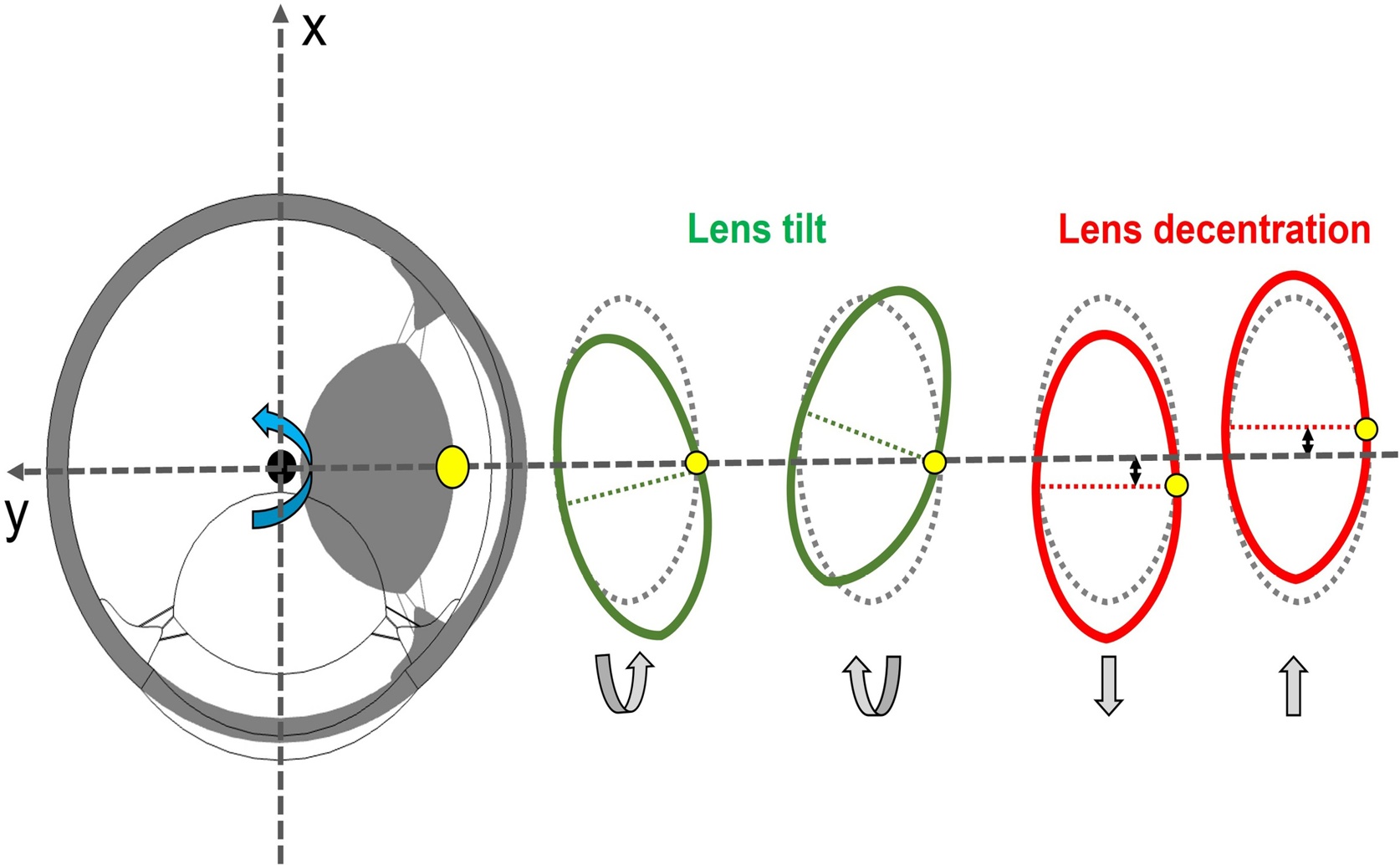
The model illustrates how the crystalline lens wobbles through decentration (shifting) and tilting in response to the eye's rotation, a motion this study shows is directly influenced by intraocular pressure.

Image adapted from: Dahaghin et al. / CC BY (Source)

Key Findings

  • Researchers at Bascom Palmer Eye Institute found that higher eye pressure limits the movement of the eye’s lens
  • Increased pressure makes the lens wobble less and stabilize faster, which is important for glaucoma management
  • This discovery could lead to new, comfortable methods for measuring eye pressure and better treatments for eye diseases
Intraocular pressure (IOP) refers to the fluid pressure inside the eye, essential for maintaining its shape and proper function. Elevated IOP is a significant risk factor for glaucoma, a leading cause of blindness. Understanding how IOP affects the eye's internal structures is crucial for developing better diagnostic and treatment methods for glaucoma and other ocular diseases. A recent study conducted by researchers at the Bascom Palmer Eye Institute[1] addresses a key aspect of this understanding by investigating how changes in IOP influence the movement of the crystalline lens, a transparent structure that helps focus light on the retina. This study fills a gap in knowledge about the biomechanical behavior of the lens under varying pressure conditions. The research utilized computational models based on porcine eyes, which are anatomically and physiologically similar to human eyes. These models incorporate fluid-structure interaction (FSI), a method that simulates the mechanical interaction between the eye's fluids and its solid structures. By maintaining constant mechanical properties and boundary conditions, the study was able to precisely measure the lens's wobbling behavior at different IOP levels. Researchers simulated different IOP scenarios to observe how the lens responds. They found that as IOP increased, the lens exhibited significant variations in both the magnitude and duration of its displacement during rotational motion. Specifically, higher IOP levels led to greater lens overshooting, a phenomenon where the lens moves beyond its equilibrium position before stabilizing. These displacement patterns are particularly relevant in conditions like glaucoma, where elevated IOP is common. This study builds on earlier research that explored various aspects of ocular biomechanics. For instance, a study by Wroclaw University of Science and Technology[2] demonstrated that increases in IOP cause measurable changes in the eye's axial length and anterior chamber depth. These changes correlate with the eye's rigidity and highlight the importance of precise IOP measurements. Another study from the University of Zaragoza[3] examined the stiffness of the crystalline lens itself, finding that lens stiffness increases with higher IOP, although not as significantly as other ocular tissues like the cornea and sclera. Additionally, research from the Bascom Palmer Eye Institute[4] emphasized the critical role of IOP fluctuations in glaucoma progression, suggesting that stable IOP levels are essential for effective disease management. By integrating these findings, the current study provides a more comprehensive view of how IOP affects the eye's internal mechanics. The use of validated computational models allows for detailed simulations that can predict lens behavior under various pressure conditions. This approach offers a controlled environment to study the complex interactions within the eye, which are difficult to observe directly in living subjects. One of the significant implications of this study is the potential application of the Purkinje imaging system for non-invasive IOP measurement. The Purkinje system detects reflections from different parts of the eye, and by analyzing lens overshoot during rotational motion, it may be possible to estimate IOP without the need for direct pressure measurements. This method could reduce patient discomfort and increase the accuracy of IOP assessments, which are crucial for glaucoma management. Moreover, understanding lens biomechanics in relation to IOP can inform the development of new treatments and diagnostic tools. For example, therapies that stabilize IOP fluctuations could be designed to minimize harmful lens movements, potentially slowing the progression of glaucoma. Additionally, personalized models based on individual eye biomechanics could lead to more tailored and effective treatment plans. The study’s findings also highlight the importance of considering the viscoelastic properties of the lens, as observed in previous research[3]. The lens’s ability to deform and return to its original shape under pressure changes plays a crucial role in its overall biomechanical response. By factoring in these properties, the computational models provide a more accurate representation of the lens's behavior under different IOP conditions. In conclusion, the research from the Bascom Palmer Eye Institute advances our understanding of the relationship between intraocular pressure and the biomechanical behavior of the crystalline lens. By utilizing sophisticated computational models, the study elucidates how varying IOP levels impact lens movement, offering potential pathways for improved non-invasive IOP measurement and better management of glaucoma. This work not only builds on previous studies but also opens new avenues for exploring the complex mechanics of the eye, ultimately contributing to better outcomes for individuals with ocular diseases.

MedicineHealthAnimal Science

References

Main Study

1) Effect of intraocular pressure on crystalline lens oscillations: a computational study using porcine eye model

Published 25th March, 2025

https://doi.org/10.1371/journal.pone.0320205


Related Studies

2) Effects of change in intraocular pressure on axial eye length and lens position.

Journal: Eye (London, England), Issue: Vol 22, Issue 5, May 2008


3) Assessing the biomechanical properties of the porcine crystalline lens as a function of intraocular pressure with optical coherence elastography.

https://doi.org/10.1364/BOE.9.006455


4) Understanding the importance of IOP variables in glaucoma: a systematic review.

https://doi.org/10.1016/j.survophthal.2009.05.001


Related Articles

An unhandled error has occurred. Reload 🗙